

WORKED PROBLEMS
645
OH
Cl
HCl
OH
Cl
HCl
(A)
(B)
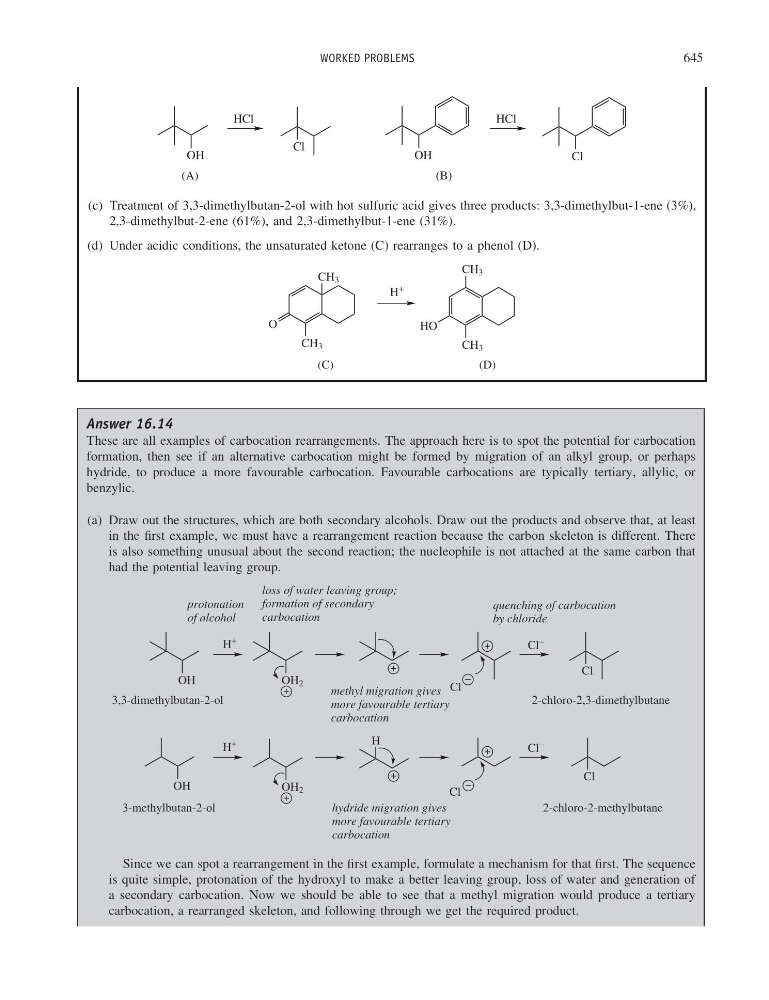
(c) Treatment of 3,3-dimethylbutan-2-ol with hot sulfuric acid gives three products: 3,3-dimethylbut-1-ene (3%),
2,3-dimethylbut-2-ene (61%), and 2,3-dimethylbut-1-ene (31%).
(d) Under acidic conditions, the unsaturated ketone (C) rearranges to a phenol (D).
CH 3
O
CH 3
H +
HO
CH 3
CH 3
(C)
(D)
Answer 16.14
These are all examples of carbocation rearrangements. The approach here is to spot the potential for carbocation
formation, then see if an alternative carbocation might be formed by migration of an alkyl group, or perhaps
hydride, to produce a more favourable carbocation. Favourable carbocations are typically tertiary, allylic, or
benzylic.
(a) Draw out the structures, which are both secondary alcohols. Draw out the products and observe that, at least
in the first example, we must have a rearrangement reaction because the carbon skeleton is different. There
is also something unusual about the second reaction; the nucleophile is not attached at the same carbon that
had the potential leaving group.
OH
3-methylbutan-2-ol
OH
3,3-dimethylbutan-2-ol
OH 2
H
+
Cl
Cl
Cl −
2-chloro-2,3-dimethylbutane
protonation
of alcohol
loss of water leaving group;
formation of secondary
carbocation
methyl migration gives
more favourable tertiary
carbocation
quenching of carbocation
by chloride
Cl
2-chloro-2-methylbutane
OH 2
H +
H
Cl
Cl
−
hydride migration gives
more favourable tertiary
carbocation
Since we can spot a rearrangement in the first example, formulate a mechanism for that first. The sequence
is quite simple, protonation of the hydroxyl to make a better leaving group, loss of water and generation of
a secondary carbocation. Now we should be able to see that a methyl migration would produce a tertiary
carbocation, a rearranged skeleton, and following through we get the required product.