

644
HOW TO APPROACH EXAMINATION QUESTIONS: SELECTED PROBLEMS AND ANSWERS
methyl group, and not on the ring. Again, the formation of a resonance-stabilized benzylic radical directs the
reaction. Eventually, we might get the hexachloro compound shown.
CHCl 2
CH 2 Cl
alternative products
CH 3
CH 2 Cl
CCl 3
CCl 3
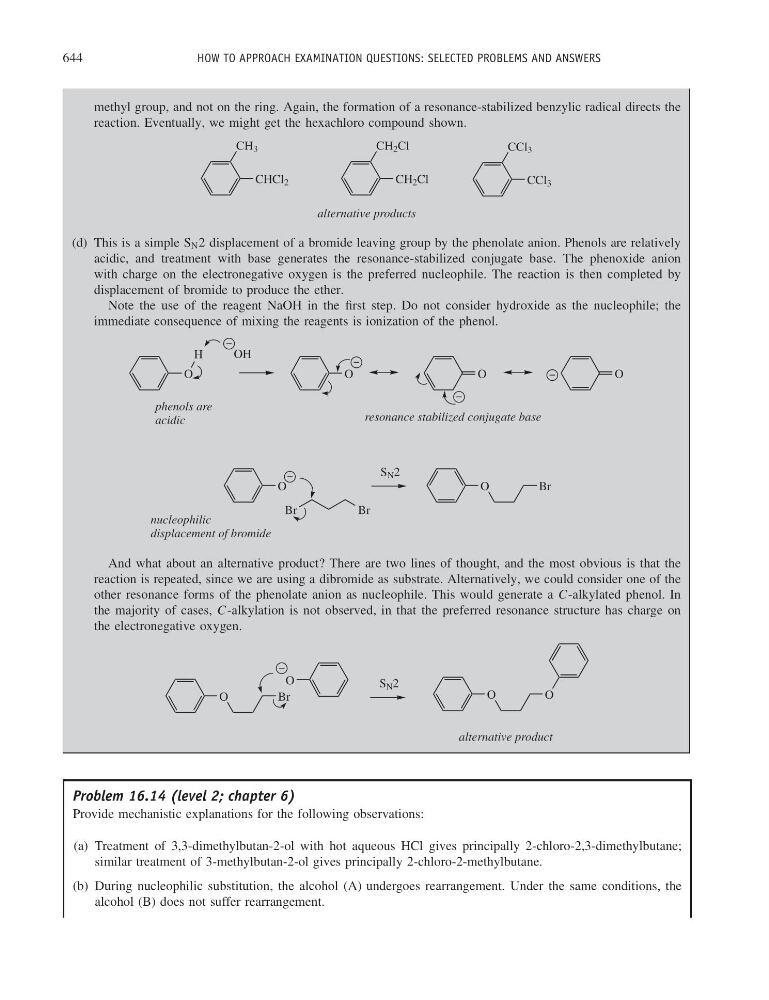
(d) This is a simple S N 2 displacement of a bromide leaving group by the phenolate anion. Phenols are relatively
acidic, and treatment with base generates the resonance-stabilized conjugate base. The phenoxide anion
with charge on the electronegative oxygen is the preferred nucleophile. The reaction is then completed by
displacement of bromide to produce the ether.
Note the use of the reagent NaOH in the first step. Do not consider hydroxide as the nucleophile; the
immediate consequence of mixing the reagents is ionization of the phenol.
O
H
OH
O
O
O
phenols are
acidic
resonance stabilized conjugate base
O
Br
Br
O
Br
S N 2
nucleophilic
displacement of bromide
And what about an alternative product? There are two lines of thought, and the most obvious is that the
reaction is repeated, since we are using a dibromide as substrate. Alternatively, we could consider one of the
other resonance forms of the phenolate anion as nucleophile. This would generate a C-alkylated phenol. In
the majority of cases, C-alkylation is not observed, in that the preferred resonance structure has charge on
the electronegative oxygen.
O
Br
O
S N 2
O
alternative product
O
Problem 16.14 (level 2; chapter 6)
Provide mechanistic explanations for the following observations:
(a) Treatment of 3,3-dimethylbutan-2-ol with hot aqueous HCl gives principally 2-chloro-2,3-dimethylbutane;
similar treatment of 3-methylbutan-2-ol gives principally 2-chloro-2-methylbutane.
(b) During nucleophilic substitution, the alcohol (A) undergoes rearrangement. Under the same conditions, the
alcohol (B) does not suffer rearrangement.