

WORKED PROBLEMS
643
N
H
O
O
H 3 CO
N
H
O
O
H 3 CO
N
H
O
O
H 3 CO
N
H
O
O
H 3 CO
resonance stabilized
arenium cation
electron donating resonance
effect of methoxyl group
stabilizes carbocation
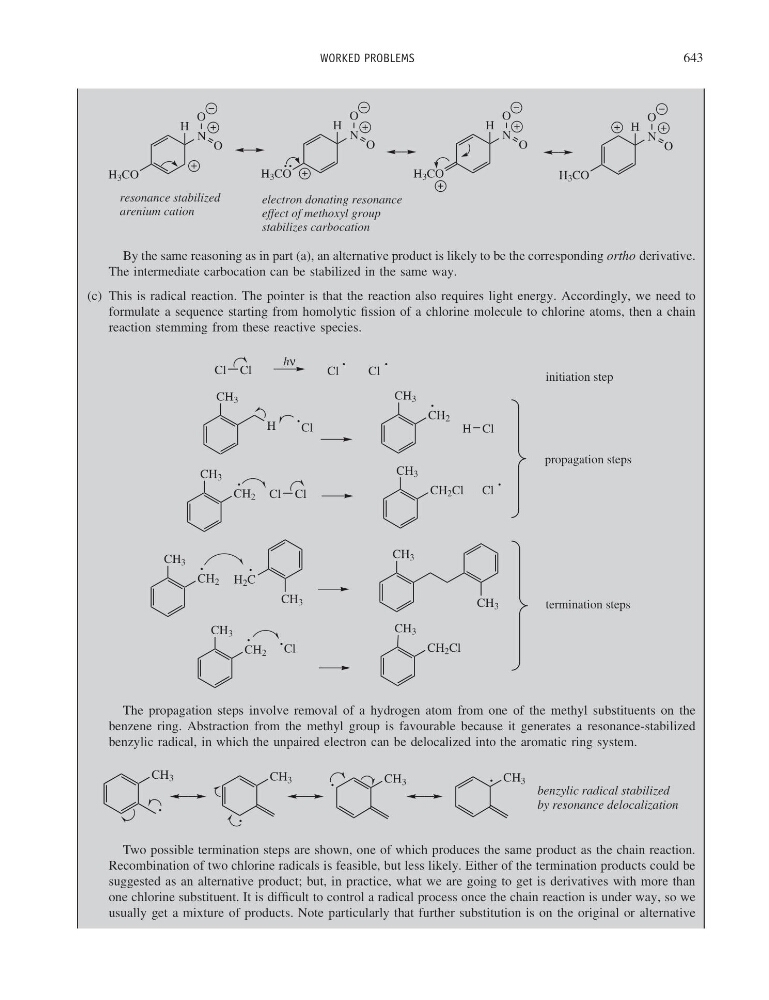
By the same reasoning as in part (a), an alternative product is likely to be the corresponding ortho derivative.
The intermediate carbocation can be stabilized in the same way.
(c) This is radical reaction. The pointer is that the reaction also requires light energy. Accordingly, we need to
formulate a sequence starting from homolytic fission of a chlorine molecule to chlorine atoms, then a chain
reaction stemming from these reactive species.
Cl Cl
hν
Cl
Cl
initiation step
Cl
H Cl
Cl Cl
Cl
propagation steps
Cl
termination steps
H
CH 2
CH 2
CH 2
CH 2 Cl
CH 2 H 2 C
CH 2 Cl
CH 3
CH 3
CH 3
CH 3
CH 3
CH 3
CH 3
CH 3
CH 3
CH 3
The propagation steps involve removal of a hydrogen atom from one of the methyl substituents on the
benzene ring. Abstraction from the methyl group is favourable because it generates a resonance-stabilized
benzylic radical, in which the unpaired electron can be delocalized into the aromatic ring system.
benzylic radical stabilized
by resonance delocalization
CH 3
CH 3
CH 3
CH 3
Two possible termination steps are shown, one of which produces the same product as the chain reaction.
Recombination of two chlorine radicals is feasible, but less likely. Either of the termination products could be
suggested as an alternative product; but, in practice, what we are going to get is derivatives with more than
one chlorine substituent. It is difficult to control a radical process once the chain reaction is under way, so we
usually get a mixture of products. Note particularly that further substitution is on the original or alternative