

642
HOW TO APPROACH EXAMINATION QUESTIONS: SELECTED PROBLEMS AND ANSWERS
H
CH 3
O
H
CH 3
O
H
CH 3
O
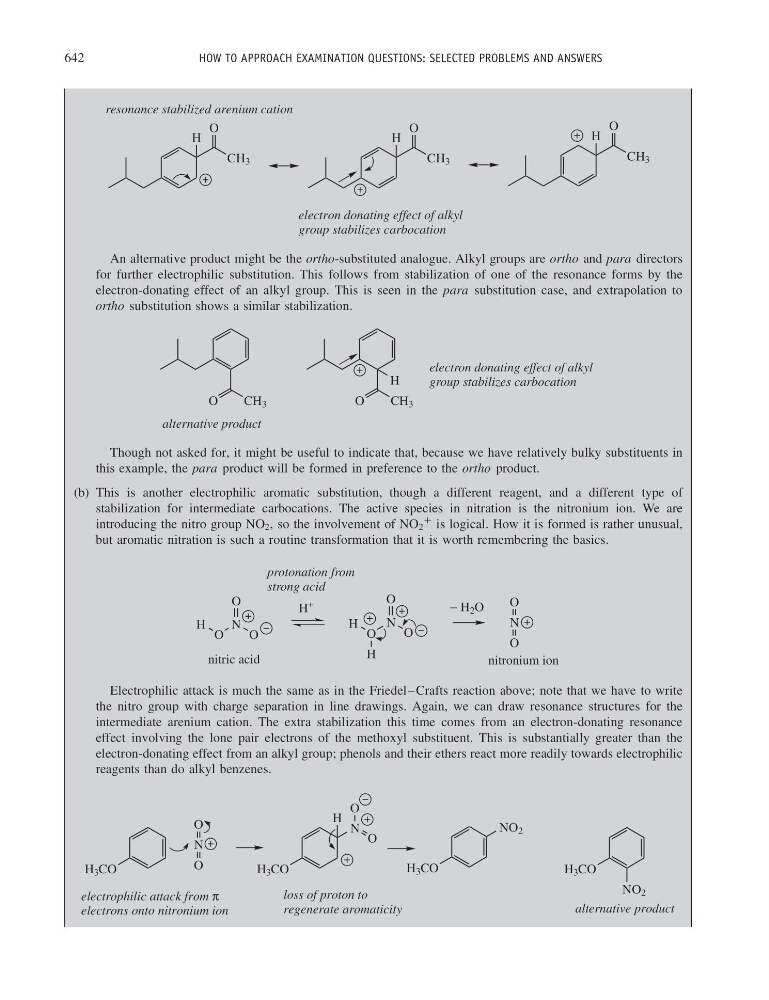
resonance stabilized arenium cation
electron donating effect of alkyl
group stabilizes carbocation
An alternative product might be the ortho-substituted analogue. Alkyl groups are ortho and para directors
for further electrophilic substitution. This follows from stabilization of one of the resonance forms by the
electron-donating effect of an alkyl group. This is seen in the para substitution case, and extrapolation to
ortho substitution shows a similar stabilization.
O
CH 3
alternative product
O
CH 3
H
electron donating effect of alkyl
group stabilizes carbocation
Though not asked for, it might be useful to indicate that, because we have relatively bulky substituents in
this example, the para product will be formed in preference to the ortho product.
(b) This is another electrophilic aromatic substitution, though a different reagent, and a different type of
stabilization for intermediate carbocations. The active species in nitration is the nitronium ion. We are
introducing the nitro group NO 2 , so the involvement of NO 2
+ is logical. How it is formed is rather unusual,
but aromatic nitration is such a routine transformation that it is worth remembering the basics.
O
N
O
O
H
H
+
protonation from
strong acid
O
N
O
O
H
H
O
N
O
− H 2 O
nitronium ion
nitric acid
Electrophilic attack is much the same as in the Friedel–Crafts reaction above; note that we have to write
the nitro group with charge separation in line drawings. Again, we can draw resonance structures for the
intermediate arenium cation. The extra stabilization this time comes from an electron-donating resonance
effect involving the lone pair electrons of the methoxyl substituent. This is substantially greater than the
electron-donating effect from an alkyl group; phenols and their ethers react more readily towards electrophilic
reagents than do alkyl benzenes.
O
N
O
N
H
NO 2
O
O
H 3 CO
H 3 CO
H 3 CO
electrophilic attack from π
electrons onto nitronium ion
loss of proton to
regenerate aromaticity
H 3 CO
NO 2
alternative product