

WORKED PROBLEMS
641
H 3 CO
HNO 3
H 2 SO 4
H 3 CO
NO 2
CH 3
Cl 2
light
CH 2 Cl
CH 3
CH 3
OH
Br
NaOH
O
Br
Br
Answer 16.13
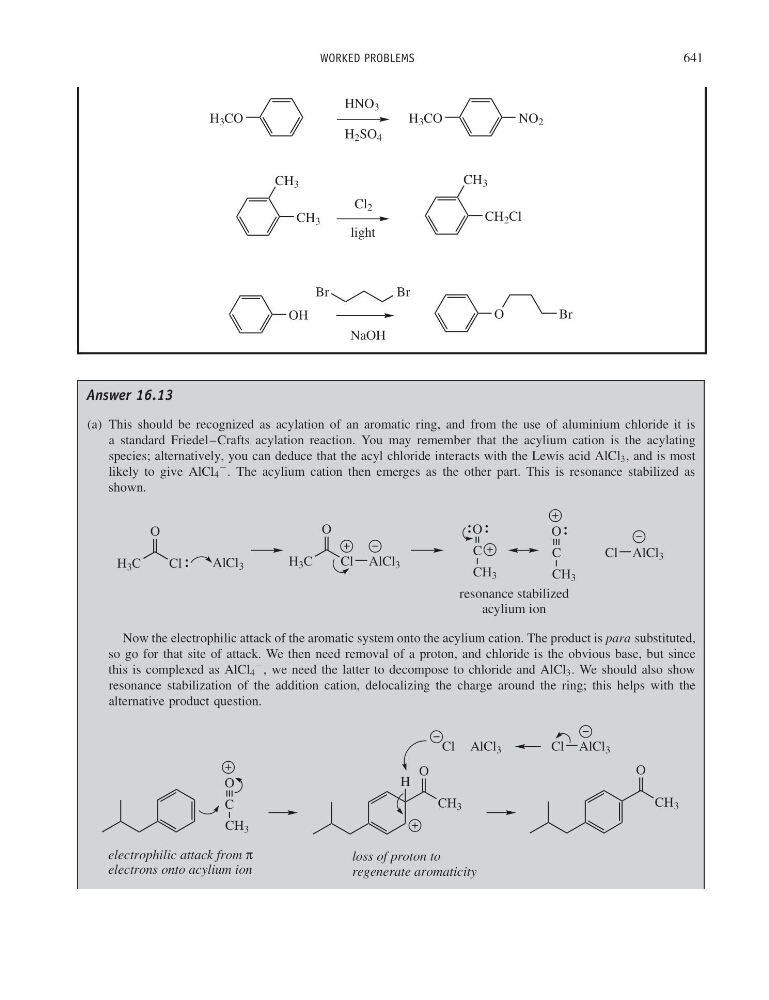
(a) This should be recognized as acylation of an aromatic ring, and from the use of aluminium chloride it is
a standard Friedel–Crafts acylation reaction. You may remember that the acylium cation is the acylating
species; alternatively, you can deduce that the acyl chloride interacts with the Lewis acid AlCl 3 , and is most
likely to give AlCl 4
− . The acylium cation then emerges as the other part. This is resonance stabilized as
shown.
O
H 3 C
Cl
AlCl 3
O
H 3 C
Cl AlCl 3
O
C
CH 3
O
C
CH 3
resonance stabilized
acylium ion
Cl AlCl 3
Now the electrophilic attack of the aromatic system onto the acylium cation. The product is para substituted,
so go for that site of attack. We then need removal of a proton, and chloride is the obvious base, but since
this is complexed as AlCl 4
− , we need the latter to decompose to chloride and AlCl 3 . We should also show
resonance stabilization of the addition cation, delocalizing the charge around the ring; this helps with the
alternative product question.
H
Cl AlCl 3
Cl AlCl 3
electrophilic attack from π
electrons onto acylium ion
O
C
CH 3
CH 3
O
CH 3
O
loss of proton to
regenerate aromaticity