

640
HOW TO APPROACH EXAMINATION QUESTIONS: SELECTED PROBLEMS AND ANSWERS
The next step is merely a repeat; instead of an electrophilic reaction with a proton, we have an electrophilic
reaction with a carbocation. The reasoning is the same; we get the tertiary carbocation intermediate. What
then follows is loss of a proton to give an alkene, and there are two possible products, depending upon
which proton is released. Both products are formed, though we would expect the more-substituted alkene to
predominate. We are not asked for, or given, any information about product ratios.
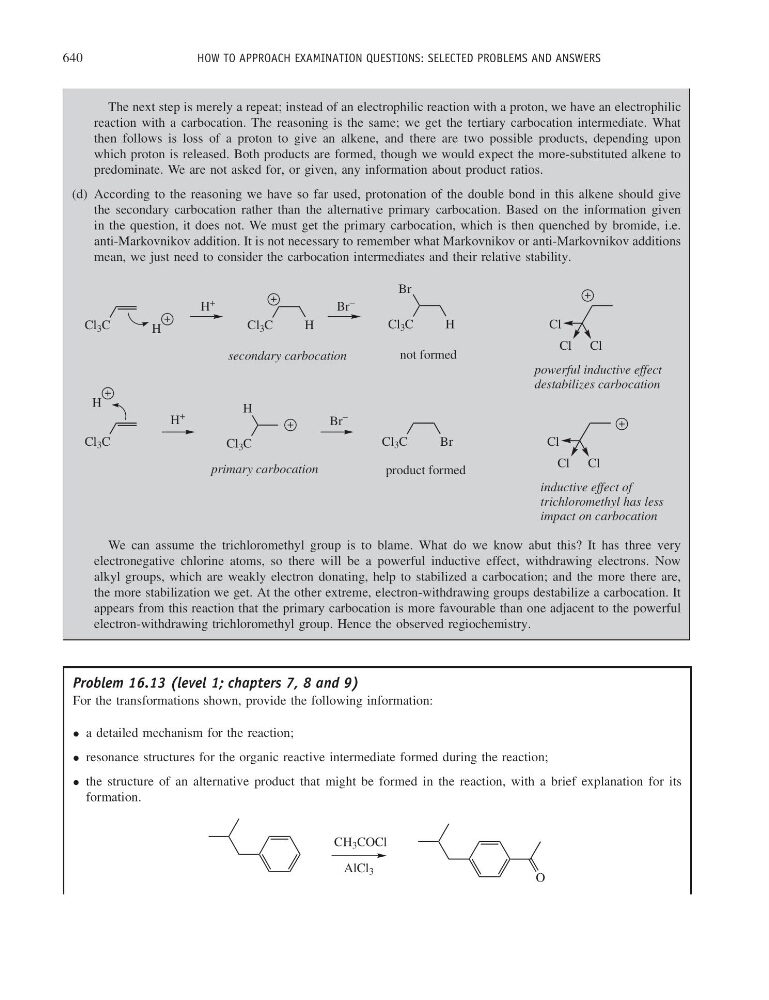
(d) According to the reasoning we have so far used, protonation of the double bond in this alkene should give
the secondary carbocation rather than the alternative primary carbocation. Based on the information given
in the question, it does not. We must get the primary carbocation, which is then quenched by bromide, i.e.
anti-Markovnikov addition. It is not necessary to remember what Markovnikov or anti-Markovnikov additions
mean, we just need to consider the carbocation intermediates and their relative stability.
Cl 3 C
H
H
+
Cl 3 C
H
Br
−
Cl 3 C
H
Br
Cl 3 C
H
H
+
Cl 3 C
H
Br
−
Cl 3 C
Br
secondary carbocation
primary carbocation
not formed
product formed
Cl
Cl
Cl
powerful inductive effect
destabilizes carbocation
inductive effect of
trichloromethyl has less
impact on carbocation
Cl
Cl
Cl
We can assume the trichloromethyl group is to blame. What do we know abut this? It has three very
electronegative chlorine atoms, so there will be a powerful inductive effect, withdrawing electrons. Now
alkyl groups, which are weakly electron donating, help to stabilized a carbocation; and the more there are,
the more stabilization we get. At the other extreme, electron-withdrawing groups destabilize a carbocation. It
appears from this reaction that the primary carbocation is more favourable than one adjacent to the powerful
electron-withdrawing trichloromethyl group. Hence the observed regiochemistry.
Problem 16.13 (level 1; chapters 7, 8 and 9)
For the transformations shown, provide the following information:
• a detailed mechanism for the reaction;
• resonance structures for the organic reactive intermediate formed during the reaction;
• the structure of an alternative product that might be formed in the reaction, with a brief explanation for its
formation.
CH 3 COCl
AlCl 3
O