

WORKED PROBLEMS
639
RO
H Br
RO H
Br
O O
RO
OR
Br
Br
Br
Br
H Br
Br
Br
Br
bromine atom adds to double bond
producing more stable secondary radical
secondary radical abstracts hydrogen atom
from HBr, generating bromine atom;
chain reaction continues
Br
Br
Br
possible termination steps
R
R
radical initiation by
homolysis of a peroxide
radical abstracts hydrogen atom from
HBr, generating bromine atom
Br
Br
Br
Br
Br
Br
Br
Br
Br
Br
Br
main product
mechanism shows
pairs of arrows
mechanism shows
single arrows
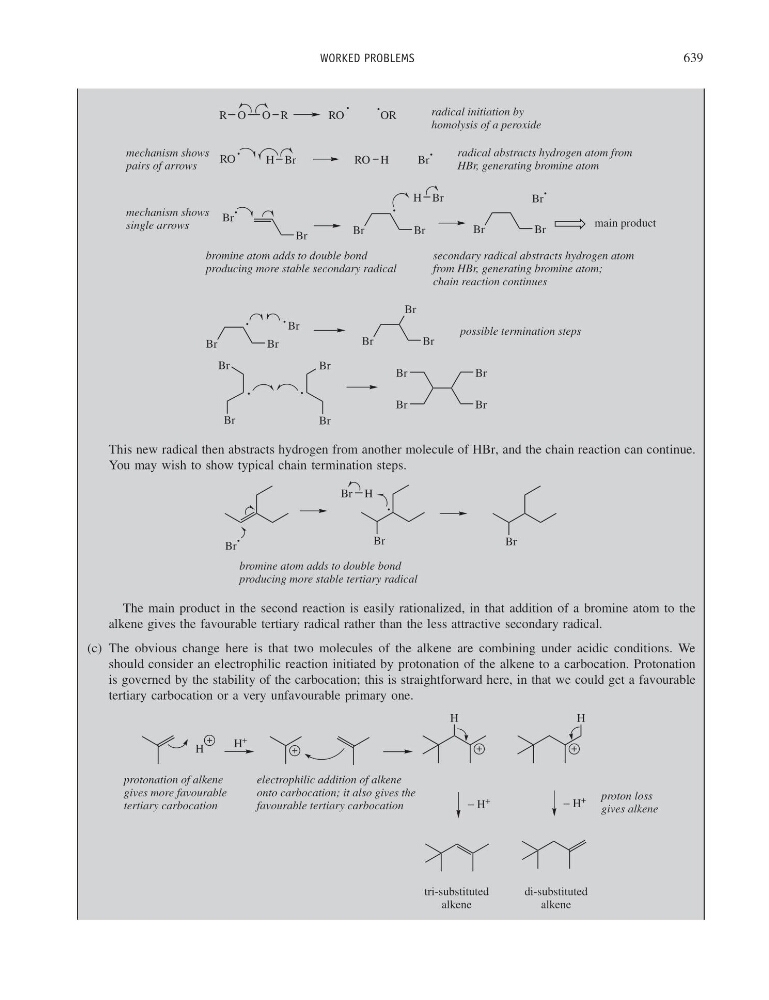
This new radical then abstracts hydrogen from another molecule of HBr, and the chain reaction can continue.
You may wish to show typical chain termination steps.
Br
Br
H
Br
Br
bromine atom adds to double bond
producing more stable tertiary radical
The main product in the second reaction is easily rationalized, in that addition of a bromine atom to the
alkene gives the favourable tertiary radical rather than the less attractive secondary radical.
(c) The obvious change here is that two molecules of the alkene are combining under acidic conditions. We
should consider an electrophilic reaction initiated by protonation of the alkene to a carbocation. Protonation
is governed by the stability of the carbocation; this is straightforward here, in that we could get a favourable
tertiary carbocation or a very unfavourable primary one.
H
H
H
H +
− H +
− H +
protonation of alkene
gives more favourable
tertiary carbocation
electrophilic addition of alkene
onto carbocation; it also gives the
favourable tertiary carbocation
proton loss
gives alkene
tri-substituted
alkene
di-substituted
alkene