

638
HOW TO APPROACH EXAMINATION QUESTIONS: SELECTED PROBLEMS AND ANSWERS
Answer 16.12
We have here a mixture of electrophilic and radical addition reactions to alkenes. Remember the guidelines that
radical reactions are characterized by the inclusion of radical initiators, such as light or peroxides. In the absence
of such initiators, consider only the alternative electrophilic mechanisms.
(a) Electrophilic addition to conjugated dienes is complicated by the concepts of kinetic and thermodynamic
control. Briefly, you should think of kinetic control being related to the stability of the intermediate
carbocations, whereas thermodynamic control is dependent on the stability of the products. Here, we have
low temperature conditions, so we need to consider protonation of the alkene, and the relative stability of the
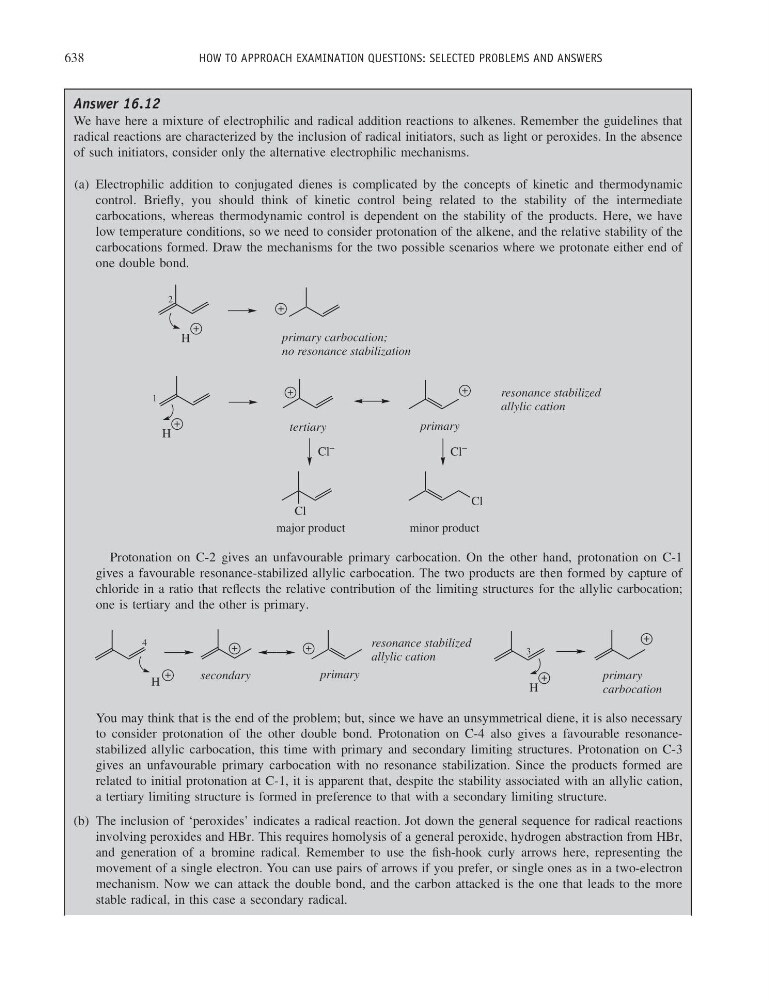
carbocations formed. Draw the mechanisms for the two possible scenarios where we protonate either end of
one double bond.
H
H
primary carbocation;
no resonance stabilization
resonance stabilized
allylic cation
Cl
Cl
tertiary
primary
Cl −
Cl −
1
2
major product
minor product
Protonation on C-2 gives an unfavourable primary carbocation. On the other hand, protonation on C-1
gives a favourable resonance-stabilized allylic carbocation. The two products are then formed by capture of
chloride in a ratio that reflects the relative contribution of the limiting structures for the allylic carbocation;
one is tertiary and the other is primary.
H
3
H
primary
carbocation
4
secondary
primary
resonance stabilized
allylic cation
You may think that is the end of the problem; but, since we have an unsymmetrical diene, it is also necessary
to consider protonation of the other double bond. Protonation on C-4 also gives a favourable resonancestabilized allylic carbocation, this time with primary and secondary limiting structures. Protonation on C-3
gives an unfavourable primary carbocation with no resonance stabilization. Since the products formed are
related to initial protonation at C-1, it is apparent that, despite the stability associated with an allylic cation,
a tertiary limiting structure is formed in preference to that with a secondary limiting structure.
(b) The inclusion of ‘peroxides’ indicates a radical reaction. Jot down the general sequence for radical reactions
involving peroxides and HBr. This requires homolysis of a general peroxide, hydrogen abstraction from HBr,
and generation of a bromine radical. Remember to use the fish-hook curly arrows here, representing the
movement of a single electron. You can use pairs of arrows if you prefer, or single ones as in a two-electron
mechanism. Now we can attack the double bond, and the carbon attacked is the one that leads to the more
stable radical, in this case a secondary radical.