

WORKED PROBLEMS
635
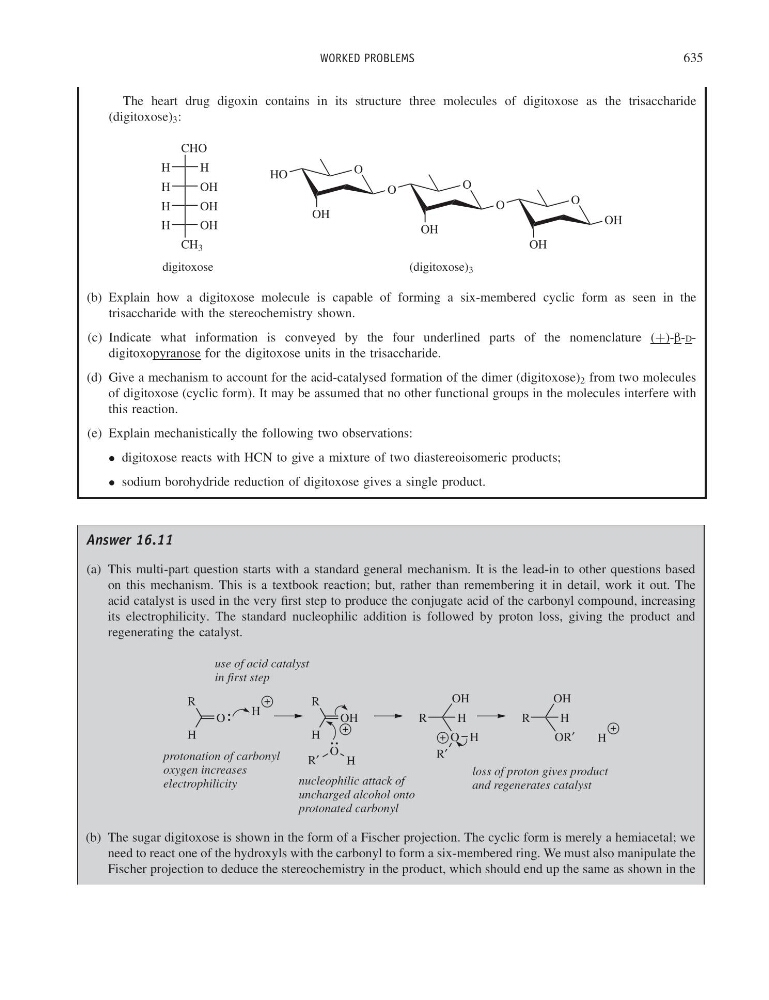
The heart drug digoxin contains in its structure three molecules of digitoxose as the trisaccharide
(digitoxose) 3 :
O
HO
OH
O
O
OH
O
O
OH
OH
CHO
H
H
OH
H
OH
H
OH
H
CH 3
digitoxose
(digitoxose) 3
(b) Explain how a digitoxose molecule is capable of forming a six-membered cyclic form as seen in the
trisaccharide with the stereochemistry shown.
(c) Indicate what information is conveyed by the four underlined parts of the nomenclature (+)-β-Ddigitoxopyranose for the digitoxose units in the trisaccharide.
(d) Give a mechanism to account for the acid-catalysed formation of the dimer (digitoxose) 2 from two molecules
of digitoxose (cyclic form). It may be assumed that no other functional groups in the molecules interfere with
this reaction.
(e) Explain mechanistically the following two observations:
• digitoxose reacts with HCN to give a mixture of two diastereoisomeric products;
• sodium borohydride reduction of digitoxose gives a single product.
Answer 16.11
(a) This multi-part question starts with a standard general mechanism. It is the lead-in to other questions based
on this mechanism. This is a textbook reaction; but, rather than remembering it in detail, work it out. The
acid catalyst is used in the very first step to produce the conjugate acid of the carbonyl compound, increasing
its electrophilicity. The standard nucleophilic addition is followed by proton loss, giving the product and
regenerating the catalyst.
O
H
R
H
OH
H
R
O
R′
H
R
OH
O
R′
H
R
OR′
OH
H
protonation of carbonyl
oxygen increases
electrophilicity
use of acid catalyst
in first step
nucleophilic attack of
uncharged alcohol onto
protonated carbonyl
loss of proton gives product
and regenerates catalyst
H
H
(b) The sugar digitoxose is shown in the form of a Fischer projection. The cyclic form is merely a hemiacetal; we
need to react one of the hydroxyls with the carbonyl to form a six-membered ring. We must also manipulate the
Fischer projection to deduce the stereochemistry in the product, which should end up the same as shown in the