

634
HOW TO APPROACH EXAMINATION QUESTIONS: SELECTED PROBLEMS AND ANSWERS
and
[base]
[acid]
= 10
0.05 = 1.12
The [acid] is known; it is
[acid] =
3.85
60.05
= 0.0641M.
Therefore, [base] = 1.12×0.0641 = 0.0718 M.
Amount of sodium acetate required
= 0.0718 × 82.03 = 5.89 g.
(b) We again use the Henderson–Hasselbalch
equation; we are adding extra base, which in turn
removes some acid, so the [base]/[acid] ratio will
alter accordingly.
The amount of base added is 1 ml of 0.1 M
NaOH = 0.001 M; this will also remove 0.001 M
of acid
pH = pK a + log
[base]
[acid]
so
pH = 4.75 + log
0.0718 + 0.001
0.0641 − 0.001
= 4.75 + log
0.0728
0.0631
pH = 4.75 + log 1.15 = 4.75 + 0.06 = 4.81
New pH = 4.81, a change of just 0.01 pH units
(c) The pH of a solution of a weak base may be
determined from the equation:
pH =
1
2
pK w +
1
2
pK a +
1
2
log[B]
[base] =
6.50
45
×
1000
600
= 0.241M
pH =
1
2 (14) +
1
2 (10.8) +
1
2 log(0.241)
= 7 + 5.4 +
1
2
(−0.618)
pH = 7 + 5.4 − 0.31 = 12.09
pH of solution = 12.09
(d) This again requires use of the Henderson–Hasselbalch equation; we have a partially
ionized acid, so the ionized fraction represents
[base] and the non-ionized fraction represents
[acid].
Let us call the fraction ionized I ; then the
fraction non-ionized is 1 − I .
pH = pK a + log
[base]
[acid]
4.90 = 5.70 + log
I
1 − I
so that
log
I
1 − I
= 4.90 − 5.70 = −0.80
and
I
1 − I
= 10
−0.80 = 0.158
from this
I = 0.158 − 0.158I
and
I =
0.158
1.158
= 0.136
This means the percentage ionized is 13.6%.
Problem 16.11 (level 1; chapters 7 and 3)
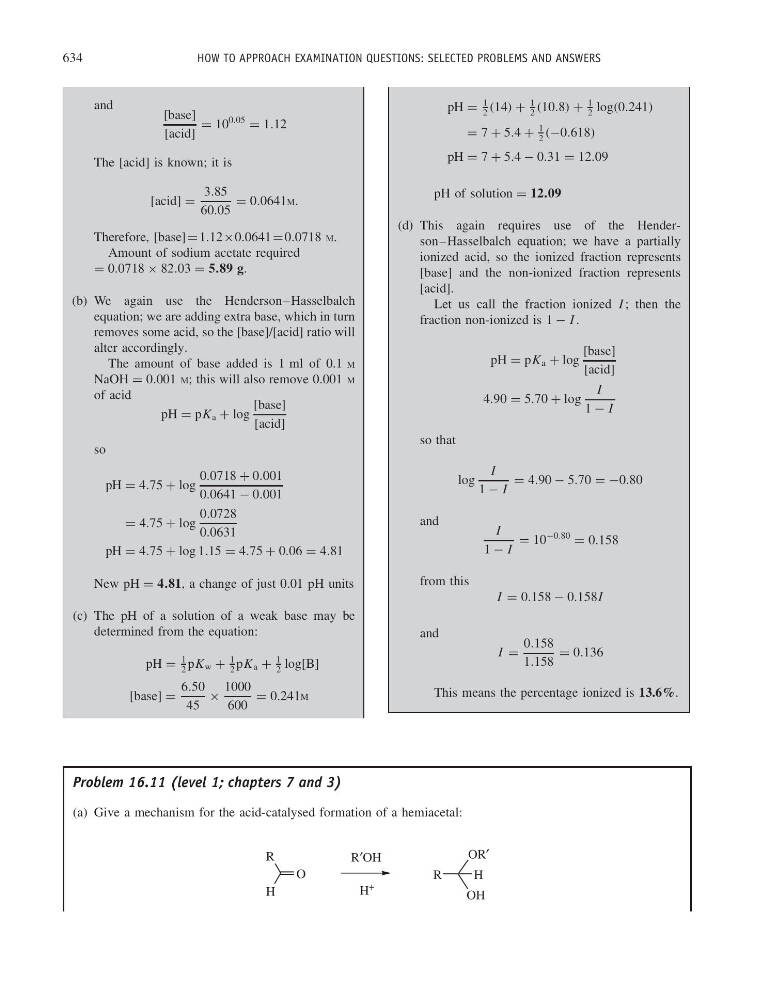
(a) Give a mechanism for the acid-catalysed formation of a hemiacetal:
R
OR′
OH
O
H
R
R′OH
H
H +