

WORKED PROBLEMS
633
O
OH
O
CH 3
O
OH
O
CH 3
resonance effect
stabilizes conjugate base
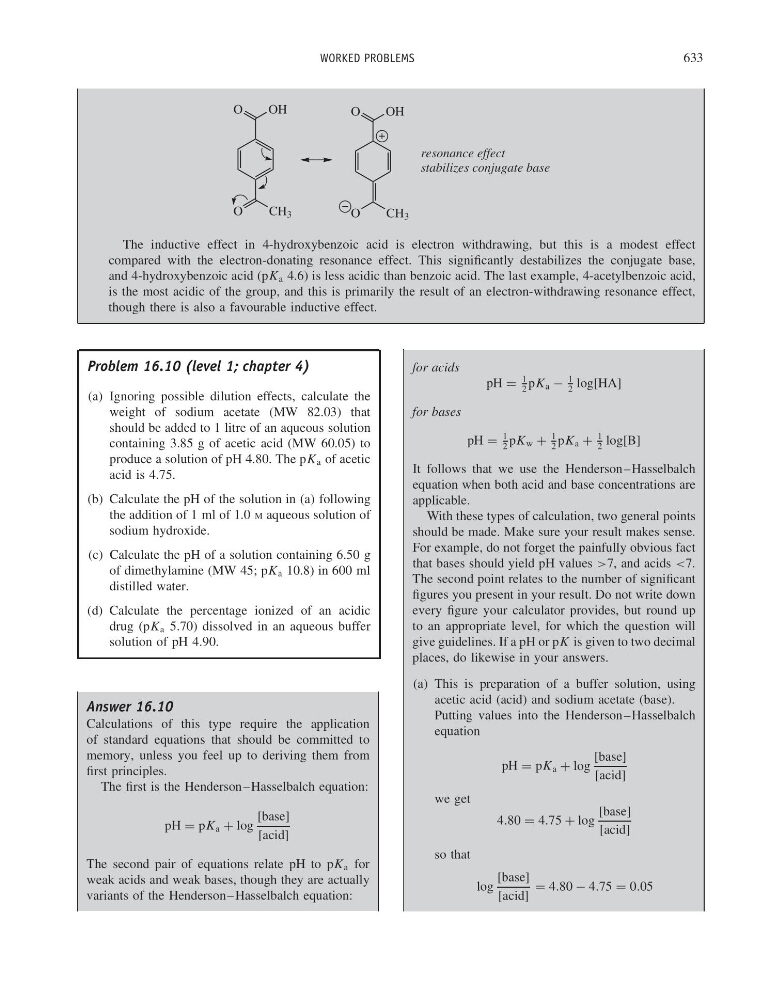
The inductive effect in 4-hydroxybenzoic acid is electron withdrawing, but this is a modest effect
compared with the electron-donating resonance effect. This significantly destabilizes the conjugate base,
and 4-hydroxybenzoic acid (pK a 4.6) is less acidic than benzoic acid. The last example, 4-acetylbenzoic acid,
is the most acidic of the group, and this is primarily the result of an electron-withdrawing resonance effect,
though there is also a favourable inductive effect.
Problem 16.10 (level 1; chapter 4)
(a) Ignoring possible dilution effects, calculate the
weight of sodium acetate (MW 82.03) that
should be added to 1 litre of an aqueous solution
containing 3.85 g of acetic acid (MW 60.05) to
produce a solution of pH 4.80. The pK a of acetic
acid is 4.75.
(b) Calculate the pH of the solution in (a) following
the addition of 1 ml of 1.0 M aqueous solution of
sodium hydroxide.
(c) Calculate the pH of a solution containing 6.50 g
of dimethylamine (MW 45; pK a 10.8) in 600 ml
distilled water.
(d) Calculate the percentage ionized of an acidic
drug (pK a 5.70) dissolved in an aqueous buffer
solution of pH 4.90.
Answer 16.10
Calculations of this type require the application
of standard equations that should be committed to
memory, unless you feel up to deriving them from
first principles.
The first is the Henderson–Hasselbalch equation:
pH = pK a + log
[base]
[acid]
The second pair of equations relate pH to pK a for
weak acids and weak bases, though they are actually
variants of the Henderson–Hasselbalch equation:
for acids
pH =
1
2 pK a −
1
2 log[HA]
for bases
pH =
1
2
pK w +
1
2
pK a +
1
2
log[B]
It follows that we use the Henderson–Hasselbalch
equation when both acid and base concentrations are
applicable.
With these types of calculation, two general points
should be made. Make sure your result makes sense.
For example, do not forget the painfully obvious fact
that bases should yield pH values >7, and acids <7.
The second point relates to the number of significant
figures you present in your result. Do not write down
every figure your calculator provides, but round up
to an appropriate level, for which the question will
give guidelines. If a pH or pK is given to two decimal
places, do likewise in your answers.
(a) This is preparation of a buffer solution, using
acetic acid (acid) and sodium acetate (base).
Putting values into the Henderson–Hasselbalch
equation
pH = pK a + log
[base]
[acid]
we get
4.80 = 4.75 + log
[base]
[acid]
so that
log
[base]
[acid]
= 4.80 − 4.75 = 0.05