

636
HOW TO APPROACH EXAMINATION QUESTIONS: SELECTED PROBLEMS AND ANSWERS
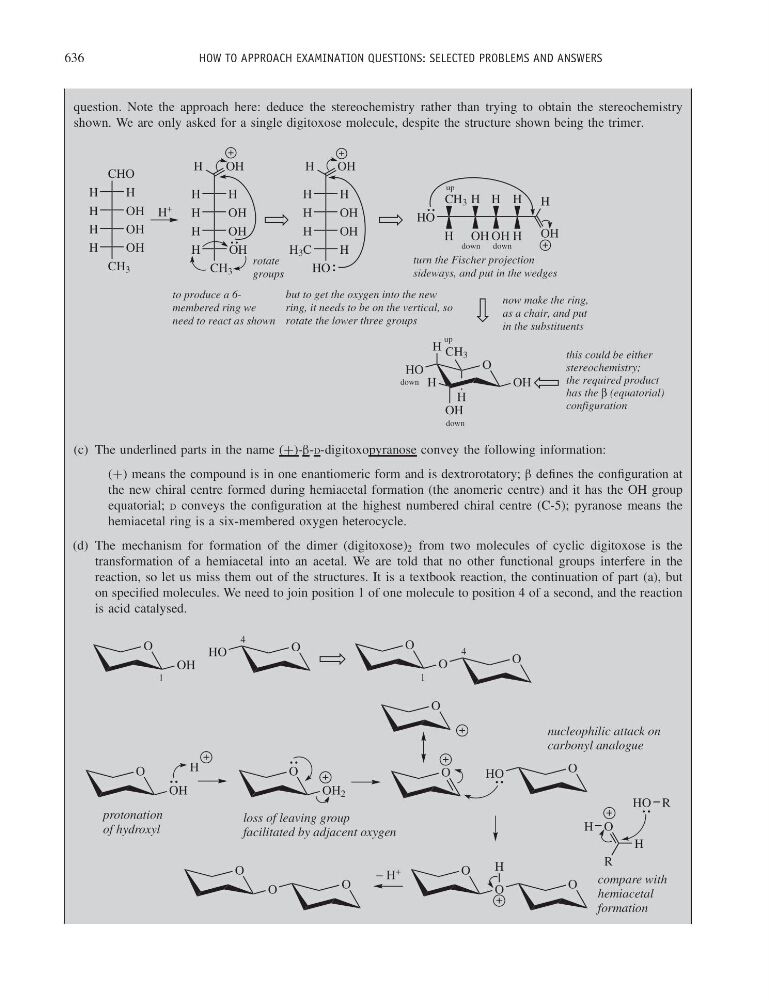
question. Note the approach here: deduce the stereochemistry rather than trying to obtain the stereochemistry
shown. We are only asked for a single digitoxose molecule, despite the structure shown being the trimer.
CHO
H
H
OH
H
OH
H
OH
H
CH 3
to produce a 6membered ring we
need to react as shown
H
H
OH
H
OH
H
OH
H
CH 3
H
OH
H +
H
H
OH
H
OH
H
H
H 3 C
HO
H
OH
but to get the oxygen into the new
ring, it needs to be on the vertical, so
rotate the lower three groups
rotate
groups
H
H
OH
H
OH
H
H
CH 3
HO
H
OH
turn the Fischer projection
sideways, and put in the wedges
O
OH
CH 3
HO
OH
up
down
down
down
down
up
H
H
H
now make the ring,
as a chair, and put
in the substituents
this could be either
stereochemistry;
the required product
has the β (equatorial)
configuration
(c) The underlined parts in the name (+)-β-D-digitoxopyranose convey the following information:
(+) means the compound is in one enantiomeric form and is dextrorotatory; β defines the configuration at
the new chiral centre formed during hemiacetal formation (the anomeric centre) and it has the OH group
equatorial; D conveys the configuration at the highest numbered chiral centre (C-5); pyranose means the
hemiacetal ring is a six-membered oxygen heterocycle.
(d) The mechanism for formation of the dimer (digitoxose) 2 from two molecules of cyclic digitoxose is the
transformation of a hemiacetal into an acetal. We are told that no other functional groups interfere in the
reaction, so let us miss them out of the structures. It is a textbook reaction, the continuation of part (a), but
on specified molecules. We need to join position 1 of one molecule to position 4 of a second, and the reaction
is acid catalysed.
O
OH
O
HO
1
4
O
O
O
1
4
O
OH
H
O
OH 2
O
O
HO
O
O
O
H
O
O
O
− H
+
protonation
of hydroxyl
loss of leaving group
facilitated by adjacent oxygen
nucleophilic attack on
carbonyl analogue
O
R
H
H
HO R
compare with
hemiacetal
formation
O