

WORKED PROBLEMS
627
H
+
protonation of alkene produces
tertiary carbocation
alcohol as nucleophile
attacks carbocation
H
Br
OH
Br
O
H
Br
O
− H
+
O
Mg
Et 2 O
Grignard reagent
O
BrMg
O
CH 3
CH 3
O
O
H
HO
O
HO
Grignard
reagent behaves
as carbanion
nucleophilic
addition to ketone
BrMg
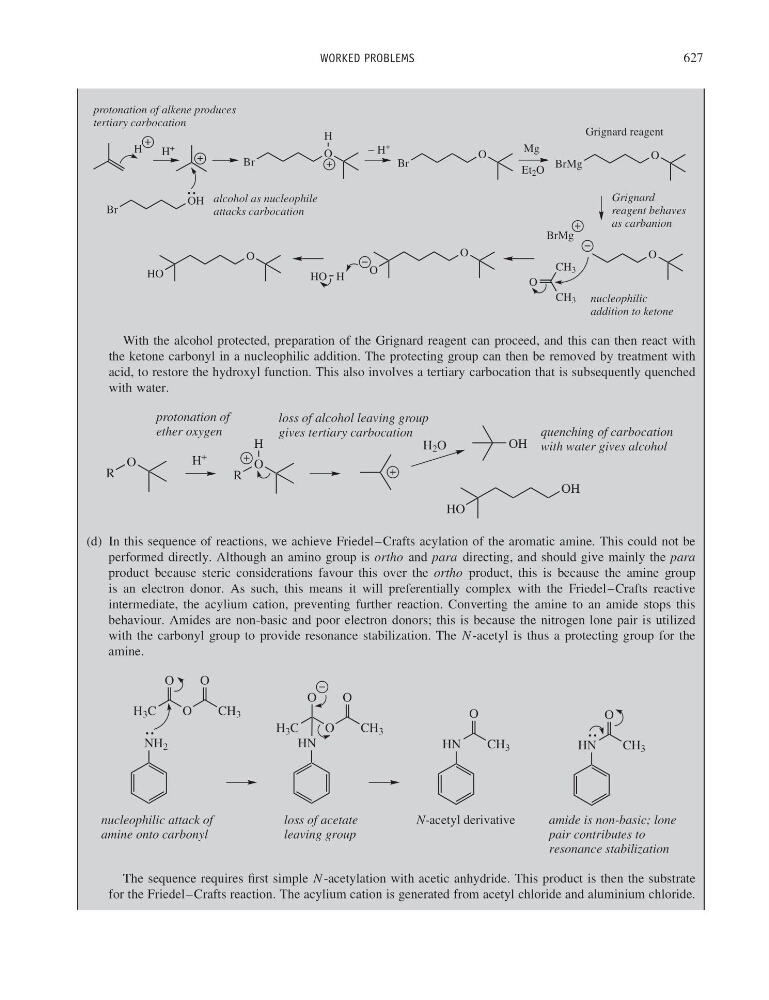
With the alcohol protected, preparation of the Grignard reagent can proceed, and this can then react with
the ketone carbonyl in a nucleophilic addition. The protecting group can then be removed by treatment with
acid, to restore the hydroxyl function. This also involves a tertiary carbocation that is subsequently quenched
with water.
OH
HO
R
O
H
+
R
O
H
OH
H 2 O
protonation of
ether oxygen
loss of alcohol leaving group
gives tertiary carbocation
quenching of carbocation
with water gives alcohol
(d) In this sequence of reactions, we achieve Friedel–Crafts acylation of the aromatic amine. This could not be
performed directly. Although an amino group is ortho and para directing, and should give mainly the para
product because steric considerations favour this over the ortho product, this is because the amine group
is an electron donor. As such, this means it will preferentially complex with the Friedel–Crafts reactive
intermediate, the acylium cation, preventing further reaction. Converting the amine to an amide stops this
behaviour. Amides are non-basic and poor electron donors; this is because the nitrogen lone pair is utilized
with the carbonyl group to provide resonance stabilization. The N-acetyl is thus a protecting group for the
amine.
O
H 3 C
O
CH 3
O
NH 2
HN
O
H 3 C
O
CH 3
O
HN
O
CH 3
HN
O
CH 3
nucleophilic attack of
amine onto carbonyl
loss of acetate
leaving group
N-acetyl derivative
amide is non-basic; lone
pair contributes to
resonance stabilization
The sequence requires first simple N-acetylation with acetic anhydride. This product is then the substrate
for the Friedel–Crafts reaction. The acylium cation is generated from acetyl chloride and aluminium chloride.