

628
HOW TO APPROACH EXAMINATION QUESTIONS: SELECTED PROBLEMS AND ANSWERS
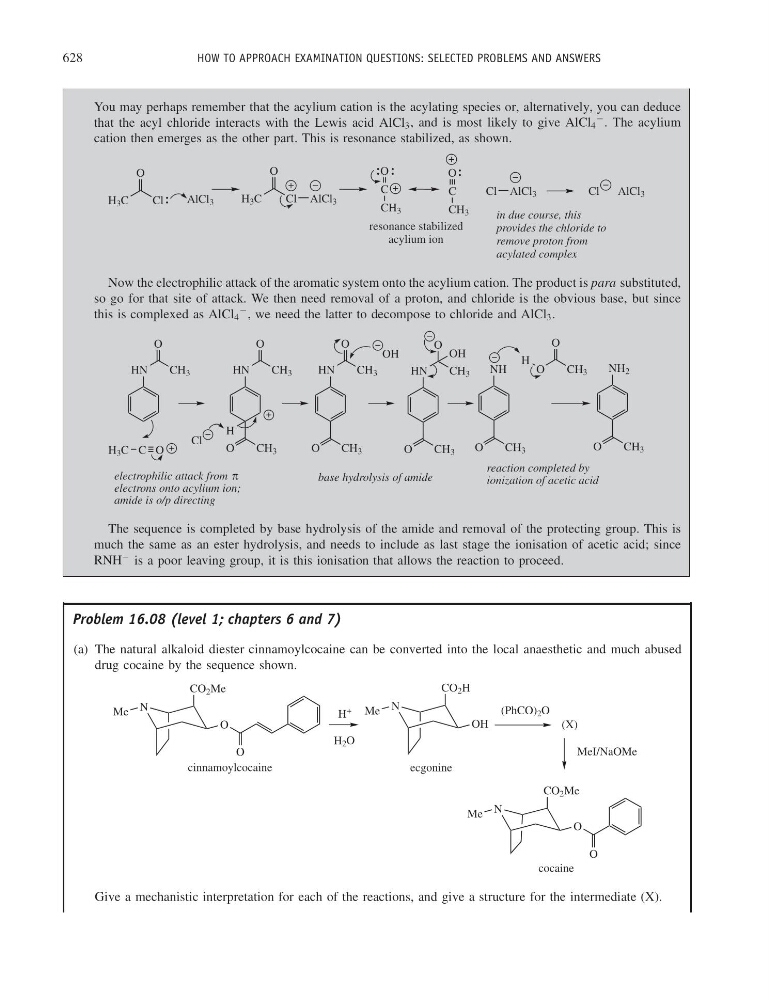
You may perhaps remember that the acylium cation is the acylating species or, alternatively, you can deduce
that the acyl chloride interacts with the Lewis acid AlCl 3 , and is most likely to give AlCl 4
− . The acylium
cation then emerges as the other part. This is resonance stabilized, as shown.
O
H 3 C
Cl
AlCl 3
O
H 3 C
Cl AlCl 3
O
C
CH 3
O
C
CH 3
resonance stabilized
acylium ion
Cl AlCl 3
AlCl 3
Cl
in due course, this
provides the chloride to
remove proton from
acylated complex
Now the electrophilic attack of the aromatic system onto the acylium cation. The product is para substituted,
so go for that site of attack. We then need removal of a proton, and chloride is the obvious base, but since
this is complexed as AlCl 4
− , we need the latter to decompose to chloride and AlCl 3 .
HN
O
CH 3
HN
O
CH 3
O
CH 3
NH 2
O
CH 3
electrophilic attack from π
electrons onto acylium ion;
amide is o/p directing
O
C
H 3 C
HN
O
CH 3
O
CH 3
H
OH
HN
O
CH 3
O
CH 3
OH
NH
O
CH 3
O
O
CH 3
H
base hydrolysis of amide
reaction completed by
ionization of acetic acid
Cl
The sequence is completed by base hydrolysis of the amide and removal of the protecting group. This is
much the same as an ester hydrolysis, and needs to include as last stage the ionisation of acetic acid; since
RNH
− is a poor leaving group, it is this ionisation that allows the reaction to proceed.
Problem 16.08 (level 1; chapters 6 and 7)
(a) The natural alkaloid diester cinnamoylcocaine can be converted into the local anaesthetic and much abused
drug cocaine by the sequence shown.
N
Me
O
O
CO 2 Me
N
Me
OH
CO 2 H
cinnamoylcocaine
ecgonine
N
Me
CO 2 Me
O
O
cocaine
(PhCO) 2 O
MeI/NaOMe
(X)
H 2 O
H
+
Give a mechanistic interpretation for each of the reactions, and give a structure for the intermediate (X).