

626
HOW TO APPROACH EXAMINATION QUESTIONS: SELECTED PROBLEMS AND ANSWERS
Answer 16.07
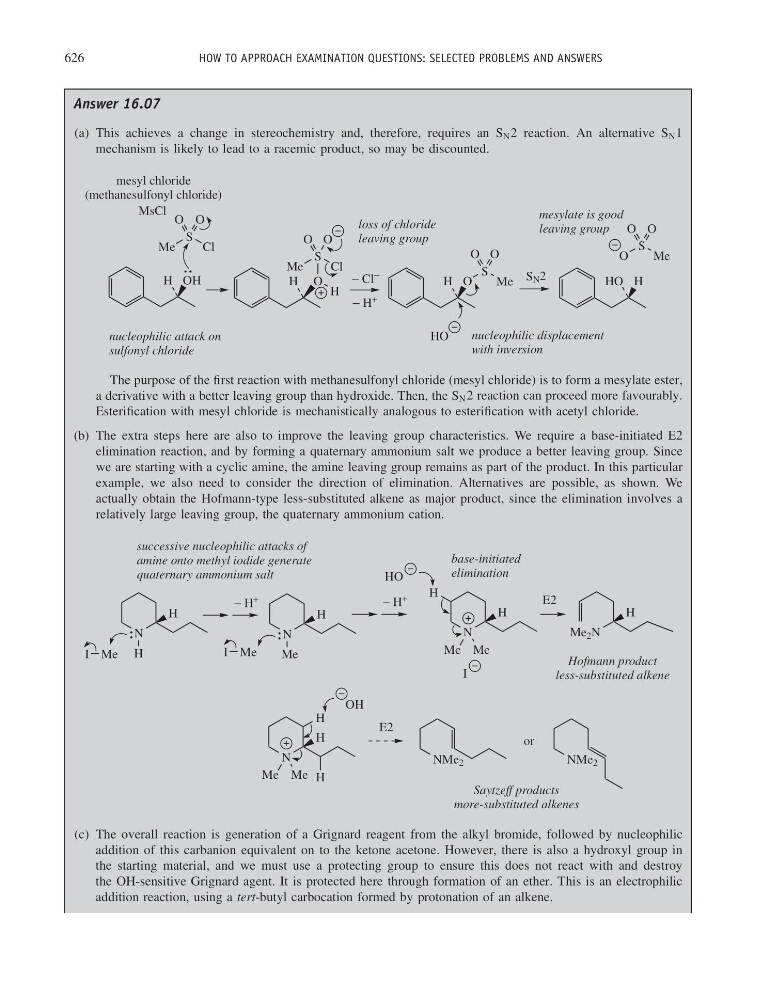
(a) This achieves a change in stereochemistry and, therefore, requires an S N 2 reaction. An alternative S N 1
mechanism is likely to lead to a racemic product, so may be discounted.
OH
H
mesyl chloride
(methanesulfonyl chloride)
S
Me
Cl
O
O
O
H
S
Me
Cl
O O
H
H
S
Me
O O
O
HO
H
HO
S
Me
O O
O
nucleophilic attack on
sulfonyl chloride
loss of chloride
leaving group
S N 2
nucleophilic displacement
with inversion
mesylate is good
leaving group
− H +
− Cl −
MsCl
The purpose of the first reaction with methanesulfonyl chloride (mesyl chloride) is to form a mesylate ester,
a derivative with a better leaving group than hydroxide. Then, the S N 2 reaction can proceed more favourably.
Esterification with mesyl chloride is mechanistically analogous to esterification with acetyl chloride.
(b) The extra steps here are also to improve the leaving group characteristics. We require a base-initiated E2
elimination reaction, and by forming a quaternary ammonium salt we produce a better leaving group. Since
we are starting with a cyclic amine, the amine leaving group remains as part of the product. In this particular
example, we also need to consider the direction of elimination. Alternatives are possible, as shown. We
actually obtain the Hofmann-type less-substituted alkene as major product, since the elimination involves a
relatively large leaving group, the quaternary ammonium cation.
N
N
Me Me
H
H
Me 2 N
H
H
Me
I
− H +
N
H
Me
Me
I
− H +
H
I
HO
successive nucleophilic attacks of
amine onto methyl iodide generate
quaternary ammonium salt
base-initiated
elimination
E2
N
Me Me
H
H
OH
E2
NMe 2
Hofmann product
less-substituted alkene
Saytzeff products
more-substituted alkenes
H
NMe 2
or
(c) The overall reaction is generation of a Grignard reagent from the alkyl bromide, followed by nucleophilic
addition of this carbanion equivalent on to the ketone acetone. However, there is also a hydroxyl group in
the starting material, and we must use a protecting group to ensure this does not react with and destroy
the OH-sensitive Grignard agent. It is protected here through formation of an ether. This is an electrophilic
addition reaction, using a tert-butyl carbocation formed by protonation of an alkene.