

BIOTIN-DEPENDENT CARBOXYLATIONS
609
15.9 Biotin-dependent carboxylations
We have briefly noted the role of biotin when
we considered the biosynthesis of fatty acids (see
Section 15.5). Biotin is a carrier of carbon dioxide
and involved in carboxylation reactions. In fatty
acid biosynthesis, we noted how acetyl-CoA was
transformed by carboxylation into the more effective
nucleophilic agent malonyl-CoA, thus facilitating the
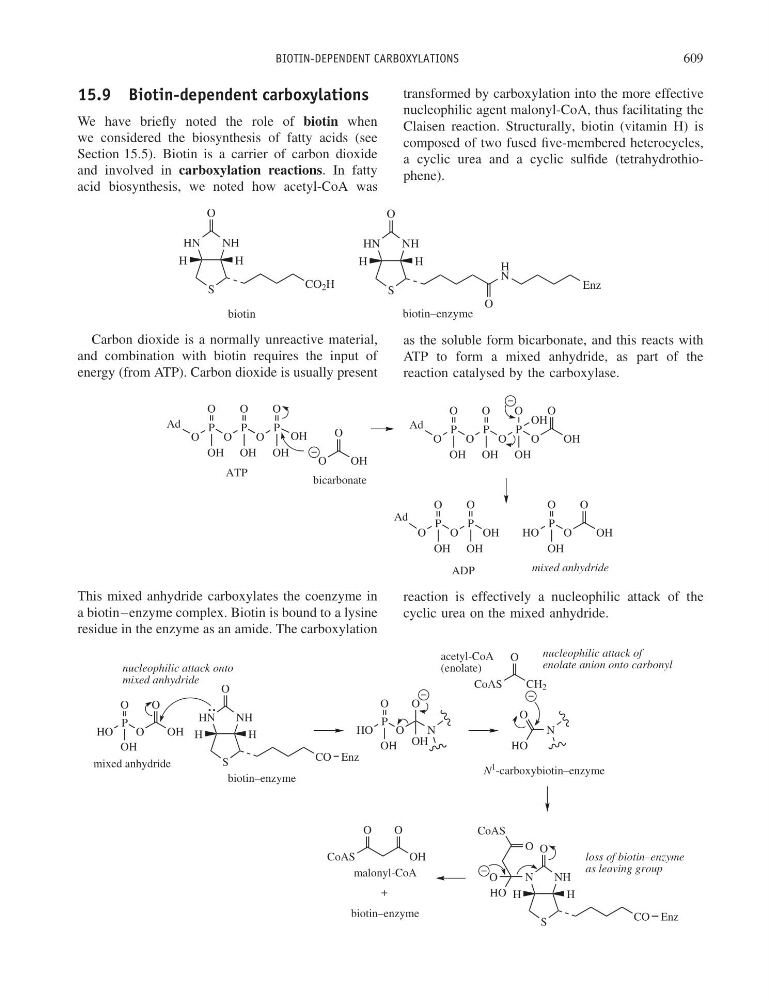
Claisen reaction. Structurally, biotin (vitamin H) is
composed of two fused five-membered heterocycles,
a cyclic urea and a cyclic sulfide (tetrahydrothiophene).
NH
HN
S
CO 2 H
H
H
O
biotin–enzyme
biotin
NH
HN
S
H
H
O
H
N
O
Enz
Carbon dioxide is a normally unreactive material,
and combination with biotin requires the input of
energy (from ATP). Carbon dioxide is usually present
as the soluble form bicarbonate, and this reacts with
ATP to form a mixed anhydride, as part of the
reaction catalysed by the carboxylase.
O
P
OH
O
P
O
O
OH
OH
P
O
O
OH
Ad
O
P
O
O
P
O
O
OH
OH
P
O
O
OH
Ad
OH
O
P
OH
O
P
O
O
OH
OH
Ad
O
P
HO
O
OH
O
O
OH
OH
O
OH
O
mixed anhydride
ATP
bicarbonate
ADP
This mixed anhydride carboxylates the coenzyme in
a biotin–enzyme complex. Biotin is bound to a lysine
residue in the enzyme as an amide. The carboxylation
reaction is effectively a nucleophilic attack of the
cyclic urea on the mixed anhydride.
NH
HN
S
CO
H
H
O
Enz
O
HO
biotin–enzyme
nucleophilic attack onto
mixed anhydride
acetyl-CoA
(enolate)
nucleophilic attack of
enolate anion onto carbonyl
mixed anhydride
O
P
HO
O
OH
OH
O
O
P
HO
O
OH OH
O
N
1 -carboxybiotin–enzyme
NH
N
S
CO
H
H
O
Enz
HO
O
CoAS
CH 2
O
CoAS
O
loss of biotin–enzyme
as leaving group
N
N
CoAS
OH
O
O
malonyl-CoA
+
biotin–enzyme