

608
THE ORGANIC CHEMISTRY OF INTERMEDIARY METABOLISM
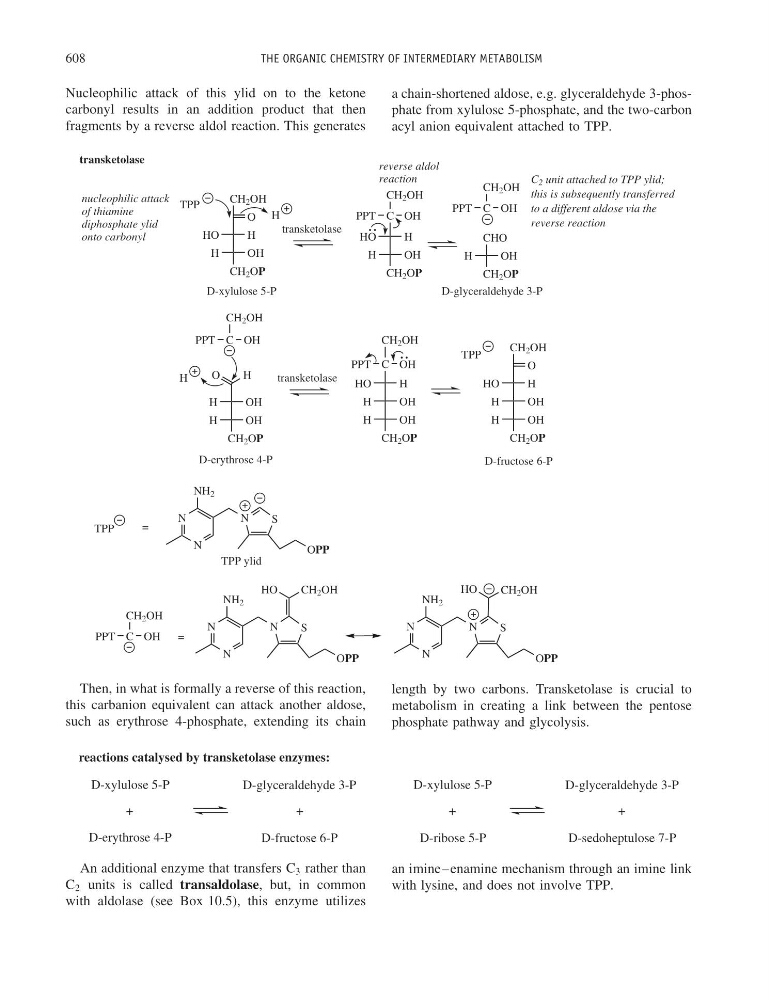
Nucleophilic attack of this ylid on to the ketone
carbonyl results in an addition product that then
fragments by a reverse aldol reaction. This generates
a chain-shortened aldose, e.g. glyceraldehyde 3-phosphate from xylulose 5-phosphate, and the two-carbon
acyl anion equivalent attached to TPP.
CH 2 OH
O
HO
H
H
CH 2 OP
OH
CH 2 OH
C OH
HO
H
H
CH 2 OP
OH
PPT
CH 2 OH
C
PPT
OH
H
OH
H
OH
CH 2 OP
D-xylulose 5-P
transketolase
D-erythrose 4-P
CH 2 OH
C
PPT
OH
CHO
H
CH 2 OP
OH
D-glyceraldehyde 3-P
O
H
CH 2 OH
C OH
HO
H
H
OH
H
OH
CH 2 OP
PPT
CH 2 OH
O
HO
H
H
OH
H
OH
CH 2 OP
D-fructose 6-P
transketolase
N
N
N
S
OPP
NH 2
HO
CH 2 OH
N
N
N
S
OPP
NH 2
CH 2 OH
C
PPT
OH
=
HO
CH 2 OH
TPP ylid
=
N
N
N
S
OPP
NH 2
nucleophilic attack
of thiamine
diphosphate ylid
onto carbonyl
reverse aldol
reaction
C 2 unit attached to TPP ylid;
this is subsequently transferred
to a different aldose via the
reverse reaction
transketolase
TPP
H
H
TPP
TPP
Then, in what is formally a reverse of this reaction,
this carbanion equivalent can attack another aldose,
such as erythrose 4-phosphate, extending its chain
length by two carbons. Transketolase is crucial to
metabolism in creating a link between the pentose
phosphate pathway and glycolysis.
D-fructose 6-P
D-xylulose 5-P
D-sedoheptulose 7-P
D-erythrose 4-P
D-ribose 5-P
D-glyceraldehyde 3-P
reactions catalysed by transketolase enzymes:
D-xylulose 5-P
D-glyceraldehyde 3-P
+
+
+
+
An additional enzyme that transfers C 3 rather than
C 2 units is called transaldolase, but, in common
with aldolase (see Box 10.5), this enzyme utilizes
an imine–enamine mechanism through an imine link
with lysine, and does not involve TPP.