

TPP-DEPENDENT REACTIONS
607
Each of the complexes pyruvate dehydrogenase
and 2-oxoglutarate dehydrogenase actually contains
three enzyme activities. We can now readily appreciate what the separate activities might be. In the
case of pyruvate dehydrogenase, the individual activities are pyruvate dehydrogenase (requires cofactor TPP), dihydrolipoamide acyltransferase (requires
cofactors lipoic acid and coenzyme A), and dihydrolipoamide dehydrogenase (requires cofactors FAD
and NAD
+ ). The requirement for NAD
+ is to reoxidize FADH 2 after regeneration of lipoic acid. The
‘lipoamide’ terminology indicates that the lipoic
acid is enzyme bound through its carboxylic acid
group to an amino group of lysine via an amide
linkage.
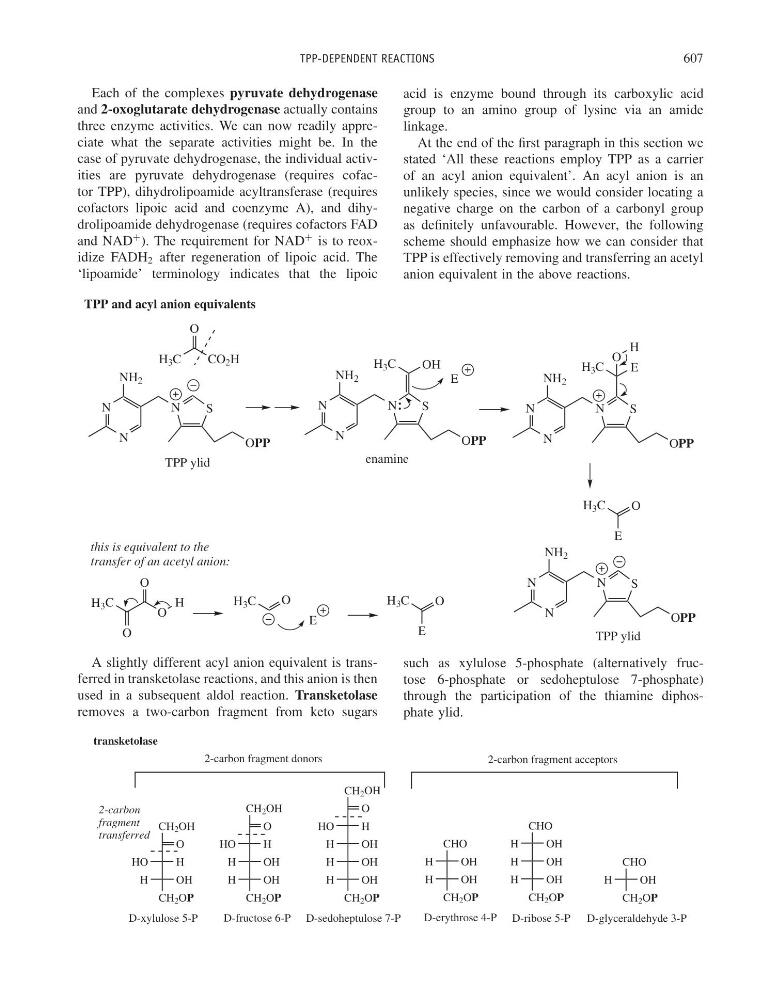
At the end of the first paragraph in this section we
stated ‘All these reactions employ TPP as a carrier
of an acyl anion equivalent’. An acyl anion is an
unlikely species, since we would consider locating a
negative charge on the carbon of a carbonyl group
as definitely unfavourable. However, the following
scheme should emphasize how we can consider that
TPP is effectively removing and transferring an acetyl
anion equivalent in the above reactions.
enamine
N
N
N
S
OPP
NH 2
H 3 C
OH
E
N
N
N
S
OPP
NH 2
H 3 C
E
O
H
TPP and acyl anion equivalents
H 3 C
CO 2 H
O
TPP ylid
N
N
N
S
OPP
NH 2
H 3 C
O
N
N
N
S
OPP
NH 2
H 3 C
O
E
this is equivalent to the
transfer of an acetyl anion:
E
H 3 C
O
E
TPP ylid
H 3 C
O
O
O
H
A slightly different acyl anion equivalent is transferred in transketolase reactions, and this anion is then
used in a subsequent aldol reaction. Transketolase
removes a two-carbon fragment from keto sugars
such as xylulose 5-phosphate (alternatively fructose 6-phosphate or sedoheptulose 7-phosphate)
through the participation of the thiamine diphosphate ylid.
CH 2 OH
O
HO
H
H
OH
H
OH
CH 2 OP
D-fructose 6-P
CH 2 OH
O
HO
H
H
CH 2 OP
OH
D-xylulose 5-P
CH 2 OH
O
HO
H
H
OH
H
OH
H
OH
CH 2 OP
D-sedoheptulose 7-P
2-carbon
fragment
transferred
CHO
H
OH
H
OH
CH 2 OP
D-erythrose 4-P
H
OH
H
OH
CH 2 OP
H
OH
CHO
D-ribose 5-P
CHO
H
CH 2 OP
OH
D-glyceraldehyde 3-P
2-carbon fragment donors
2-carbon fragment acceptors
transketolase