

606
THE ORGANIC CHEMISTRY OF INTERMEDIARY METABOLISM
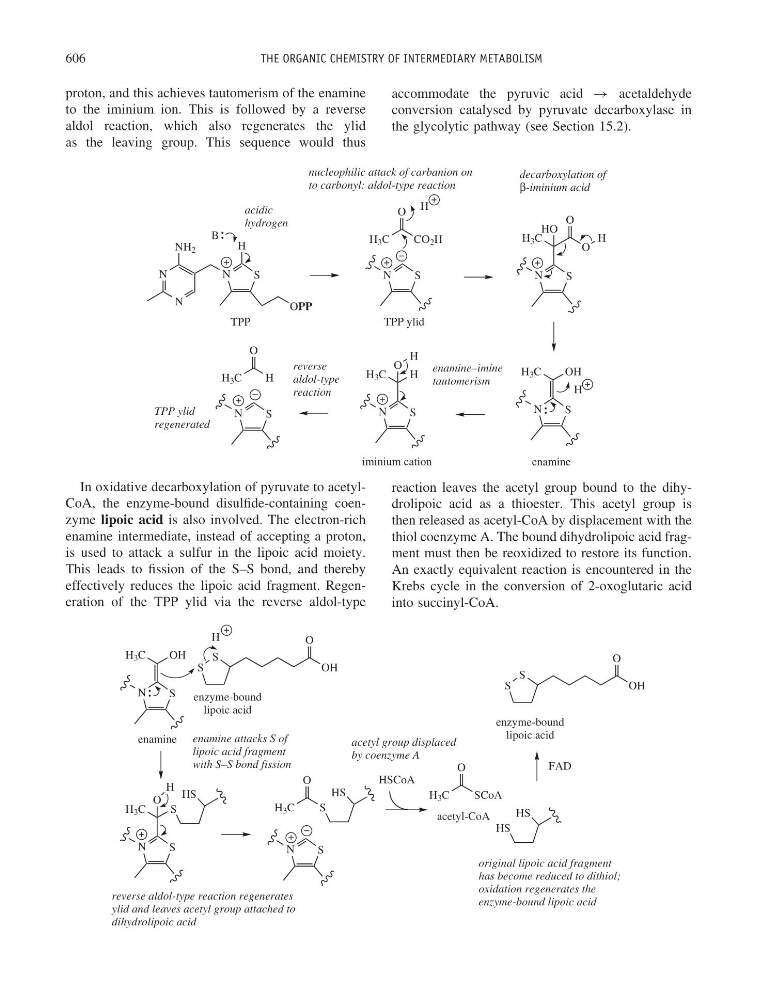
proton, and this achieves tautomerism of the enamine
to the iminium ion. This is followed by a reverse
aldol reaction, which also regenerates the ylid
as the leaving group. This sequence would thus
accommodate the pyruvic acid → acetaldehyde
conversion catalysed by pyruvate decarboxylase in
the glycolytic pathway (see Section 15.2).
N
S
H 3 C
CO 2 H
O
N
S
H 3 C
HO
O
H
O
N
S
H 3 C
OH
N
S
H 3 C
O
H
H
N
S
H 3 C
H
O
nucleophilic attack of carbanion on
to carbonyl: aldol-type reaction
acidic
hydrogen
TPP ylid
decarboxylation of
β-iminium acid
enamine
TPP ylid
regenerated
iminium cation
reverse
aldol-type
reaction
enamine–imine
tautomerism
N
N
N
S
OPP
NH 2
H
H
TPP
H
B
In oxidative decarboxylation of pyruvate to acetylCoA, the enzyme-bound disulfide-containing coenzyme lipoic acid is also involved. The electron-rich
enamine intermediate, instead of accepting a proton,
is used to attack a sulfur in the lipoic acid moiety.
This leads to fission of the S–S bond, and thereby
effectively reduces the lipoic acid fragment. Regeneration of the TPP ylid via the reverse aldol-type
reaction leaves the acetyl group bound to the dihydrolipoic acid as a thioester. This acetyl group is
then released as acetyl-CoA by displacement with the
thiol coenzyme A. The bound dihydrolipoic acid fragment must then be reoxidized to restore its function.
An exactly equivalent reaction is encountered in the
Krebs cycle in the conversion of 2-oxoglutaric acid
into succinyl-CoA.
N
S
H 3 C
OH
S
S
N
S
H 3 C
O
S
HS
H
N
S
S
HS
H 3 C
O
HS
HS
SCoA
H 3 C
O
S
S
enzyme-bound
lipoic acid
enzyme-bound
lipoic acid
enamine enamine attacks S of
lipoic acid fragment
with S–S bond fission
reverse aldol-type reaction regenerates
ylid and leaves acetyl group attached to
dihydrolipoic acid
acetyl group displaced
by coenzyme A
original lipoic acid fragment
has become reduced to dithiol;
oxidation regenerates the
enzyme-bound lipoic acid
acetyl-CoA
OH
O
OH
O
H
HSCoA
FAD