

TPP-DEPENDENT REACTIONS
605
15.8 TPP-dependent reactions
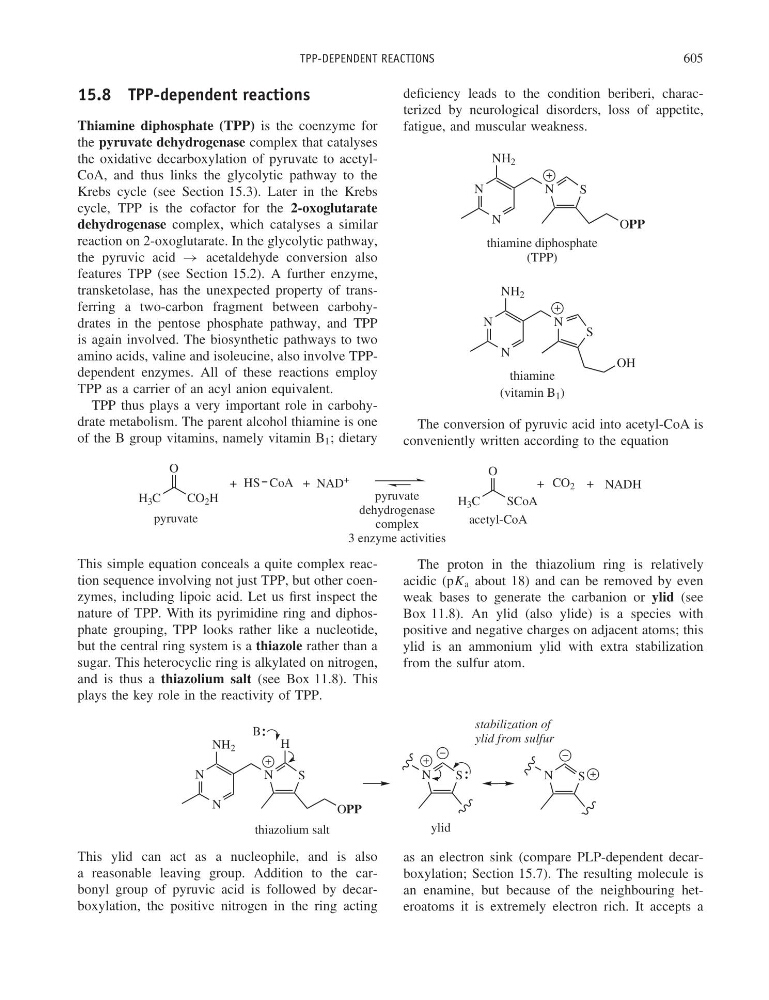
Thiamine diphosphate (TPP) is the coenzyme for
the pyruvate dehydrogenase complex that catalyses
the oxidative decarboxylation of pyruvate to acetylCoA, and thus links the glycolytic pathway to the
Krebs cycle (see Section 15.3). Later in the Krebs
cycle, TPP is the cofactor for the 2-oxoglutarate
dehydrogenase complex, which catalyses a similar
reaction on 2-oxoglutarate. In the glycolytic pathway,
the pyruvic acid → acetaldehyde conversion also
features TPP (see Section 15.2). A further enzyme,
transketolase, has the unexpected property of transferring a two-carbon fragment between carbohydrates in the pentose phosphate pathway, and TPP
is again involved. The biosynthetic pathways to two
amino acids, valine and isoleucine, also involve TPPdependent enzymes. All of these reactions employ
TPP as a carrier of an acyl anion equivalent.
TPP thus plays a very important role in carbohydrate metabolism. The parent alcohol thiamine is one
of the B group vitamins, namely vitamin B 1 ; dietary
deficiency leads to the condition beriberi, characterized by neurological disorders, loss of appetite,
fatigue, and muscular weakness.
N
N
N
S
OH
NH 2
thiamine
(vitamin B 1 )
N
N
N
S
OPP
NH 2
thiamine diphosphate
(TPP)
The conversion of pyruvic acid into acetyl-CoA is
conveniently written according to the equation
HS CoA
+
+
+
+
pyruvate
dehydrogenase
complex
3 enzyme activities
O
H 3 C
CO 2 H
H 3 C
SCoA
O
pyruvate
acetyl-CoA
NAD
+
CO 2
NADH
This simple equation conceals a quite complex reaction sequence involving not just TPP, but other coenzymes, including lipoic acid. Let us first inspect the
nature of TPP. With its pyrimidine ring and diphosphate grouping, TPP looks rather like a nucleotide,
but the central ring system is a thiazole rather than a
sugar. This heterocyclic ring is alkylated on nitrogen,
and is thus a thiazolium salt (see Box 11.8). This
plays the key role in the reactivity of TPP.
The proton in the thiazolium ring is relatively
acidic (pK a about 18) and can be removed by even
weak bases to generate the carbanion or ylid (see
Box 11.8). An ylid (also ylide) is a species with
positive and negative charges on adjacent atoms; this
ylid is an ammonium ylid with extra stabilization
from the sulfur atom.
N
S
N
S
ylid
thiazolium salt
N
N
N
S
OPP
NH 2
H
stabilization of
ylid from sulfur
B
This ylid can act as a nucleophile, and is also
a reasonable leaving group. Addition to the carbonyl group of pyruvic acid is followed by decarboxylation, the positive nitrogen in the ring acting
as an electron sink (compare PLP-dependent decarboxylation; Section 15.7). The resulting molecule is
an enamine, but because of the neighbouring heteroatoms it is extremely electron rich. It accepts a