

604
THE ORGANIC CHEMISTRY OF INTERMEDIARY METABOLISM
Do appreciate that one enzyme will not catalyse all
three types of reaction. We need different enzymes
to accomplish a particular reaction on a particular
substrate. Rotation about the N–C bond positions the
vulnerable group for reaction; it also positions the R
and/or CO 2
− groups so that they can interact and bind
to the enzyme, thus providing the specificity.
One further point for the sake of accuracy; we
have omitted it to simplify the mechanistic features.
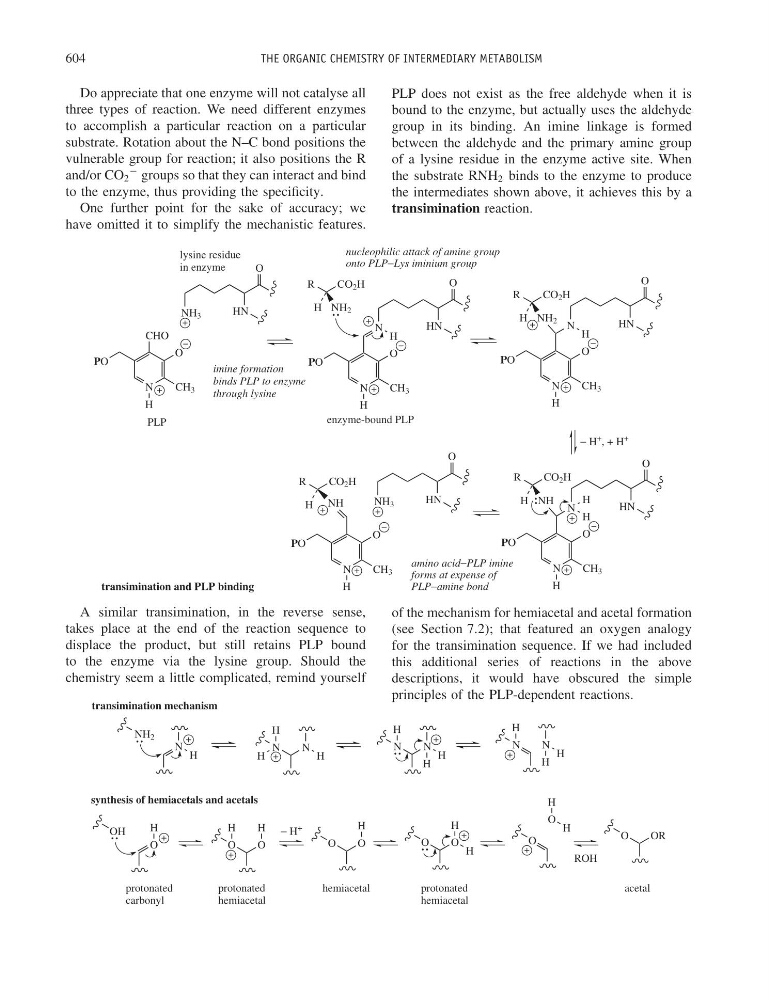
PLP does not exist as the free aldehyde when it is
bound to the enzyme, but actually uses the aldehyde
group in its binding. An imine linkage is formed
between the aldehyde and the primary amine group
of a lysine residue in the enzyme active site. When
the substrate RNH 2 binds to the enzyme to produce
the intermediates shown above, it achieves this by a
transimination reaction.
transimination and PLP binding
N
CHO
O
CH 3
PO
PLP
H
NH 3
HN
O
lysine residue
in enzyme
N
O
CH 3
PO
N
H
HN
O
H
R
CO 2 H
NH 2
H
enzyme-bound PLP
nucleophilic attack of amine group
onto PLP−Lys iminium group
N
O
CH 3
PO
N
H
HN
O
H
R
CO 2 H
NH 2
H
N
O
CH 3
PO
N
H
HN
O
H
R
CO 2 H
NH
H
H
− H
+
, + H
+
N
O
CH 3
PO
NH 3
H
HN
O
R
CO 2 H
NH
H
imine formation
binds PLP to enzyme
through lysine
amino acid−PLP imine
forms at expense of
PLP−amine bond
A similar transimination, in the reverse sense,
takes place at the end of the reaction sequence to
displace the product, but still retains PLP bound
to the enzyme via the lysine group. Should the
chemistry seem a little complicated, remind yourself
of the mechanism for hemiacetal and acetal formation
(see Section 7.2); that featured an oxygen analogy
for the transimination sequence. If we had included
this additional series of reactions in the above
descriptions, it would have obscured the simple
principles of the PLP-dependent reactions.
N
H
NH 2
N
H
N
H
H
N
H
N
H
H
N
H
N
H
H
O
H
OH
O
H
O
H
O
H
H
O
O
H
H
O
protonated
carbonyl
protonated
hemiacetal
protonated
hemiacetal
O
H
O
− H +
hemiacetal
ROH
O
OR
acetal
transimination mechanism
synthesis of hemiacetals and acetals