

PLP-DEPENDENT REACTIONS
603
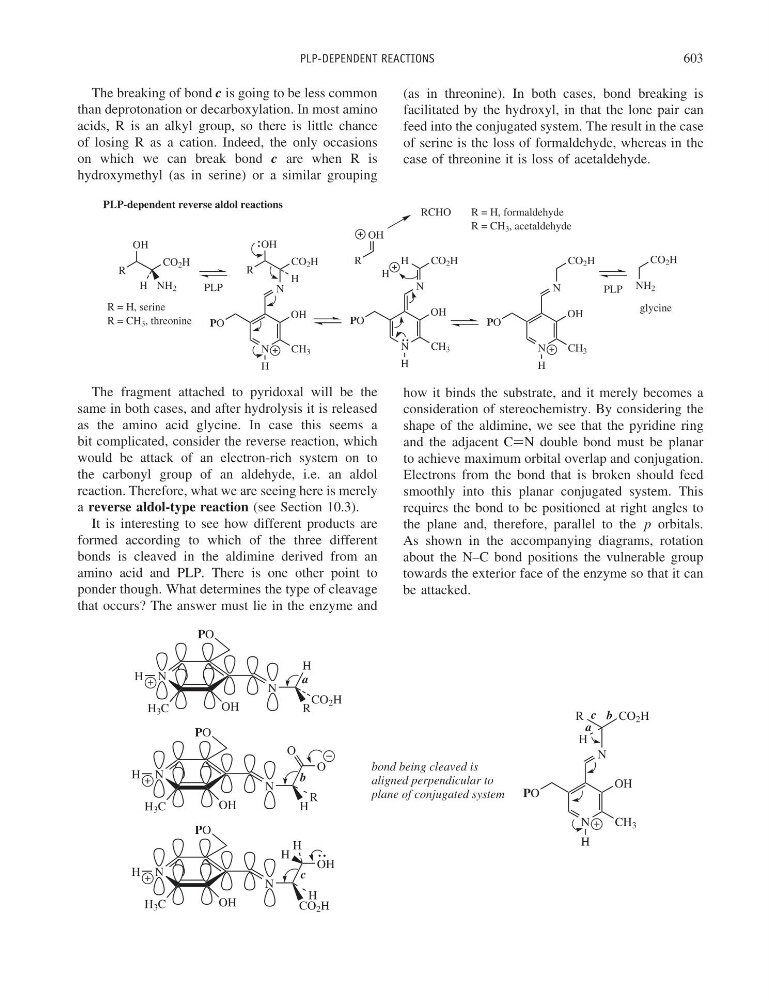
The breaking of bond c is going to be less common
than deprotonation or decarboxylation. In most amino
acids, R is an alkyl group, so there is little chance
of losing R as a cation. Indeed, the only occasions
on which we can break bond c are when R is
hydroxymethyl (as in serine) or a similar grouping
(as in threonine). In both cases, bond breaking is
facilitated by the hydroxyl, in that the lone pair can
feed into the conjugated system. The result in the case
of serine is the loss of formaldehyde, whereas in the
case of threonine it is loss of acetaldehyde.
N
OH
CH 3
PO
N
CO 2 H
H
N
OH
CH 3
PO
N
CO 2 H
H
H
N
OH
CH 3
PO
N
CO 2 H
H
CO 2 H
NH 2
H
PLP
CO 2 H
PLP
glycine
R
OH
R
OH
R = H, serine
R = CH 3 , threonine
H
OH
R
NH 2
RCHO
PLP-dependent reverse aldol reactions
R = H, formaldehyde
R = CH 3 , acetaldehyde
H
The fragment attached to pyridoxal will be the
same in both cases, and after hydrolysis it is released
as the amino acid glycine. In case this seems a
bit complicated, consider the reverse reaction, which
would be attack of an electron-rich system on to
the carbonyl group of an aldehyde, i.e. an aldol
reaction. Therefore, what we are seeing here is merely
a reverse aldol-type reaction (see Section 10.3).
It is interesting to see how different products are
formed according to which of the three different
bonds is cleaved in the aldimine derived from an
amino acid and PLP. There is one other point to
ponder though. What determines the type of cleavage
that occurs? The answer must lie in the enzyme and
how it binds the substrate, and it merely becomes a
consideration of stereochemistry. By considering the
shape of the aldimine, we see that the pyridine ring
and the adjacent C=N double bond must be planar
to achieve maximum orbital overlap and conjugation.
Electrons from the bond that is broken should feed
smoothly into this planar conjugated system. This
requires the bond to be positioned at right angles to
the plane and, therefore, parallel to the p orbitals.
As shown in the accompanying diagrams, rotation
about the N–C bond positions the vulnerable group
towards the exterior face of the enzyme so that it can
be attacked.
N
H
N
R
CO 2 H
H 3 C
OH
PO
H
a
H
R
O
O
b
CO 2 H
H
OH
H
H
c
N
H
N
H 3 C
OH
PO
N
H
N
H 3 C
OH
PO
bond being cleaved is
aligned perpendicular to
plane of conjugated system
N
OH
CH 3
PO
N
CO 2 H
R
H
H
a
b
c