

602
THE ORGANIC CHEMISTRY OF INTERMEDIARY METABOLISM
Box 15.3 (continued)
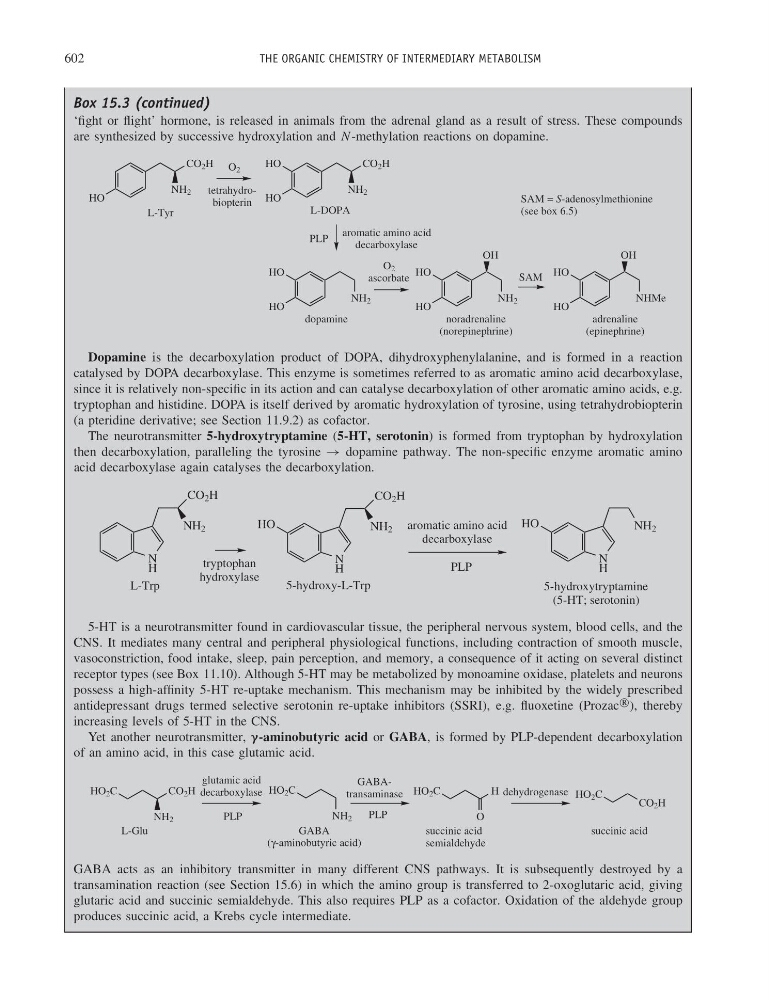
‘fight or flight’ hormone, is released in animals from the adrenal gland as a result of stress. These compounds
are synthesized by successive hydroxylation and N-methylation reactions on dopamine.
CO 2 H
HO
NH 2
CO 2 H
HO
NH 2
HO
HO
NH 2
HO
HO
NH 2
HO
HO
NHMe
HO
OH
OH
L-Tyr
L-DOPA
dopamine
adrenaline
(epinephrine)
noradrenaline
(norepinephrine)
PLP
tetrahydrobiopterin
O 2
ascorbate
O 2
aromatic amino acid
decarboxylase
SAM = S-adenosylmethionine
(see box 6.5)
SAM
Dopamine is the decarboxylation product of DOPA, dihydroxyphenylalanine, and is formed in a reaction
catalysed by DOPA decarboxylase. This enzyme is sometimes referred to as aromatic amino acid decarboxylase,
since it is relatively non-specific in its action and can catalyse decarboxylation of other aromatic amino acids, e.g.
tryptophan and histidine. DOPA is itself derived by aromatic hydroxylation of tyrosine, using tetrahydrobiopterin
(a pteridine derivative; see Section 11.9.2) as cofactor.
The neurotransmitter 5-hydroxytryptamine (5-HT, serotonin) is formed from tryptophan by hydroxylation
then decarboxylation, paralleling the tyrosine → dopamine pathway. The non-specific enzyme aromatic amino
acid decarboxylase again catalyses the decarboxylation.
N
H
CO 2 H
NH 2
N
H
CO 2 H
NH 2
HO
N
H
NH 2
HO
L-Trp
5-hydroxy-L-Trp
5-hydroxytryptamine
(5-HT; serotonin)
aromatic amino acid
decarboxylase
PLP
tryptophan
hydroxylase
5-HT is a neurotransmitter found in cardiovascular tissue, the peripheral nervous system, blood cells, and the
CNS. It mediates many central and peripheral physiological functions, including contraction of smooth muscle,
vasoconstriction, food intake, sleep, pain perception, and memory, a consequence of it acting on several distinct
receptor types (see Box 11.10). Although 5-HT may be metabolized by monoamine oxidase, platelets and neurons
possess a high-affinity 5-HT re-uptake mechanism. This mechanism may be inhibited by the widely prescribed
antidepressant drugs termed selective serotonin re-uptake inhibitors (SSRI), e.g. fluoxetine (Prozac ® ), thereby
increasing levels of 5-HT in the CNS.
Yet another neurotransmitter, γ-aminobutyric acid or GABA, is formed by PLP-dependent decarboxylation
of an amino acid, in this case glutamic acid.
HO 2 C
CO 2 H
NH 2
L-Glu
glutamic acid
decarboxylase
PLP
HO 2 C
NH 2
GABA
(γ-aminobutyric acid)
GABAtransaminase
PLP
HO 2 C
O
succinic acid
semialdehyde
HO 2 C
CO 2 H
succinic acid
dehydrogenase
H
GABA acts as an inhibitory transmitter in many different CNS pathways. It is subsequently destroyed by a
transamination reaction (see Section 15.6) in which the amino group is transferred to 2-oxoglutaric acid, giving
glutaric acid and succinic semialdehyde. This also requires PLP as a cofactor. Oxidation of the aldehyde group
produces succinic acid, a Krebs cycle intermediate.