

PLP-DEPENDENT REACTIONS
601
In transamination and racemization reactions, we
have seen loss of a proton from the aldimine, i.e.
breaking of bond a. Let us now consider the two
alternatives, namely the breaking of bonds b or
c, to explore further the scope for PLP-dependent
reactions.
N
OH
CH 3
PO
N
CO 2 H
R
H
H
a
b
c
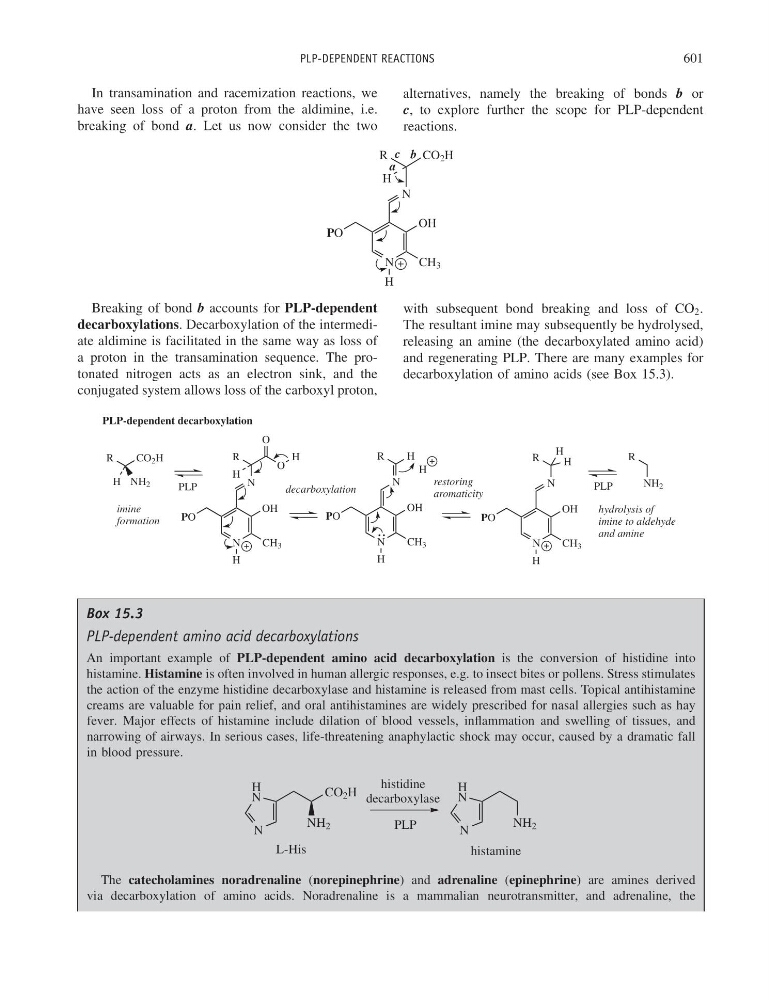
Breaking of bond b accounts for PLP-dependent
decarboxylations. Decarboxylation of the intermediate aldimine is facilitated in the same way as loss of
a proton in the transamination sequence. The protonated nitrogen acts as an electron sink, and the
conjugated system allows loss of the carboxyl proton,
with subsequent bond breaking and loss of CO 2 .
The resultant imine may subsequently be hydrolysed,
releasing an amine (the decarboxylated amino acid)
and regenerating PLP. There are many examples for
decarboxylation of amino acids (see Box 15.3).
R
CO 2 H
NH 2
H
N
OH
CH 3
PO
N
R
H
N
OH
CH 3
PO
N
H
R
H
N
OH
CH 3
PO
N
H
R
O
O
H
H
restoring
aromaticity
decarboxylation
hydrolysis of
imine to aldehyde
and amine
PLP
H
PLP
H
R
NH 2
imine
formation
PLP-dependent decarboxylation
H
Box 15.3
PLP-dependent amino acid decarboxylations
An important example of PLP-dependent amino acid decarboxylation is the conversion of histidine into
histamine. Histamine is often involved in human allergic responses, e.g. to insect bites or pollens. Stress stimulates
the action of the enzyme histidine decarboxylase and histamine is released from mast cells. Topical antihistamine
creams are valuable for pain relief, and oral antihistamines are widely prescribed for nasal allergies such as hay
fever. Major effects of histamine include dilation of blood vessels, inflammation and swelling of tissues, and
narrowing of airways. In serious cases, life-threatening anaphylactic shock may occur, caused by a dramatic fall
in blood pressure.
H
N
N
CO 2 H
NH 2
H
N
N
NH 2
L-His
histamine
histidine
decarboxylase
PLP
The catecholamines noradrenaline (norepinephrine) and adrenaline (epinephrine) are amines derived
via decarboxylation of amino acids. Noradrenaline is a mammalian neurotransmitter, and adrenaline, the