

600
THE ORGANIC CHEMISTRY OF INTERMEDIARY METABOLISM
may be readily available, to provide another amino
acid, which could be in short supply.
This has obvious advantages over the process seen
for glutamate synthesis via the reductive amination
of 2-oxoglutarate, in that it no longer requires
the intervention of free ammonia. We thus have
the situation that some organisms are able to carry
out the fixation of ammonia via reductive amination,
whereas others manipulate via transamination the
amino acid structures obtained from protein in
the diet.
15.7 PLP-dependent reactions
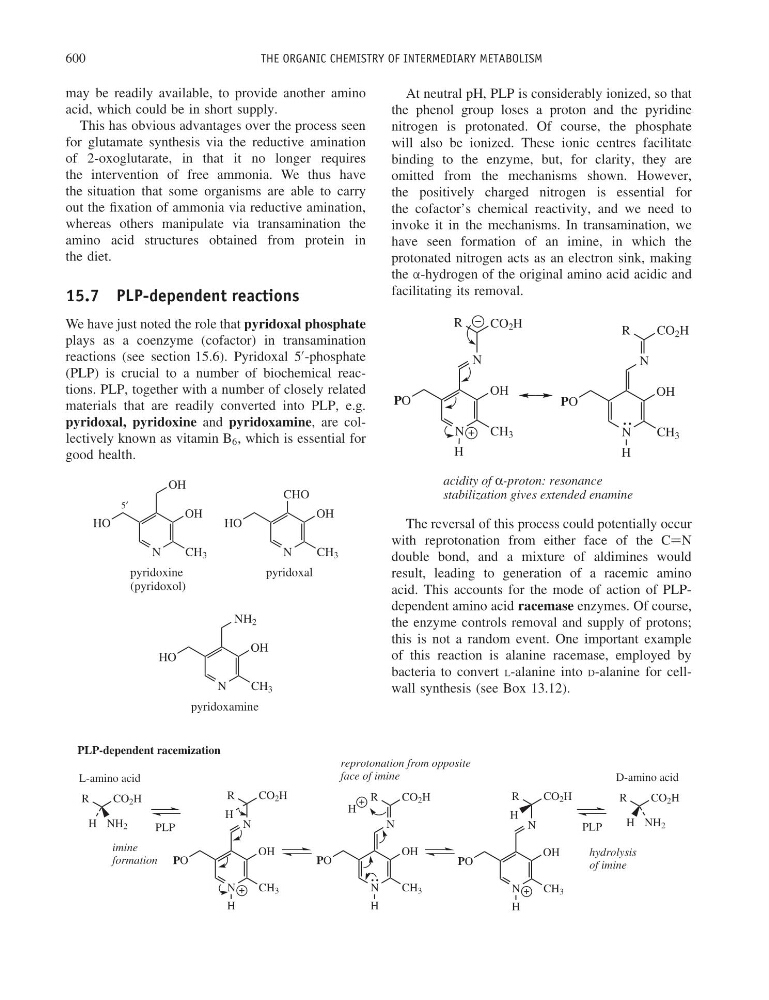
We have just noted the role that pyridoxal phosphate
plays as a coenzyme (cofactor) in transamination
reactions (see section 15.6). Pyridoxal 5
-phosphate
(PLP) is crucial to a number of biochemical reactions. PLP, together with a number of closely related
materials that are readily converted into PLP, e.g.
pyridoxal, pyridoxine and pyridoxamine, are collectively known as vitamin B 6 , which is essential for
good health.
N
OH
CH 3
HO
N
CHO
OH
CH 3
HO
N
OH
CH 3
HO
5′
pyridoxal
pyridoxamine
pyridoxine
(pyridoxol)
OH
NH 2
At neutral pH, PLP is considerably ionized, so that
the phenol group loses a proton and the pyridine
nitrogen is protonated. Of course, the phosphate
will also be ionized. These ionic centres facilitate
binding to the enzyme, but, for clarity, they are
omitted from the mechanisms shown. However,
the positively charged nitrogen is essential for
the cofactor’s chemical reactivity, and we need to
invoke it in the mechanisms. In transamination, we
have seen formation of an imine, in which the
protonated nitrogen acts as an electron sink, making
the α-hydrogen of the original amino acid acidic and
facilitating its removal.
N
OH
CH 3
PO
N
CO 2 H
R
H
N
OH
CH 3
PO
N
CO 2 H
R
H
acidity of α-proton: resonance
stabilization gives extended enamine
The reversal of this process could potentially occur
with reprotonation from either face of the C=N
double bond, and a mixture of aldimines would
result, leading to generation of a racemic amino
acid. This accounts for the mode of action of PLPdependent amino acid racemase enzymes. Of course,
the enzyme controls removal and supply of protons;
this is not a random event. One important example
of this reaction is alanine racemase, employed by
bacteria to convert L-alanine into D-alanine for cellwall synthesis (see Box 13.12).
N
OH
CH 3
PO
N
CO 2 H
R
H
H
N
OH
CH 3
PO
N
CO 2 H
R
H
N
OH
CH 3
PO
N
CO 2 H
R
H
H
L-amino acid
R
CO 2 H
NH 2
H
PLP
R
CO 2 H
NH 2
H
PLP
D-amino acid
reprotonation from opposite
face of imine
hydrolysis
of imine
imine
formation
PLP-dependent racemization
H