

AMINO ACIDS AND TRANSAMINATION
599
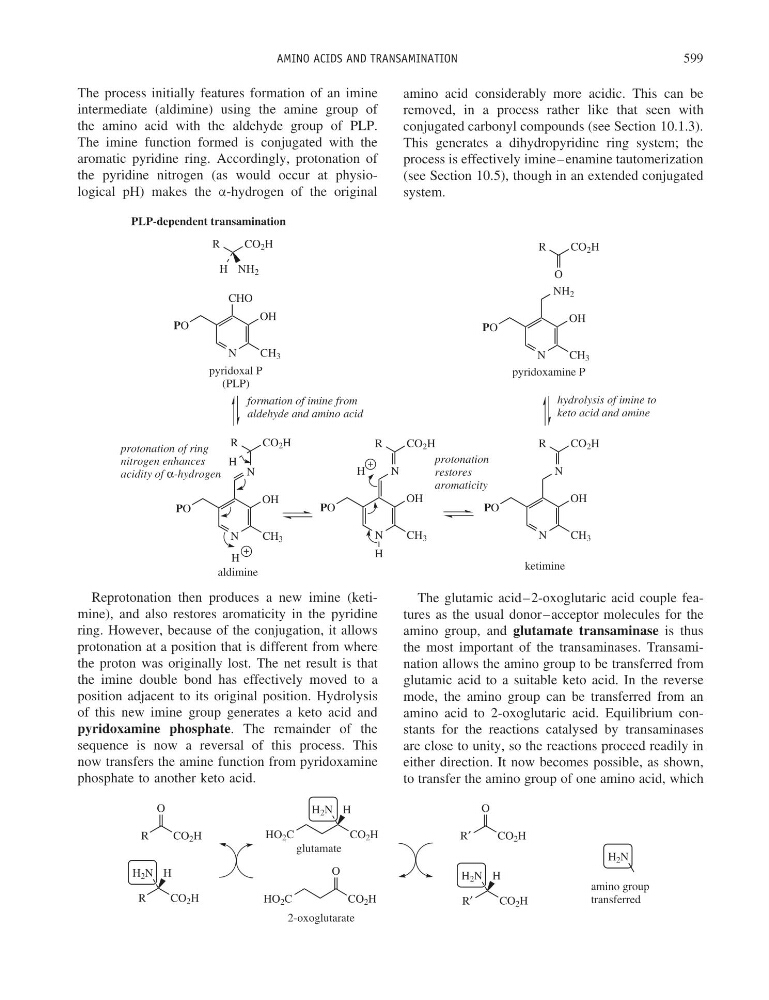
The process initially features formation of an imine
intermediate (aldimine) using the amine group of
the amino acid with the aldehyde group of PLP.
The imine function formed is conjugated with the
aromatic pyridine ring. Accordingly, protonation of
the pyridine nitrogen (as would occur at physiological pH) makes the α-hydrogen of the original
amino acid considerably more acidic. This can be
removed, in a process rather like that seen with
conjugated carbonyl compounds (see Section 10.1.3).
This generates a dihydropyridine ring system; the
process is effectively imine–enamine tautomerization
(see Section 10.5), though in an extended conjugated
system.
N
CHO
OH
CH 3
PO
R
CO 2 H
NH 2
H
N
OH
CH 3
PO
N
CO 2 H
R
H
N
OH
CH 3
PO
N
CO 2 H
R
H
N
OH
CH 3
PO
N
CO 2 H
R
N
OH
CH 3
PO
R
CO 2 H
O
NH 2
formation of imine from
aldehyde and amino acid
protonation of ring
nitrogen enhances
acidity of α-hydrogen
protonation
restores
aromaticity
hydrolysis of imine to
keto acid and amine
pyridoxal P
(PLP)
aldimine
ketimine
pyridoxamine P
PLP-dependent transamination
H
H
Reprotonation then produces a new imine (ketimine), and also restores aromaticity in the pyridine
ring. However, because of the conjugation, it allows
protonation at a position that is different from where
the proton was originally lost. The net result is that
the imine double bond has effectively moved to a
position adjacent to its original position. Hydrolysis
of this new imine group generates a keto acid and
pyridoxamine phosphate. The remainder of the
sequence is now a reversal of this process. This
now transfers the amine function from pyridoxamine
phosphate to another keto acid.
The glutamic acid–2-oxoglutaric acid couple features as the usual donor–acceptor molecules for the
amino group, and glutamate transaminase is thus
the most important of the transaminases. Transamination allows the amino group to be transferred from
glutamic acid to a suitable keto acid. In the reverse
mode, the amino group can be transferred from an
amino acid to 2-oxoglutaric acid. Equilibrium constants for the reactions catalysed by transaminases
are close to unity, so the reactions proceed readily in
either direction. It now becomes possible, as shown,
to transfer the amino group of one amino acid, which
glutamate
2-oxoglutarate
CO 2 H
HO 2 C
H 2 N H
CO 2 H
HO 2 C
O
O
R
CO 2 H
R
CO 2 H
H 2 N H
O
R′
CO 2 H
R′
CO 2 H
H 2 N H
H 2 N
amino group
transferred