

594
THE ORGANIC CHEMISTRY OF INTERMEDIARY METABOLISM
COSCoA
COSCoA
β-oxidation (3×)
COSCoA
isomerase
β-oxidation (2×)
COSCoA
E
Z
Z
E
Z
Z
hydratase
COSCoA
HO
R
COSCoA
R
COSCoA
R
COSCoA
H OH
R
COSCoA
O
S
acyl-CoA
dehydrogenase
enoyl-CoA
hydratase
β-hydroxyacyl-CoA
dehydrogenase
R
epimerase
COSCoA
HO
S
β-oxidation
stereochemistry of β-oxidation
linoleoyl-CoA
Z
Z
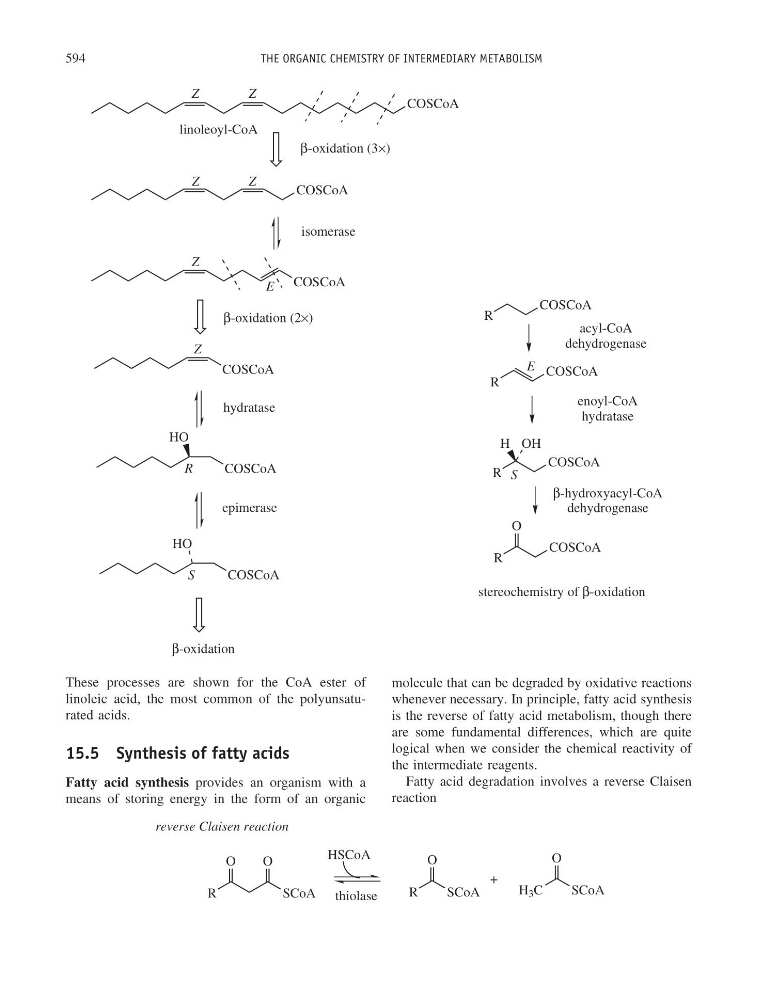
These processes are shown for the CoA ester of
linoleic acid, the most common of the polyunsaturated acids.
15.5 Synthesis of fatty acids
Fatty acid synthesis provides an organism with a
means of storing energy in the form of an organic
molecule that can be degraded by oxidative reactions
whenever necessary. In principle, fatty acid synthesis
is the reverse of fatty acid metabolism, though there
are some fundamental differences, which are quite
logical when we consider the chemical reactivity of
the intermediate reagents.
Fatty acid degradation involves a reverse Claisen
reaction
reverse Claisen reaction
thiolase
+
R
O
SCoA
O
R
SCoA
O
H 3 C
SCoA
O
HSCoA
THE ORGANIC CHEMISTRY OF INTERMEDIARY METABOLISM
COSCoA
COSCoA
β-oxidation (3×)
COSCoA
isomerase
β-oxidation (2×)
COSCoA
E
Z
Z
E
Z
Z
hydratase
COSCoA
HO
R
COSCoA
R
COSCoA
R
COSCoA
H OH
R
COSCoA
O
S
acyl-CoA
dehydrogenase
enoyl-CoA
hydratase
β-hydroxyacyl-CoA
dehydrogenase
R
epimerase
COSCoA
HO
S
β-oxidation
stereochemistry of β-oxidation
linoleoyl-CoA
Z
Z
These processes are shown for the CoA ester of
linoleic acid, the most common of the polyunsaturated acids.
15.5 Synthesis of fatty acids
Fatty acid synthesis provides an organism with a
means of storing energy in the form of an organic
molecule that can be degraded by oxidative reactions
whenever necessary. In principle, fatty acid synthesis
is the reverse of fatty acid metabolism, though there
are some fundamental differences, which are quite
logical when we consider the chemical reactivity of
the intermediate reagents.
Fatty acid degradation involves a reverse Claisen
reaction
reverse Claisen reaction
thiolase
+
R
O
SCoA
O
R
SCoA
O
H 3 C
SCoA
O
HSCoA