

OXIDATION OF FATTY ACIDS
593
(C 18 unsaturated), and only relatively small amounts
of saturated fatty acids. Animal fats have a much
higher proportion of saturated fatty acid derivatives,
but they still contain a substantial level of unsaturated
fatty acids. The fatty acid analysis of butterfat, for
example, shows it contains about 28% oleic acid,
and most of the remainder is composed of saturated
fatty acids: 13% stearic acid (C 18 ), 29% palmitic acid
(C 16 ), 12% myristic acid (C 14 ), and other shorterchain saturated fatty acids. The vast majority of
natural unsaturated fatty acids have one or more
double bonds with the Z or cis configuration.
CO 2 H
oleic acid
CO 2 H
stearic acid
Z
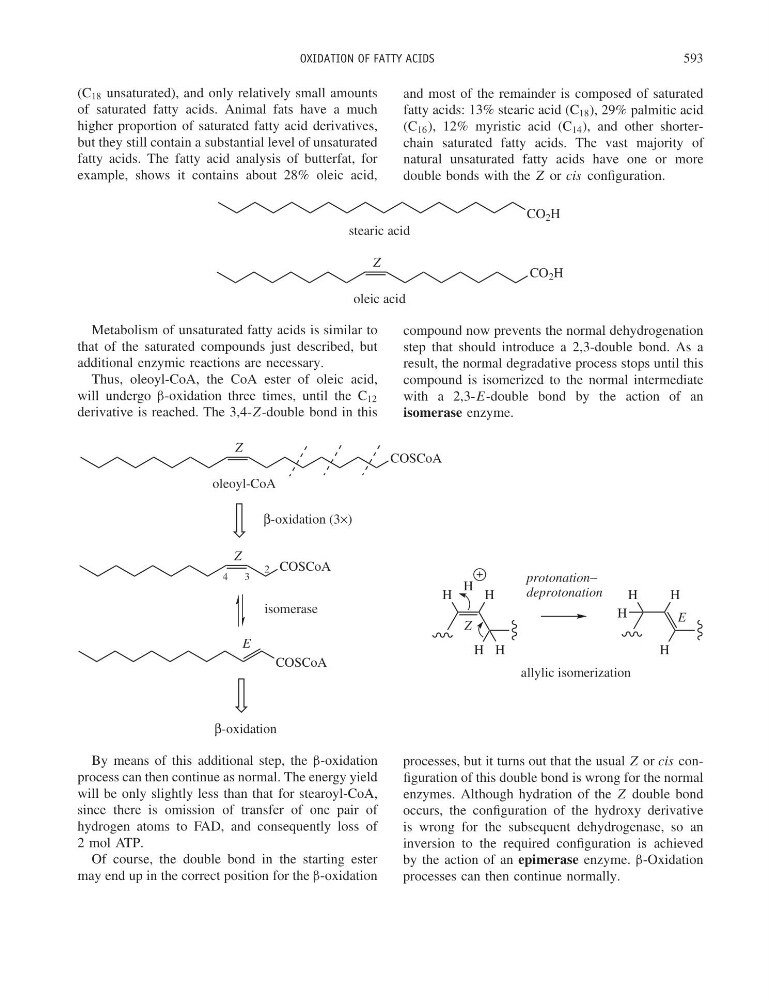
Metabolism of unsaturated fatty acids is similar to
that of the saturated compounds just described, but
additional enzymic reactions are necessary.
Thus, oleoyl-CoA, the CoA ester of oleic acid,
will undergo β-oxidation three times, until the C 12
derivative is reached. The 3,4-Z-double bond in this
compound now prevents the normal dehydrogenation
step that should introduce a 2,3-double bond. As a
result, the normal degradative process stops until this
compound is isomerized to the normal intermediate
with a 2,3-E-double bond by the action of an
isomerase enzyme.
β-oxidation (3×)
H
H
H H
H
protonation−
deprotonation
H
H
H
H
isomerase
E
E
Z
β-oxidation
allylic isomerization
COSCoA
oleoyl-CoA
Z
COSCoA
Z
COSCoA
2
3
4
By means of this additional step, the β-oxidation
process can then continue as normal. The energy yield
will be only slightly less than that for stearoyl-CoA,
since there is omission of transfer of one pair of
hydrogen atoms to FAD, and consequently loss of
2 mol ATP.
Of course, the double bond in the starting ester
may end up in the correct position for the β-oxidation
processes, but it turns out that the usual Z or cis configuration of this double bond is wrong for the normal
enzymes. Although hydration of the Z double bond
occurs, the configuration of the hydroxy derivative
is wrong for the subsequent dehydrogenase, so an
inversion to the required configuration is achieved
by the action of an epimerase enzyme. β-Oxidation
processes can then continue normally.
593
(C 18 unsaturated), and only relatively small amounts
of saturated fatty acids. Animal fats have a much
higher proportion of saturated fatty acid derivatives,
but they still contain a substantial level of unsaturated
fatty acids. The fatty acid analysis of butterfat, for
example, shows it contains about 28% oleic acid,
and most of the remainder is composed of saturated
fatty acids: 13% stearic acid (C 18 ), 29% palmitic acid
(C 16 ), 12% myristic acid (C 14 ), and other shorterchain saturated fatty acids. The vast majority of
natural unsaturated fatty acids have one or more
double bonds with the Z or cis configuration.
CO 2 H
oleic acid
CO 2 H
stearic acid
Z
Metabolism of unsaturated fatty acids is similar to
that of the saturated compounds just described, but
additional enzymic reactions are necessary.
Thus, oleoyl-CoA, the CoA ester of oleic acid,
will undergo β-oxidation three times, until the C 12
derivative is reached. The 3,4-Z-double bond in this
compound now prevents the normal dehydrogenation
step that should introduce a 2,3-double bond. As a
result, the normal degradative process stops until this
compound is isomerized to the normal intermediate
with a 2,3-E-double bond by the action of an
isomerase enzyme.
β-oxidation (3×)
H
H
H H
H
protonation−
deprotonation
H
H
H
H
isomerase
E
E
Z
β-oxidation
allylic isomerization
COSCoA
oleoyl-CoA
Z
COSCoA
Z
COSCoA
2
3
4
By means of this additional step, the β-oxidation
process can then continue as normal. The energy yield
will be only slightly less than that for stearoyl-CoA,
since there is omission of transfer of one pair of
hydrogen atoms to FAD, and consequently loss of
2 mol ATP.
Of course, the double bond in the starting ester
may end up in the correct position for the β-oxidation
processes, but it turns out that the usual Z or cis configuration of this double bond is wrong for the normal
enzymes. Although hydration of the Z double bond
occurs, the configuration of the hydroxy derivative
is wrong for the subsequent dehydrogenase, so an
inversion to the required configuration is achieved
by the action of an epimerase enzyme. β-Oxidation
processes can then continue normally.