

592
THE ORGANIC CHEMISTRY OF INTERMEDIARY METABOLISM
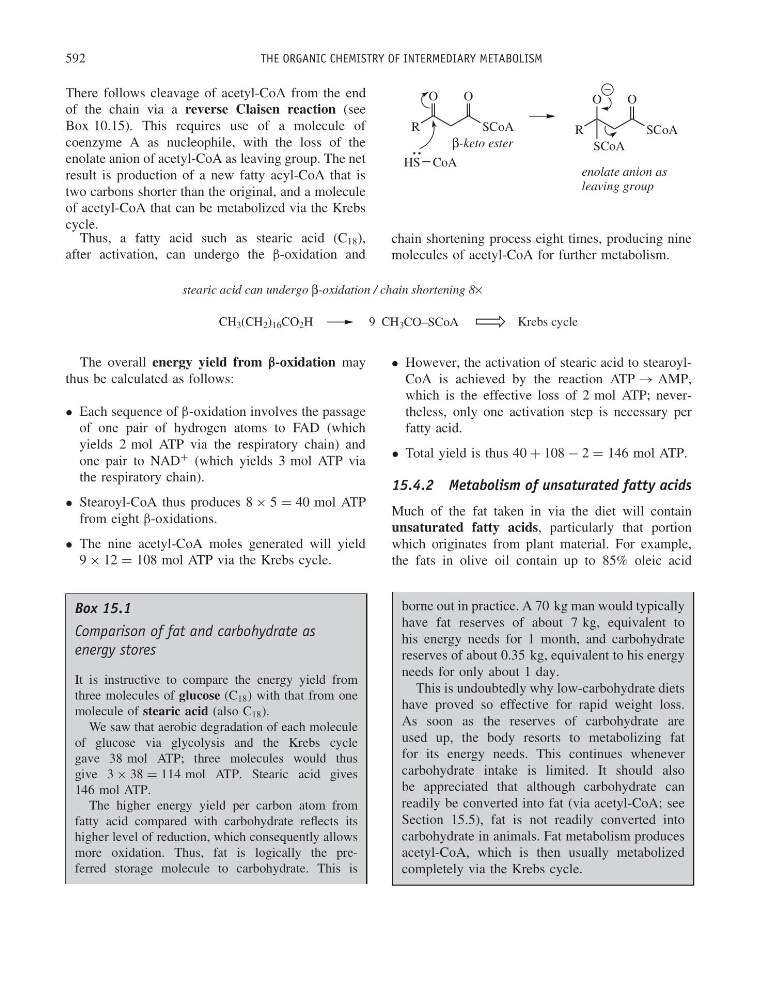
There follows cleavage of acetyl-CoA from the end
of the chain via a reverse Claisen reaction (see
Box 10.15). This requires use of a molecule of
coenzyme A as nucleophile, with the loss of the
enolate anion of acetyl-CoA as leaving group. The net
result is production of a new fatty acyl-CoA that is
two carbons shorter than the original, and a molecule
of acetyl-CoA that can be metabolized via the Krebs
cycle.
HS CoA
enolate anion as
leaving group
β-keto ester
R
O
SCoA
O
R
O
SCoA
O
SCoA
Thus, a fatty acid such as stearic acid (C 18 ),
after activation, can undergo the β-oxidation and
chain shortening process eight times, producing nine
molecules of acetyl-CoA for further metabolism.
stearic acid can undergo β-oxidation / chain shortening 8×
9 CH 3 CO–SCoA
Krebs cycle
CH 3 (CH 2 ) 16 CO 2 H
The overall energy yield from β-oxidation may
thus be calculated as follows:
• Each sequence of β-oxidation involves the passage
of one pair of hydrogen atoms to FAD (which
yields 2 mol ATP via the respiratory chain) and
one pair to NAD
+ (which yields 3 mol ATP via
the respiratory chain).
• Stearoyl-CoA thus produces 8 × 5 = 40 mol ATP
from eight β-oxidations.
• The nine acetyl-CoA moles generated will yield
9 × 12 = 108 mol ATP via the Krebs cycle.
• However, the activation of stearic acid to stearoylCoA is achieved by the reaction ATP → AMP,
which is the effective loss of 2 mol ATP; nevertheless, only one activation step is necessary per
fatty acid.
• Total yield is thus 40 + 108 − 2 = 146 mol ATP.
15.4.2 Metabolism of unsaturated fatty acids
Much of the fat taken in via the diet will contain
unsaturated fatty acids, particularly that portion
which originates from plant material. For example,
the fats in olive oil contain up to 85% oleic acid
Box 15.1
Comparison of fat and carbohydrate as
energy stores
It is instructive to compare the energy yield from
three molecules of glucose (C 18 ) with that from one
molecule of stearic acid (also C 18 ).
We saw that aerobic degradation of each molecule
of glucose via glycolysis and the Krebs cycle
gave 38 mol ATP; three molecules would thus
give 3 × 38 = 114 mol ATP. Stearic acid gives
146 mol ATP.
The higher energy yield per carbon atom from
fatty acid compared with carbohydrate reflects its
higher level of reduction, which consequently allows
more oxidation. Thus, fat is logically the preferred storage molecule to carbohydrate. This is
borne out in practice. A 70 kg man would typically
have fat reserves of about 7 kg, equivalent to
his energy needs for 1 month, and carbohydrate
reserves of about 0.35 kg, equivalent to his energy
needs for only about 1 day.
This is undoubtedly why low-carbohydrate diets
have proved so effective for rapid weight loss.
As soon as the reserves of carbohydrate are
used up, the body resorts to metabolizing fat
for its energy needs. This continues whenever
carbohydrate intake is limited. It should also
be appreciated that although carbohydrate can
readily be converted into fat (via acetyl-CoA; see
Section 15.5), fat is not readily converted into
carbohydrate in animals. Fat metabolism produces
acetyl-CoA, which is then usually metabolized
completely via the Krebs cycle.
THE ORGANIC CHEMISTRY OF INTERMEDIARY METABOLISM
There follows cleavage of acetyl-CoA from the end
of the chain via a reverse Claisen reaction (see
Box 10.15). This requires use of a molecule of
coenzyme A as nucleophile, with the loss of the
enolate anion of acetyl-CoA as leaving group. The net
result is production of a new fatty acyl-CoA that is
two carbons shorter than the original, and a molecule
of acetyl-CoA that can be metabolized via the Krebs
cycle.
HS CoA
enolate anion as
leaving group
β-keto ester
R
O
SCoA
O
R
O
SCoA
O
SCoA
Thus, a fatty acid such as stearic acid (C 18 ),
after activation, can undergo the β-oxidation and
chain shortening process eight times, producing nine
molecules of acetyl-CoA for further metabolism.
stearic acid can undergo β-oxidation / chain shortening 8×
9 CH 3 CO–SCoA
Krebs cycle
CH 3 (CH 2 ) 16 CO 2 H
The overall energy yield from β-oxidation may
thus be calculated as follows:
• Each sequence of β-oxidation involves the passage
of one pair of hydrogen atoms to FAD (which
yields 2 mol ATP via the respiratory chain) and
one pair to NAD
+ (which yields 3 mol ATP via
the respiratory chain).
• Stearoyl-CoA thus produces 8 × 5 = 40 mol ATP
from eight β-oxidations.
• The nine acetyl-CoA moles generated will yield
9 × 12 = 108 mol ATP via the Krebs cycle.
• However, the activation of stearic acid to stearoylCoA is achieved by the reaction ATP → AMP,
which is the effective loss of 2 mol ATP; nevertheless, only one activation step is necessary per
fatty acid.
• Total yield is thus 40 + 108 − 2 = 146 mol ATP.
15.4.2 Metabolism of unsaturated fatty acids
Much of the fat taken in via the diet will contain
unsaturated fatty acids, particularly that portion
which originates from plant material. For example,
the fats in olive oil contain up to 85% oleic acid
Box 15.1
Comparison of fat and carbohydrate as
energy stores
It is instructive to compare the energy yield from
three molecules of glucose (C 18 ) with that from one
molecule of stearic acid (also C 18 ).
We saw that aerobic degradation of each molecule
of glucose via glycolysis and the Krebs cycle
gave 38 mol ATP; three molecules would thus
give 3 × 38 = 114 mol ATP. Stearic acid gives
146 mol ATP.
The higher energy yield per carbon atom from
fatty acid compared with carbohydrate reflects its
higher level of reduction, which consequently allows
more oxidation. Thus, fat is logically the preferred storage molecule to carbohydrate. This is
borne out in practice. A 70 kg man would typically
have fat reserves of about 7 kg, equivalent to
his energy needs for 1 month, and carbohydrate
reserves of about 0.35 kg, equivalent to his energy
needs for only about 1 day.
This is undoubtedly why low-carbohydrate diets
have proved so effective for rapid weight loss.
As soon as the reserves of carbohydrate are
used up, the body resorts to metabolizing fat
for its energy needs. This continues whenever
carbohydrate intake is limited. It should also
be appreciated that although carbohydrate can
readily be converted into fat (via acetyl-CoA; see
Section 15.5), fat is not readily converted into
carbohydrate in animals. Fat metabolism produces
acetyl-CoA, which is then usually metabolized
completely via the Krebs cycle.