

OXIDATION OF FATTY ACIDS
591
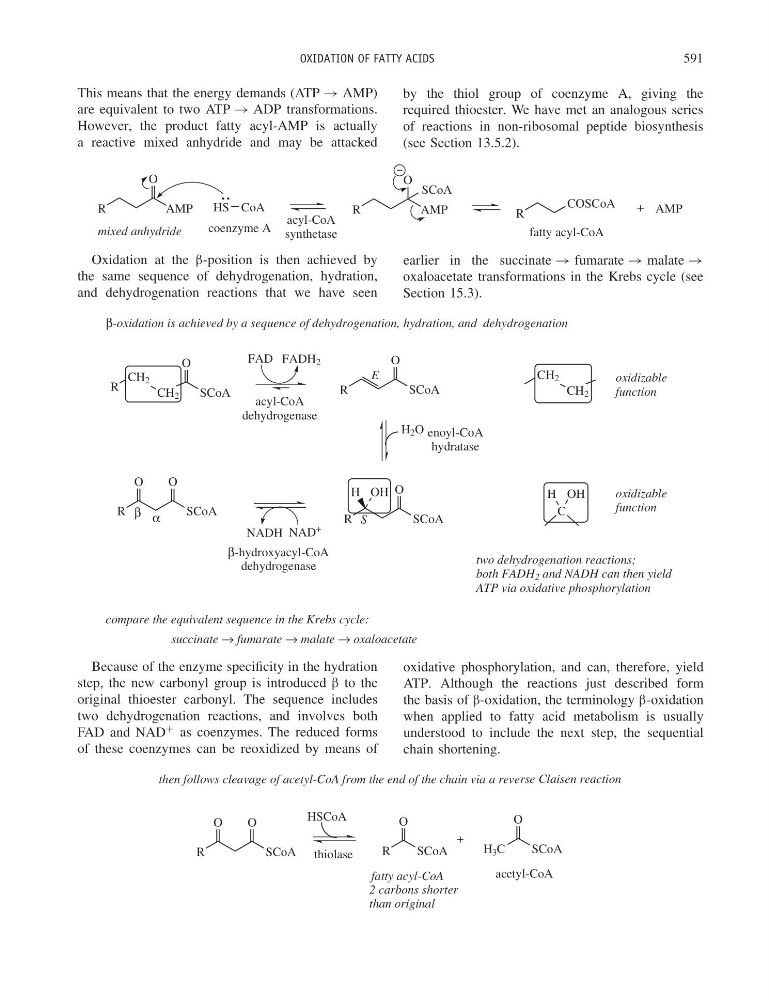
This means that the energy demands (ATP → AMP)
are equivalent to two ATP → ADP transformations.
However, the product fatty acyl-AMP is actually
a reactive mixed anhydride and may be attacked
by the thiol group of coenzyme A, giving the
required thioester. We have met an analogous series
of reactions in non-ribosomal peptide biosynthesis
(see Section 13.5.2).
R
AMP
O
HS CoA
coenzyme A
mixed anhydride
acyl-CoA
synthetase
R
AMP
O
SCoA
R
COSCoA
fatty acyl-CoA
+ AMP
Oxidation at the β-position is then achieved by
the same sequence of dehydrogenation, hydration,
and dehydrogenation reactions that we have seen
earlier in the succinate → fumarate → malate →
oxaloacetate transformations in the Krebs cycle (see
Section 15.3).
β-oxidation is achieved by a sequence of dehydrogenation, hydration, and dehydrogenation
enoyl-CoA
hydratase
α
β
two dehydrogenation reactions;
both FADH 2 and NADH can then yield
ATP via oxidative phosphorylation
compare the equivalent sequence in the Krebs cycle:
succinate → fumarate → malate → oxaloacetate
R
CH 2
CH 2
acyl-CoA
dehydrogenase
E
R
CH 2
CH 2
oxidizable
function
R
H OH
S
C
H OH
oxidizable
function
R
O
β-hydroxyacyl-CoA
dehydrogenase
O
SCoA
SCoA
O
SCoA
O
SCoA
O
H 2 O
FADH 2
FAD
NAD +
NADH
Because of the enzyme specificity in the hydration
step, the new carbonyl group is introduced β to the
original thioester carbonyl. The sequence includes
two dehydrogenation reactions, and involves both
FAD and NAD
+ as coenzymes. The reduced forms
of these coenzymes can be reoxidized by means of
oxidative phosphorylation, and can, therefore, yield
ATP. Although the reactions just described form
the basis of β-oxidation, the terminology β-oxidation
when applied to fatty acid metabolism is usually
understood to include the next step, the sequential
chain shortening.
rse Claisen reaction
then follows cleavage of acetyl-CoA from the end of the chain via a reve
thiolase
+
fatty acyl-CoA
acetyl-CoA
R
O
SCoA
O
R
SCoA
O
H 3 C
SCoA
O
HSCoA
2 carbons shorter
than original
591
This means that the energy demands (ATP → AMP)
are equivalent to two ATP → ADP transformations.
However, the product fatty acyl-AMP is actually
a reactive mixed anhydride and may be attacked
by the thiol group of coenzyme A, giving the
required thioester. We have met an analogous series
of reactions in non-ribosomal peptide biosynthesis
(see Section 13.5.2).
R
AMP
O
HS CoA
coenzyme A
mixed anhydride
acyl-CoA
synthetase
R
AMP
O
SCoA
R
COSCoA
fatty acyl-CoA
+ AMP
Oxidation at the β-position is then achieved by
the same sequence of dehydrogenation, hydration,
and dehydrogenation reactions that we have seen
earlier in the succinate → fumarate → malate →
oxaloacetate transformations in the Krebs cycle (see
Section 15.3).
β-oxidation is achieved by a sequence of dehydrogenation, hydration, and dehydrogenation
enoyl-CoA
hydratase
α
β
two dehydrogenation reactions;
both FADH 2 and NADH can then yield
ATP via oxidative phosphorylation
compare the equivalent sequence in the Krebs cycle:
succinate → fumarate → malate → oxaloacetate
R
CH 2
CH 2
acyl-CoA
dehydrogenase
E
R
CH 2
CH 2
oxidizable
function
R
H OH
S
C
H OH
oxidizable
function
R
O
β-hydroxyacyl-CoA
dehydrogenase
O
SCoA
SCoA
O
SCoA
O
SCoA
O
H 2 O
FADH 2
FAD
NAD +
NADH
Because of the enzyme specificity in the hydration
step, the new carbonyl group is introduced β to the
original thioester carbonyl. The sequence includes
two dehydrogenation reactions, and involves both
FAD and NAD
+ as coenzymes. The reduced forms
of these coenzymes can be reoxidized by means of
oxidative phosphorylation, and can, therefore, yield
ATP. Although the reactions just described form
the basis of β-oxidation, the terminology β-oxidation
when applied to fatty acid metabolism is usually
understood to include the next step, the sequential
chain shortening.
rse Claisen reaction
then follows cleavage of acetyl-CoA from the end of the chain via a reve
thiolase
+
fatty acyl-CoA
acetyl-CoA
R
O
SCoA
O
R
SCoA
O
H 3 C
SCoA
O
HSCoA
2 carbons shorter
than original