

590
THE ORGANIC CHEMISTRY OF INTERMEDIARY METABOLISM
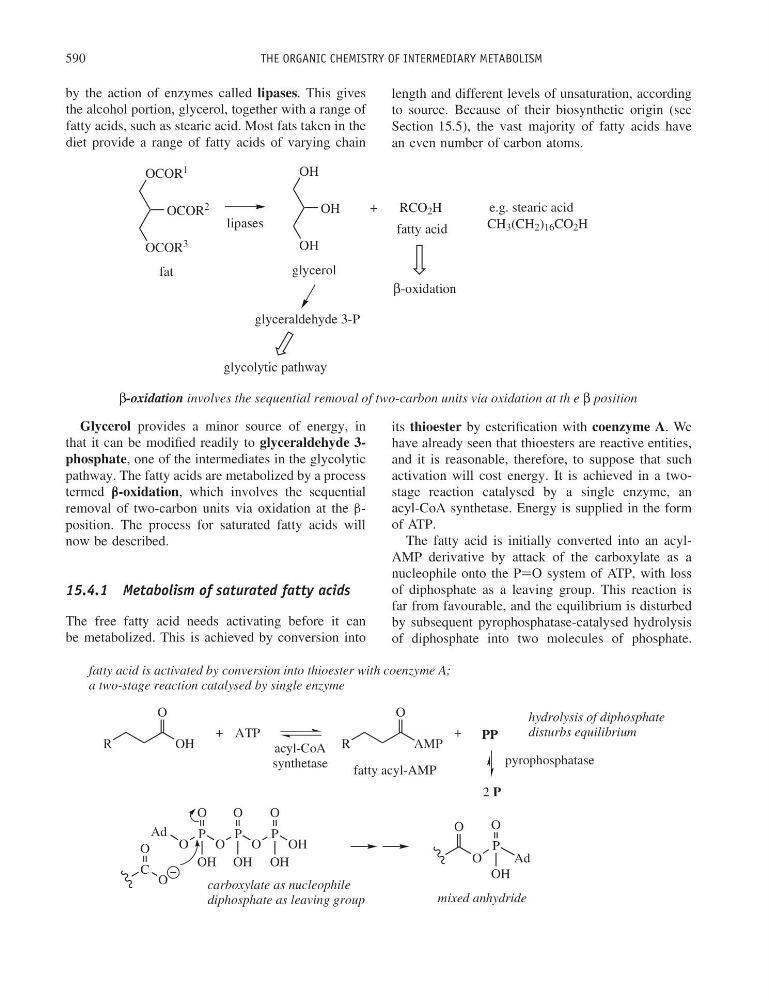
by the action of enzymes called lipases. This gives
the alcohol portion, glycerol, together with a range of
fatty acids, such as stearic acid. Most fats taken in the
diet provide a range of fatty acids of varying chain
length and different levels of unsaturation, according
to source. Because of their biosynthetic origin (see
Section 15.5), the vast majority of fatty acids have
an even number of carbon atoms.
lipases
glycerol
+
glyceraldehyde 3-P
glycolytic pathway
fatty acid
β-oxidation
β-oxidation involves the sequential removal of two-carbon units via oxidation at th e β position
e.g. stearic acid
OCOR 2
OCOR 1
OCOR 3
OH
OH
OH
fat
RCO 2 H
CH 3 (CH 2 ) 16 CO 2 H
Glycerol provides a minor source of energy, in
that it can be modified readily to glyceraldehyde 3phosphate, one of the intermediates in the glycolytic
pathway. The fatty acids are metabolized by a process
termed β-oxidation, which involves the sequential
removal of two-carbon units via oxidation at the βposition. The process for saturated fatty acids will
now be described.
15.4.1 Metabolism of saturated fatty acids
The free fatty acid needs activating before it can
be metabolized. This is achieved by conversion into
its thioester by esterification with coenzyme A. We
have already seen that thioesters are reactive entities,
and it is reasonable, therefore, to suppose that such
activation will cost energy. It is achieved in a twostage reaction catalysed by a single enzyme, an
acyl-CoA synthetase. Energy is supplied in the form
of ATP.
The fatty acid is initially converted into an acylAMP derivative by attack of the carboxylate as a
nucleophile onto the P=O system of ATP, with loss
of diphosphate as a leaving group. This reaction is
far from favourable, and the equilibrium is disturbed
by subsequent pyrophosphatase-catalysed hydrolysis
of diphosphate into two molecules of phosphate.
fatty acid is activated by conversion into thioester with coenzyme A;
a two-stage reaction catalysed by single enzyme
C
O
O
ATP
+
+
acyl-CoA
synthetase
pyrophosphatase
hydrolysis of diphosphate
disturbs equilibrium
carboxylate as nucleophile
diphosphate as leaving group
R
R
AMP
O
OH
O
PP
O
O
P
O
OH
Ad
mixed anhydride
fatty acyl-AMP
O
P
OH
O
P
O
O
OH
OH
P
O
O
OH
Ad
2 P
THE ORGANIC CHEMISTRY OF INTERMEDIARY METABOLISM
by the action of enzymes called lipases. This gives
the alcohol portion, glycerol, together with a range of
fatty acids, such as stearic acid. Most fats taken in the
diet provide a range of fatty acids of varying chain
length and different levels of unsaturation, according
to source. Because of their biosynthetic origin (see
Section 15.5), the vast majority of fatty acids have
an even number of carbon atoms.
lipases
glycerol
+
glyceraldehyde 3-P
glycolytic pathway
fatty acid
β-oxidation
β-oxidation involves the sequential removal of two-carbon units via oxidation at th e β position
e.g. stearic acid
OCOR 2
OCOR 1
OCOR 3
OH
OH
OH
fat
RCO 2 H
CH 3 (CH 2 ) 16 CO 2 H
Glycerol provides a minor source of energy, in
that it can be modified readily to glyceraldehyde 3phosphate, one of the intermediates in the glycolytic
pathway. The fatty acids are metabolized by a process
termed β-oxidation, which involves the sequential
removal of two-carbon units via oxidation at the βposition. The process for saturated fatty acids will
now be described.
15.4.1 Metabolism of saturated fatty acids
The free fatty acid needs activating before it can
be metabolized. This is achieved by conversion into
its thioester by esterification with coenzyme A. We
have already seen that thioesters are reactive entities,
and it is reasonable, therefore, to suppose that such
activation will cost energy. It is achieved in a twostage reaction catalysed by a single enzyme, an
acyl-CoA synthetase. Energy is supplied in the form
of ATP.
The fatty acid is initially converted into an acylAMP derivative by attack of the carboxylate as a
nucleophile onto the P=O system of ATP, with loss
of diphosphate as a leaving group. This reaction is
far from favourable, and the equilibrium is disturbed
by subsequent pyrophosphatase-catalysed hydrolysis
of diphosphate into two molecules of phosphate.
fatty acid is activated by conversion into thioester with coenzyme A;
a two-stage reaction catalysed by single enzyme
C
O
O
ATP
+
+
acyl-CoA
synthetase
pyrophosphatase
hydrolysis of diphosphate
disturbs equilibrium
carboxylate as nucleophile
diphosphate as leaving group
R
R
AMP
O
OH
O
PP
O
O
P
O
OH
Ad
mixed anhydride
fatty acyl-AMP
O
P
OH
O
P
O
O
OH
OH
P
O
O
OH
Ad
2 P