

OXIDATION OF FATTY ACIDS
589
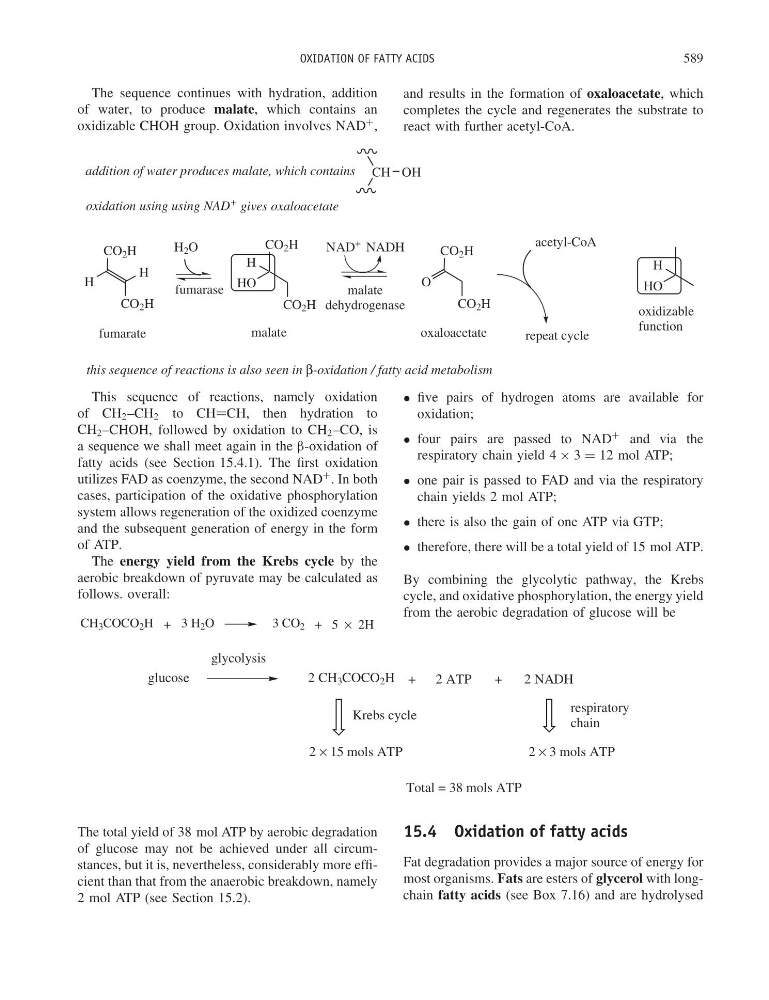
The sequence continues with hydration, addition
of water, to produce malate, which contains an
oxidizable CHOH group. Oxidation involves NAD
+ ,
and results in the formation of oxaloacetate, which
completes the cycle and regenerates the substrate to
react with further acetyl-CoA.
fumarate
fumarase
malate
malate
dehydrogenase
oxaloacetate
addition of water produces malate, which contains
oxidation using using NAD + gives oxaloacetate
acetyl-CoA
repeat cycle
this sequence of reactions is also seen in β-oxidation / fatty acid metabolism
H
CO 2 H
CO 2 H
H
CO 2 H
CO 2 H
HO
H
CO 2 H
CO 2 H
O
CH OH
HO
H
oxidizable
function
H 2 O
NAD
+ NADH
This sequence of reactions, namely oxidation
of CH 2 –CH 2 to CH=CH, then hydration to
CH 2 –CHOH, followed by oxidation to CH 2 –CO, is
a sequence we shall meet again in the β-oxidation of
fatty acids (see Section 15.4.1). The first oxidation
utilizes FAD as coenzyme, the second NAD
+ . In both
cases, participation of the oxidative phosphorylation
system allows regeneration of the oxidized coenzyme
and the subsequent generation of energy in the form
of ATP.
The energy yield from the Krebs cycle by the
aerobic breakdown of pyruvate may be calculated as
follows. overall:
CH 3 COCO 2 H
5 × 2H
+
+
3 H 2 O
3 CO 2
• five pairs of hydrogen atoms are available for
oxidation;
• four pairs are passed to NAD
+ and via the
respiratory chain yield 4 × 3 = 12 mol ATP;
• one pair is passed to FAD and via the respiratory
chain yields 2 mol ATP;
• there is also the gain of one ATP via GTP;
• therefore, there will be a total yield of 15 mol ATP.
By combining the glycolytic pathway, the Krebs
cycle, and oxidative phosphorylation, the energy yield
from the aerobic degradation of glucose will be
glycolysis
glucose
2 CH 3 COCO 2 H
2 ATP
+
+
Krebs cycle
respiratory
chain
2 × 15 mols ATP
2 × 3 mols ATP
Total = 38 mols ATP
2 NADH
The total yield of 38 mol ATP by aerobic degradation
of glucose may not be achieved under all circumstances, but it is, nevertheless, considerably more efficient than that from the anaerobic breakdown, namely
2 mol ATP (see Section 15.2).
15.4 Oxidation of fatty acids
Fat degradation provides a major source of energy for
most organisms. Fats are esters of glycerol with longchain fatty acids (see Box 7.16) and are hydrolysed
589
The sequence continues with hydration, addition
of water, to produce malate, which contains an
oxidizable CHOH group. Oxidation involves NAD
+ ,
and results in the formation of oxaloacetate, which
completes the cycle and regenerates the substrate to
react with further acetyl-CoA.
fumarate
fumarase
malate
malate
dehydrogenase
oxaloacetate
addition of water produces malate, which contains
oxidation using using NAD + gives oxaloacetate
acetyl-CoA
repeat cycle
this sequence of reactions is also seen in β-oxidation / fatty acid metabolism
H
CO 2 H
CO 2 H
H
CO 2 H
CO 2 H
HO
H
CO 2 H
CO 2 H
O
CH OH
HO
H
oxidizable
function
H 2 O
NAD
+ NADH
This sequence of reactions, namely oxidation
of CH 2 –CH 2 to CH=CH, then hydration to
CH 2 –CHOH, followed by oxidation to CH 2 –CO, is
a sequence we shall meet again in the β-oxidation of
fatty acids (see Section 15.4.1). The first oxidation
utilizes FAD as coenzyme, the second NAD
+ . In both
cases, participation of the oxidative phosphorylation
system allows regeneration of the oxidized coenzyme
and the subsequent generation of energy in the form
of ATP.
The energy yield from the Krebs cycle by the
aerobic breakdown of pyruvate may be calculated as
follows. overall:
CH 3 COCO 2 H
5 × 2H
+
+
3 H 2 O
3 CO 2
• five pairs of hydrogen atoms are available for
oxidation;
• four pairs are passed to NAD
+ and via the
respiratory chain yield 4 × 3 = 12 mol ATP;
• one pair is passed to FAD and via the respiratory
chain yields 2 mol ATP;
• there is also the gain of one ATP via GTP;
• therefore, there will be a total yield of 15 mol ATP.
By combining the glycolytic pathway, the Krebs
cycle, and oxidative phosphorylation, the energy yield
from the aerobic degradation of glucose will be
glycolysis
glucose
2 CH 3 COCO 2 H
2 ATP
+
+
Krebs cycle
respiratory
chain
2 × 15 mols ATP
2 × 3 mols ATP
Total = 38 mols ATP
2 NADH
The total yield of 38 mol ATP by aerobic degradation
of glucose may not be achieved under all circumstances, but it is, nevertheless, considerably more efficient than that from the anaerobic breakdown, namely
2 mol ATP (see Section 15.2).
15.4 Oxidation of fatty acids
Fat degradation provides a major source of energy for
most organisms. Fats are esters of glycerol with longchain fatty acids (see Box 7.16) and are hydrolysed