

588
THE ORGANIC CHEMISTRY OF INTERMEDIARY METABOLISM
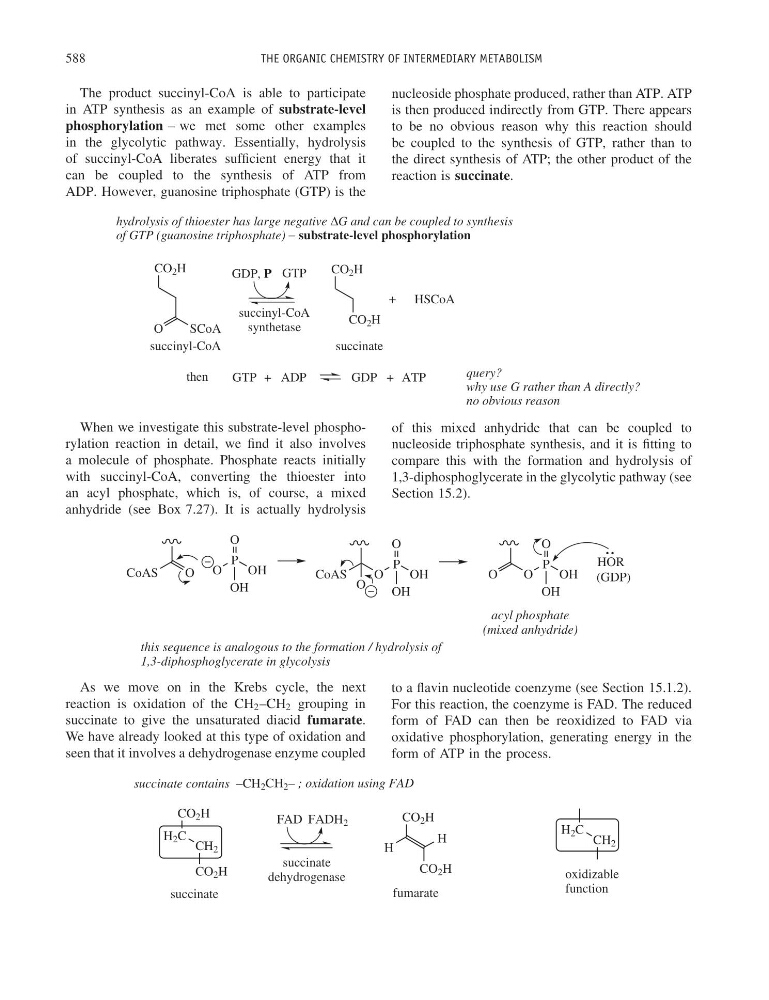
The product succinyl-CoA is able to participate
in ATP synthesis as an example of substrate-level
phosphorylation – we met some other examples
in the glycolytic pathway. Essentially, hydrolysis
of succinyl-CoA liberates sufficient energy that it
can be coupled to the synthesis of ATP from
ADP. However, guanosine triphosphate (GTP) is the
nucleoside phosphate produced, rather than ATP. ATP
is then produced indirectly from GTP. There appears
to be no obvious reason why this reaction should
be coupled to the synthesis of GTP, rather than to
the direct synthesis of ATP; the other product of the
reaction is succinate.
succinyl-CoA
GDP, P
hydrolysis of thioester has large negative ΔG and can be coupled to synthesis
of GTP (guanosine triphosphate) − substrate-level phosphorylation
GTP
succinate
succinyl-CoA
synthetase
then
GTP
+
GDP +
query?
why use G rather than A directly?
no obvious reason
+ ADP
ATP
SCoA
CO 2 H
O
CO 2 H
CO 2 H
HSCoA
When we investigate this substrate-level phosphorylation reaction in detail, we find it also involves
a molecule of phosphate. Phosphate reacts initially
with succinyl-CoA, converting the thioester into
an acyl phosphate, which is, of course, a mixed
anhydride (see Box 7.27). It is actually hydrolysis
of this mixed anhydride that can be coupled to
nucleoside triphosphate synthesis, and it is fitting to
compare this with the formation and hydrolysis of
1,3-diphosphoglycerate in the glycolytic pathway (see
Section 15.2).
CoAS
O
CoAS
O
acyl phosphate
(mixed anhydride)
this sequence is analogous to the formation / hydrolysis of
1,3-diphosphoglycerate in glycolysis
(GDP)
O
P
O
OH
OH
O
P
O
OH
OH
O
O
P
O
OH
OH
HOR
As we move on in the Krebs cycle, the next
reaction is oxidation of the CH 2 –CH 2 grouping in
succinate to give the unsaturated diacid fumarate.
We have already looked at this type of oxidation and
seen that it involves a dehydrogenase enzyme coupled
to a flavin nucleotide coenzyme (see Section 15.1.2).
For this reaction, the coenzyme is FAD. The reduced
form of FAD can then be reoxidized to FAD via
oxidative phosphorylation, generating energy in the
form of ATP in the process.
H
CO 2 H
CO 2 H
H
succinate
succinate contains –CH 2 CH 2 – ; oxidation using FAD
fumarate
succinate
dehydrogenase
CH 2
CO 2 H
H 2 C
CO 2 H
CH 2
H 2 C
oxidizable
function
FAD FADH 2
THE ORGANIC CHEMISTRY OF INTERMEDIARY METABOLISM
The product succinyl-CoA is able to participate
in ATP synthesis as an example of substrate-level
phosphorylation – we met some other examples
in the glycolytic pathway. Essentially, hydrolysis
of succinyl-CoA liberates sufficient energy that it
can be coupled to the synthesis of ATP from
ADP. However, guanosine triphosphate (GTP) is the
nucleoside phosphate produced, rather than ATP. ATP
is then produced indirectly from GTP. There appears
to be no obvious reason why this reaction should
be coupled to the synthesis of GTP, rather than to
the direct synthesis of ATP; the other product of the
reaction is succinate.
succinyl-CoA
GDP, P
hydrolysis of thioester has large negative ΔG and can be coupled to synthesis
of GTP (guanosine triphosphate) − substrate-level phosphorylation
GTP
succinate
succinyl-CoA
synthetase
then
GTP
+
GDP +
query?
why use G rather than A directly?
no obvious reason
+ ADP
ATP
SCoA
CO 2 H
O
CO 2 H
CO 2 H
HSCoA
When we investigate this substrate-level phosphorylation reaction in detail, we find it also involves
a molecule of phosphate. Phosphate reacts initially
with succinyl-CoA, converting the thioester into
an acyl phosphate, which is, of course, a mixed
anhydride (see Box 7.27). It is actually hydrolysis
of this mixed anhydride that can be coupled to
nucleoside triphosphate synthesis, and it is fitting to
compare this with the formation and hydrolysis of
1,3-diphosphoglycerate in the glycolytic pathway (see
Section 15.2).
CoAS
O
CoAS
O
acyl phosphate
(mixed anhydride)
this sequence is analogous to the formation / hydrolysis of
1,3-diphosphoglycerate in glycolysis
(GDP)
O
P
O
OH
OH
O
P
O
OH
OH
O
O
P
O
OH
OH
HOR
As we move on in the Krebs cycle, the next
reaction is oxidation of the CH 2 –CH 2 grouping in
succinate to give the unsaturated diacid fumarate.
We have already looked at this type of oxidation and
seen that it involves a dehydrogenase enzyme coupled
to a flavin nucleotide coenzyme (see Section 15.1.2).
For this reaction, the coenzyme is FAD. The reduced
form of FAD can then be reoxidized to FAD via
oxidative phosphorylation, generating energy in the
form of ATP in the process.
H
CO 2 H
CO 2 H
H
succinate
succinate contains –CH 2 CH 2 – ; oxidation using FAD
fumarate
succinate
dehydrogenase
CH 2
CO 2 H
H 2 C
CO 2 H
CH 2
H 2 C
oxidizable
function
FAD FADH 2