

THE KREBS CYCLE
587
decarboxylates through an intramolecular hydrogenbonded system (see Section 10.9). Although thermal
(non-enzymic) decarboxylation would probably occur
readily, it turns out that the enzyme isocitrate
dehydrogenase also catalyses this reaction.
isocitrate
available for oxidation using NAD +
isocitrate has
isocitrate
dehydrogenase
oxalosuccinate
β-keto acid
2-oxoglutarate
(α-oxoglutarate,
α-ketoglutarate)
isocitrate
dehydrogenase
O
H
O
O
β-keto acids readily decarboxylate via
intramolecular H-bonded system
loss of first carbon
CH OH
CO 2 H
CO 2 H
CO 2 H
HO
H
CO 2 H
CO 2 H
CO 2 H
O
CO 2 H
CO 2 H
O
NAD
+ NADH
CO 2
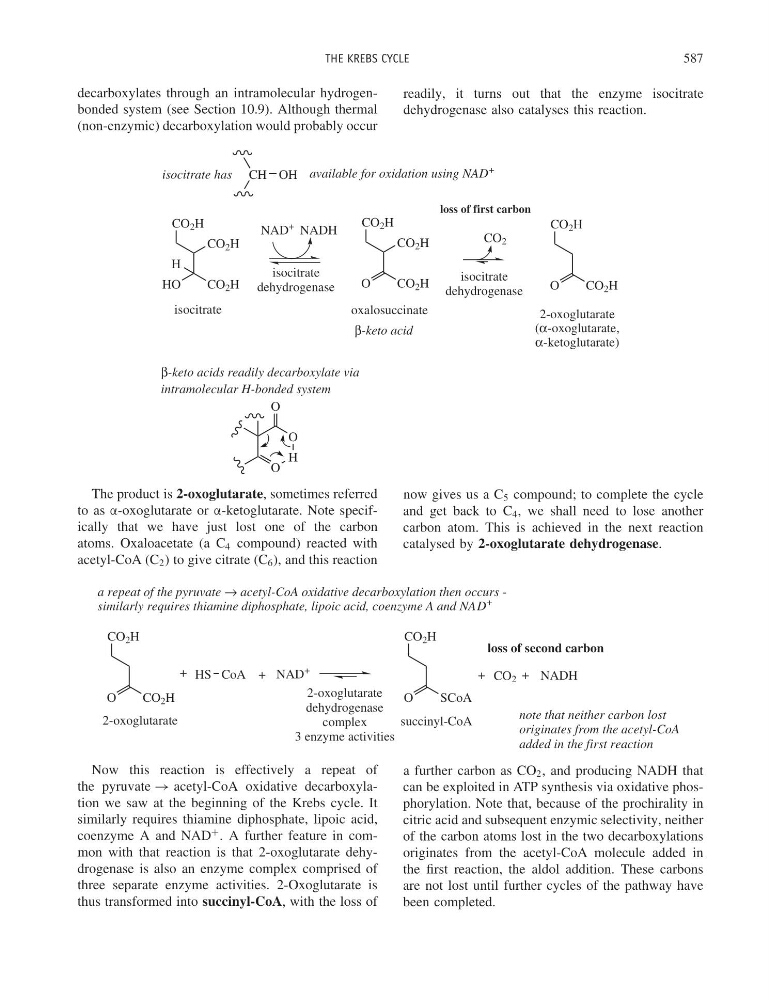
The product is 2-oxoglutarate, sometimes referred
to as α-oxoglutarate or α-ketoglutarate. Note specifically that we have just lost one of the carbon
atoms. Oxaloacetate (a C 4 compound) reacted with
acetyl-CoA (C 2 ) to give citrate (C 6 ), and this reaction
now gives us a C 5 compound; to complete the cycle
and get back to C 4 , we shall need to lose another
carbon atom. This is achieved in the next reaction
catalysed by 2-oxoglutarate dehydrogenase.
2-oxoglutarate
HS CoA
+
a repeat of the pyruvate → acetyl-CoA oxidative decarboxylation then occurs -
similarly requires thiamine diphosphate, lipoic acid, coenzyme A and NAD
+
+
+
+
2-oxoglutarate
dehydrogenase
complex
3 enzyme activities
succinyl-CoA
note that neither carbon lost
originates from the acetyl-CoA
added in the first reaction
CO 2 H
CO 2 H
O
SCoA
CO 2 H
O
loss of second carbon
NAD
+
CO 2
NADH
Now this reaction is effectively a repeat of
the pyruvate → acetyl-CoA oxidative decarboxylation we saw at the beginning of the Krebs cycle. It
similarly requires thiamine diphosphate, lipoic acid,
coenzyme A and NAD
+ . A further feature in common with that reaction is that 2-oxoglutarate dehydrogenase is also an enzyme complex comprised of
three separate enzyme activities. 2-Oxoglutarate is
thus transformed into succinyl-CoA, with the loss of
a further carbon as CO 2 , and producing NADH that
can be exploited in ATP synthesis via oxidative phosphorylation. Note that, because of the prochirality in
citric acid and subsequent enzymic selectivity, neither
of the carbon atoms lost in the two decarboxylations
originates from the acetyl-CoA molecule added in
the first reaction, the aldol addition. These carbons
are not lost until further cycles of the pathway have
been completed.
587
decarboxylates through an intramolecular hydrogenbonded system (see Section 10.9). Although thermal
(non-enzymic) decarboxylation would probably occur
readily, it turns out that the enzyme isocitrate
dehydrogenase also catalyses this reaction.
isocitrate
available for oxidation using NAD +
isocitrate has
isocitrate
dehydrogenase
oxalosuccinate
β-keto acid
2-oxoglutarate
(α-oxoglutarate,
α-ketoglutarate)
isocitrate
dehydrogenase
O
H
O
O
β-keto acids readily decarboxylate via
intramolecular H-bonded system
loss of first carbon
CH OH
CO 2 H
CO 2 H
CO 2 H
HO
H
CO 2 H
CO 2 H
CO 2 H
O
CO 2 H
CO 2 H
O
NAD
+ NADH
CO 2
The product is 2-oxoglutarate, sometimes referred
to as α-oxoglutarate or α-ketoglutarate. Note specifically that we have just lost one of the carbon
atoms. Oxaloacetate (a C 4 compound) reacted with
acetyl-CoA (C 2 ) to give citrate (C 6 ), and this reaction
now gives us a C 5 compound; to complete the cycle
and get back to C 4 , we shall need to lose another
carbon atom. This is achieved in the next reaction
catalysed by 2-oxoglutarate dehydrogenase.
2-oxoglutarate
HS CoA
+
a repeat of the pyruvate → acetyl-CoA oxidative decarboxylation then occurs -
similarly requires thiamine diphosphate, lipoic acid, coenzyme A and NAD
+
+
+
+
2-oxoglutarate
dehydrogenase
complex
3 enzyme activities
succinyl-CoA
note that neither carbon lost
originates from the acetyl-CoA
added in the first reaction
CO 2 H
CO 2 H
O
SCoA
CO 2 H
O
loss of second carbon
NAD
+
CO 2
NADH
Now this reaction is effectively a repeat of
the pyruvate → acetyl-CoA oxidative decarboxylation we saw at the beginning of the Krebs cycle. It
similarly requires thiamine diphosphate, lipoic acid,
coenzyme A and NAD
+ . A further feature in common with that reaction is that 2-oxoglutarate dehydrogenase is also an enzyme complex comprised of
three separate enzyme activities. 2-Oxoglutarate is
thus transformed into succinyl-CoA, with the loss of
a further carbon as CO 2 , and producing NADH that
can be exploited in ATP synthesis via oxidative phosphorylation. Note that, because of the prochirality in
citric acid and subsequent enzymic selectivity, neither
of the carbon atoms lost in the two decarboxylations
originates from the acetyl-CoA molecule added in
the first reaction, the aldol addition. These carbons
are not lost until further cycles of the pathway have
been completed.