

586
THE ORGANIC CHEMISTRY OF INTERMEDIARY METABOLISM
also involves hydrolysis of thioester which drives reaction from oxaloac
oxaloacetate
citryl-CoA
citrate
HO 2 C
CO 2 H
O
O
H 2 C
SCoA
citrate synthase
citrate synthase
CO 2 H
CO 2 H
OH
HO 2 C
COSCoA
CO 2 H
OH
HO 2 C
H SCoA
aldol reaction
H
etate to citrate
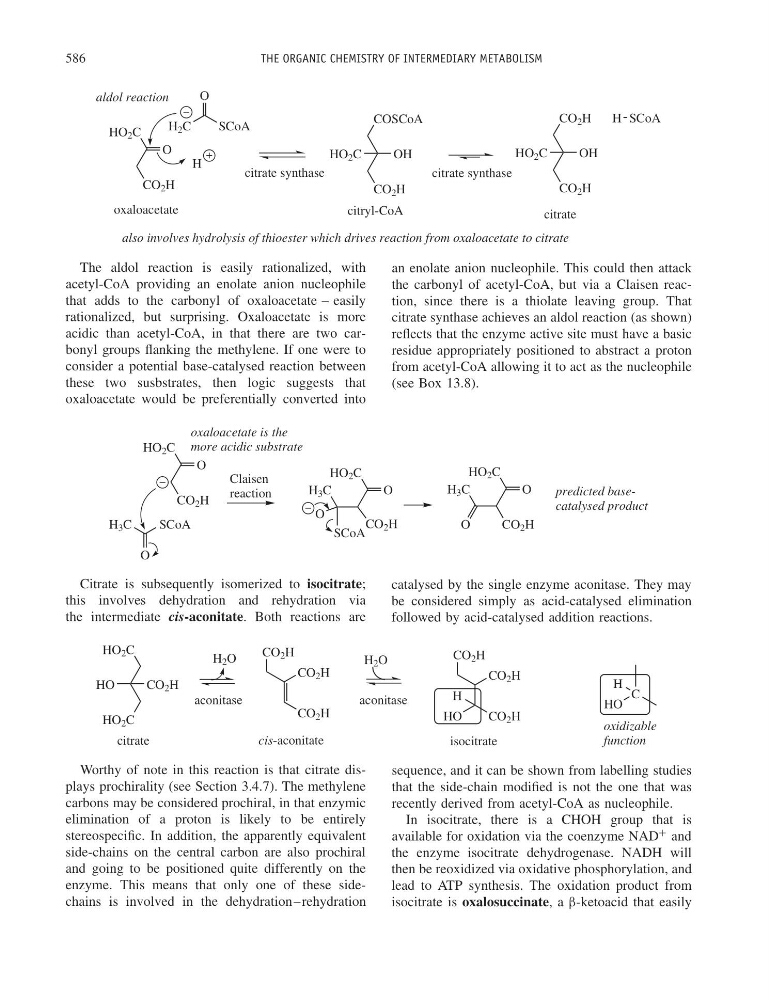
The aldol reaction is easily rationalized, with
acetyl-CoA providing an enolate anion nucleophile
that adds to the carbonyl of oxaloacetate – easily
rationalized, but surprising. Oxaloacetate is more
acidic than acetyl-CoA, in that there are two carbonyl groups flanking the methylene. If one were to
consider a potential base-catalysed reaction between
these two susbstrates, then logic suggests that
oxaloacetate would be preferentially converted into
an enolate anion nucleophile. This could then attack
the carbonyl of acetyl-CoA, but via a Claisen reaction, since there is a thiolate leaving group. That
citrate synthase achieves an aldol reaction (as shown)
reflects that the enzyme active site must have a basic
residue appropriately positioned to abstract a proton
from acetyl-CoA allowing it to act as the nucleophile
(see Box 13.8).
predicted basecatalysed product
HO 2 C
CO 2 H
O
O
H 3 C
SCoA
HO 2 C
CO 2 H
O
SCoA
H 3 C
O
HO 2 C
CO 2 H
O
H 3 C
O
oxaloacetate is the
more acidic substrate
Claisen
reaction
Citrate is subsequently isomerized to isocitrate;
this involves dehydration and rehydration via
the intermediate cis-aconitate. Both reactions are
catalysed by the single enzyme aconitase. They may
be considered simply as acid-catalysed elimination
followed by acid-catalysed addition reactions.
citrate
isocitrate
cis-aconitate
aconitase
aconitase
oxidizable
function
HO 2 C
HO 2 C
HO
CO 2 H
CO 2 H
CO 2 H
CO 2 H
CO 2 H
CO 2 H
CO 2 H
HO
H
C
HO
H
H 2 O
H 2 O
Worthy of note in this reaction is that citrate displays prochirality (see Section 3.4.7). The methylene
carbons may be considered prochiral, in that enzymic
elimination of a proton is likely to be entirely
stereospecific. In addition, the apparently equivalent
side-chains on the central carbon are also prochiral
and going to be positioned quite differently on the
enzyme. This means that only one of these sidechains is involved in the dehydration–rehydration
sequence, and it can be shown from labelling studies
that the side-chain modified is not the one that was
recently derived from acetyl-CoA as nucleophile.
In isocitrate, there is a CHOH group that is
available for oxidation via the coenzyme NAD
+ and
the enzyme isocitrate dehydrogenase. NADH will
then be reoxidized via oxidative phosphorylation, and
lead to ATP synthesis. The oxidation product from
isocitrate is oxalosuccinate, a β-ketoacid that easily
THE ORGANIC CHEMISTRY OF INTERMEDIARY METABOLISM
also involves hydrolysis of thioester which drives reaction from oxaloac
oxaloacetate
citryl-CoA
citrate
HO 2 C
CO 2 H
O
O
H 2 C
SCoA
citrate synthase
citrate synthase
CO 2 H
CO 2 H
OH
HO 2 C
COSCoA
CO 2 H
OH
HO 2 C
H SCoA
aldol reaction
H
etate to citrate
The aldol reaction is easily rationalized, with
acetyl-CoA providing an enolate anion nucleophile
that adds to the carbonyl of oxaloacetate – easily
rationalized, but surprising. Oxaloacetate is more
acidic than acetyl-CoA, in that there are two carbonyl groups flanking the methylene. If one were to
consider a potential base-catalysed reaction between
these two susbstrates, then logic suggests that
oxaloacetate would be preferentially converted into
an enolate anion nucleophile. This could then attack
the carbonyl of acetyl-CoA, but via a Claisen reaction, since there is a thiolate leaving group. That
citrate synthase achieves an aldol reaction (as shown)
reflects that the enzyme active site must have a basic
residue appropriately positioned to abstract a proton
from acetyl-CoA allowing it to act as the nucleophile
(see Box 13.8).
predicted basecatalysed product
HO 2 C
CO 2 H
O
O
H 3 C
SCoA
HO 2 C
CO 2 H
O
SCoA
H 3 C
O
HO 2 C
CO 2 H
O
H 3 C
O
oxaloacetate is the
more acidic substrate
Claisen
reaction
Citrate is subsequently isomerized to isocitrate;
this involves dehydration and rehydration via
the intermediate cis-aconitate. Both reactions are
catalysed by the single enzyme aconitase. They may
be considered simply as acid-catalysed elimination
followed by acid-catalysed addition reactions.
citrate
isocitrate
cis-aconitate
aconitase
aconitase
oxidizable
function
HO 2 C
HO 2 C
HO
CO 2 H
CO 2 H
CO 2 H
CO 2 H
CO 2 H
CO 2 H
CO 2 H
HO
H
C
HO
H
H 2 O
H 2 O
Worthy of note in this reaction is that citrate displays prochirality (see Section 3.4.7). The methylene
carbons may be considered prochiral, in that enzymic
elimination of a proton is likely to be entirely
stereospecific. In addition, the apparently equivalent
side-chains on the central carbon are also prochiral
and going to be positioned quite differently on the
enzyme. This means that only one of these sidechains is involved in the dehydration–rehydration
sequence, and it can be shown from labelling studies
that the side-chain modified is not the one that was
recently derived from acetyl-CoA as nucleophile.
In isocitrate, there is a CHOH group that is
available for oxidation via the coenzyme NAD
+ and
the enzyme isocitrate dehydrogenase. NADH will
then be reoxidized via oxidative phosphorylation, and
lead to ATP synthesis. The oxidation product from
isocitrate is oxalosuccinate, a β-ketoacid that easily