

THE KREBS CYCLE
585
that enters the cycle is the thioester acetyl-coenzyme
A (acetyl-CoA).
We have just seen that anaerobic organisms
metabolize pyruvate from the glycolytic pathway by
various means, but that the prime objective is to
reoxidize NADH to NAD
+ . In aerobic organisms,
reoxidation of NADH is achieved via oxidative
phosphorylation, generating ATP in the process, and
there is no longer any need to sacrifice pyruvate for
this purpose. Accordingly, pyruvate from glycolysis
is converted into acetyl-CoA by a process known
as oxidative decarboxylation. This transformation
is dealt with in more detail in Section 15.8; but,
for the moment, it can be represented by the
equation
HS CoA
+
+
+
+
pyruvate
dehydrogenase
complex
3 enzyme activities
O
H 3 C
CO 2 H
H 3 C
SCoA
O
pyruvate
acetyl-CoA
NAD +
CO 2
NADH
The whole process is multi-step, and catalysed by the
pyruvate dehydrogenase enzyme complex, which
has three separate enzyme activities. During the transformation, an acetyl group is effectively removed
from pyruvate, and passed via carriers thiamine
diphosphate (TPP) and lipoic acid eventually to
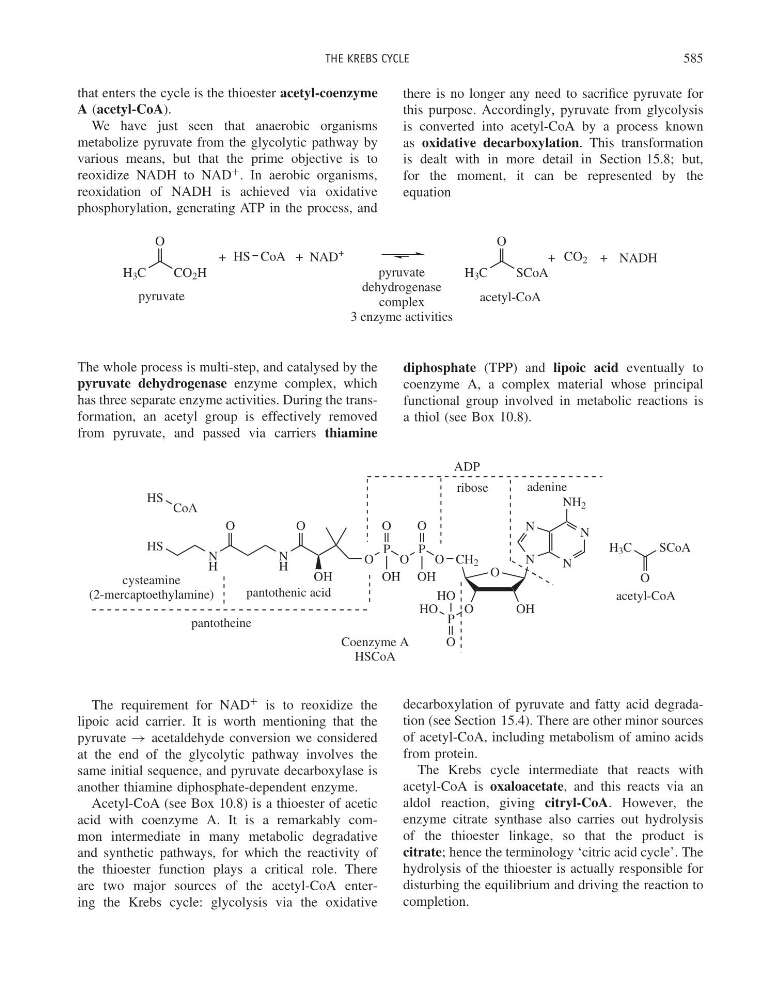
coenzyme A, a complex material whose principal
functional group involved in metabolic reactions is
a thiol (see Box 10.8).
H 3 C
SCoA
O
acetyl-CoA
N
N
N
NH 2
O
OH
N
CH 2
N
H
N
H
OH
O
O
HS
Coenzyme A
HSCoA
O
P
O
O
OH
P
O
O
OH
O
P
HO
O
HO
adenine
ribose
ADP
pantothenic acid
pantotheine
cysteamine
(2-mercaptoethylamine)
CoA
HS
The requirement for NAD
+ is to reoxidize the
lipoic acid carrier. It is worth mentioning that the
pyruvate → acetaldehyde conversion we considered
at the end of the glycolytic pathway involves the
same initial sequence, and pyruvate decarboxylase is
another thiamine diphosphate-dependent enzyme.
Acetyl-CoA (see Box 10.8) is a thioester of acetic
acid with coenzyme A. It is a remarkably common intermediate in many metabolic degradative
and synthetic pathways, for which the reactivity of
the thioester function plays a critical role. There
are two major sources of the acetyl-CoA entering the Krebs cycle: glycolysis via the oxidative
decarboxylation of pyruvate and fatty acid degradation (see Section 15.4). There are other minor sources
of acetyl-CoA, including metabolism of amino acids
from protein.
The Krebs cycle intermediate that reacts with
acetyl-CoA is oxaloacetate, and this reacts via an
aldol reaction, giving citryl-CoA. However, the
enzyme citrate synthase also carries out hydrolysis
of the thioester linkage, so that the product is
citrate; hence the terminology ‘citric acid cycle’. The
hydrolysis of the thioester is actually responsible for
disturbing the equilibrium and driving the reaction to
completion.
585
that enters the cycle is the thioester acetyl-coenzyme
A (acetyl-CoA).
We have just seen that anaerobic organisms
metabolize pyruvate from the glycolytic pathway by
various means, but that the prime objective is to
reoxidize NADH to NAD
+ . In aerobic organisms,
reoxidation of NADH is achieved via oxidative
phosphorylation, generating ATP in the process, and
there is no longer any need to sacrifice pyruvate for
this purpose. Accordingly, pyruvate from glycolysis
is converted into acetyl-CoA by a process known
as oxidative decarboxylation. This transformation
is dealt with in more detail in Section 15.8; but,
for the moment, it can be represented by the
equation
HS CoA
+
+
+
+
pyruvate
dehydrogenase
complex
3 enzyme activities
O
H 3 C
CO 2 H
H 3 C
SCoA
O
pyruvate
acetyl-CoA
NAD +
CO 2
NADH
The whole process is multi-step, and catalysed by the
pyruvate dehydrogenase enzyme complex, which
has three separate enzyme activities. During the transformation, an acetyl group is effectively removed
from pyruvate, and passed via carriers thiamine
diphosphate (TPP) and lipoic acid eventually to
coenzyme A, a complex material whose principal
functional group involved in metabolic reactions is
a thiol (see Box 10.8).
H 3 C
SCoA
O
acetyl-CoA
N
N
N
NH 2
O
OH
N
CH 2
N
H
N
H
OH
O
O
HS
Coenzyme A
HSCoA
O
P
O
O
OH
P
O
O
OH
O
P
HO
O
HO
adenine
ribose
ADP
pantothenic acid
pantotheine
cysteamine
(2-mercaptoethylamine)
CoA
HS
The requirement for NAD
+ is to reoxidize the
lipoic acid carrier. It is worth mentioning that the
pyruvate → acetaldehyde conversion we considered
at the end of the glycolytic pathway involves the
same initial sequence, and pyruvate decarboxylase is
another thiamine diphosphate-dependent enzyme.
Acetyl-CoA (see Box 10.8) is a thioester of acetic
acid with coenzyme A. It is a remarkably common intermediate in many metabolic degradative
and synthetic pathways, for which the reactivity of
the thioester function plays a critical role. There
are two major sources of the acetyl-CoA entering the Krebs cycle: glycolysis via the oxidative
decarboxylation of pyruvate and fatty acid degradation (see Section 15.4). There are other minor sources
of acetyl-CoA, including metabolism of amino acids
from protein.
The Krebs cycle intermediate that reacts with
acetyl-CoA is oxaloacetate, and this reacts via an
aldol reaction, giving citryl-CoA. However, the
enzyme citrate synthase also carries out hydrolysis
of the thioester linkage, so that the product is
citrate; hence the terminology ‘citric acid cycle’. The
hydrolysis of the thioester is actually responsible for
disturbing the equilibrium and driving the reaction to
completion.