

584
THE ORGANIC CHEMISTRY OF INTERMEDIARY METABOLISM
This is another example of substrate-level phosphorylation, but differs from the earlier example
that involved hydrolysis of a mixed anhydride. Here,
we have merely the hydrolysis of an ester, and thus
a much lower release of energy. In fact, with 1,3diphosphoglycerate, we specifically noted the difference in reactivity between the anhydride and ester
groups. So how can this reaction lead to ATP synthesis? The answer lies in the stability of the hydrolysis
product, enolpyruvic acid. Once formed, this enol
is rapidly isomerized to its keto tautomer, pyruvic
acid, with the equilibrium heavily favouring the keto
tautomer (see Section 10.1). The driving force for
the substrate-level phosphorylation reaction is actually the position of equilibrium in the subsequent
tautomerization.
This completes the glycolytic pathway; well,
almost. To maintain operation of the pathway, the
NAD
+ used in the conversion of glyceraldehyde
3-phosphate into 1,3-diphosphoglycerate must be
regenerated from its reduced form NADH, since only
small amounts of the coenzyme will be available
to the organism. If the organism is aerobic, then
it is possible to use the oxidative phosphorylation
processes to regenerate NAD
+ from NADH, and in
so doing also achieve the synthesis of ATP. However,
for anaerobes, or for aerobes under temporary
anaerobic conditions, pyruvate synthesized in the last
reaction is modified further to achieve this end. For
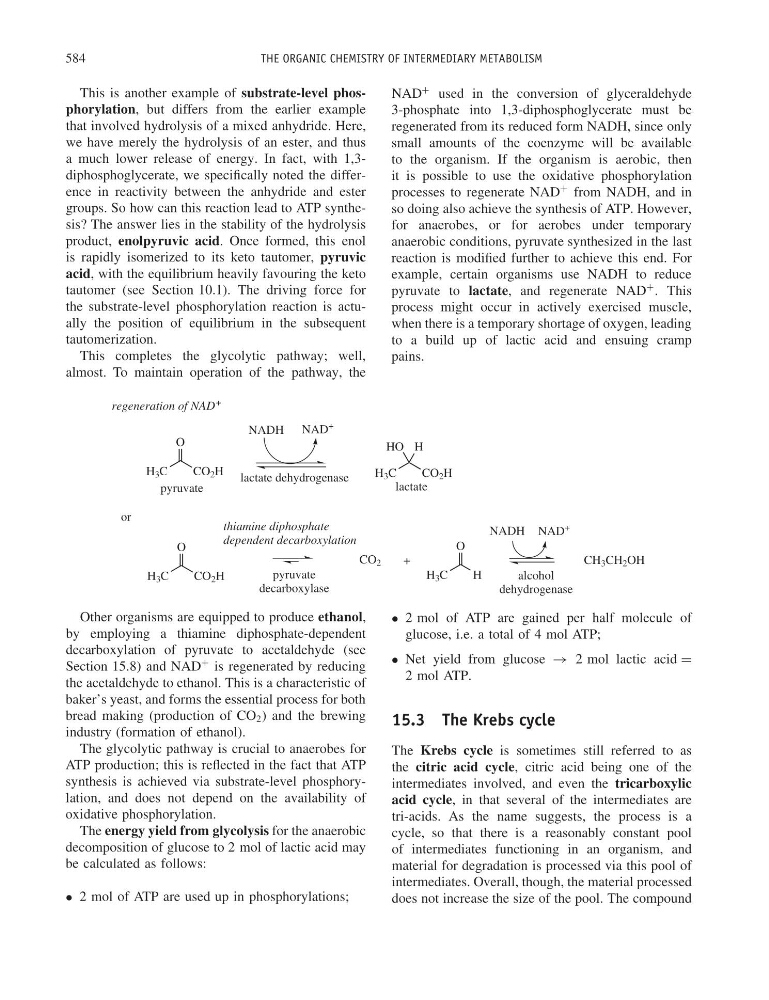
example, certain organisms use NADH to reduce
pyruvate to lactate, and regenerate NAD
+ . This
process might occur in actively exercised muscle,
when there is a temporary shortage of oxygen, leading
to a build up of lactic acid and ensuing cramp
pains.
pyruvate
lactate
lactate dehydrogenase
or
pyruvate
decarboxylase
alcohol
dehydrogenase
thiamine diphosphate
dependent decarboxylation
+
regeneration of NAD +
O
H 3 C
CO 2 H
H 3 C
CO 2 H
H
HO
O
H 3 C
CO 2 H
O
H 3 C
H
NADH NAD +
CO 2
CH 3 CH 2 OH
NADH NAD +
Other organisms are equipped to produce ethanol,
by employing a thiamine diphosphate-dependent
decarboxylation of pyruvate to acetaldehyde (see
Section 15.8) and NAD
+ is regenerated by reducing
the acetaldehyde to ethanol. This is a characteristic of
baker’s yeast, and forms the essential process for both
bread making (production of CO 2 ) and the brewing
industry (formation of ethanol).
The glycolytic pathway is crucial to anaerobes for
ATP production; this is reflected in the fact that ATP
synthesis is achieved via substrate-level phosphorylation, and does not depend on the availability of
oxidative phosphorylation.
The energy yield from glycolysis for the anaerobic
decomposition of glucose to 2 mol of lactic acid may
be calculated as follows:
• 2 mol of ATP are used up in phosphorylations;
• 2 mol of ATP are gained per half molecule of
glucose, i.e. a total of 4 mol ATP;
• Net yield from glucose → 2 mol lactic acid =
2 mol ATP.
15.3 The Krebs cycle
The Krebs cycle is sometimes still referred to as
the citric acid cycle, citric acid being one of the
intermediates involved, and even the tricarboxylic
acid cycle, in that several of the intermediates are
tri-acids. As the name suggests, the process is a
cycle, so that there is a reasonably constant pool
of intermediates functioning in an organism, and
material for degradation is processed via this pool of
intermediates. Overall, though, the material processed
does not increase the size of the pool. The compound
THE ORGANIC CHEMISTRY OF INTERMEDIARY METABOLISM
This is another example of substrate-level phosphorylation, but differs from the earlier example
that involved hydrolysis of a mixed anhydride. Here,
we have merely the hydrolysis of an ester, and thus
a much lower release of energy. In fact, with 1,3diphosphoglycerate, we specifically noted the difference in reactivity between the anhydride and ester
groups. So how can this reaction lead to ATP synthesis? The answer lies in the stability of the hydrolysis
product, enolpyruvic acid. Once formed, this enol
is rapidly isomerized to its keto tautomer, pyruvic
acid, with the equilibrium heavily favouring the keto
tautomer (see Section 10.1). The driving force for
the substrate-level phosphorylation reaction is actually the position of equilibrium in the subsequent
tautomerization.
This completes the glycolytic pathway; well,
almost. To maintain operation of the pathway, the
NAD
+ used in the conversion of glyceraldehyde
3-phosphate into 1,3-diphosphoglycerate must be
regenerated from its reduced form NADH, since only
small amounts of the coenzyme will be available
to the organism. If the organism is aerobic, then
it is possible to use the oxidative phosphorylation
processes to regenerate NAD
+ from NADH, and in
so doing also achieve the synthesis of ATP. However,
for anaerobes, or for aerobes under temporary
anaerobic conditions, pyruvate synthesized in the last
reaction is modified further to achieve this end. For
example, certain organisms use NADH to reduce
pyruvate to lactate, and regenerate NAD
+ . This
process might occur in actively exercised muscle,
when there is a temporary shortage of oxygen, leading
to a build up of lactic acid and ensuing cramp
pains.
pyruvate
lactate
lactate dehydrogenase
or
pyruvate
decarboxylase
alcohol
dehydrogenase
thiamine diphosphate
dependent decarboxylation
+
regeneration of NAD +
O
H 3 C
CO 2 H
H 3 C
CO 2 H
H
HO
O
H 3 C
CO 2 H
O
H 3 C
H
NADH NAD +
CO 2
CH 3 CH 2 OH
NADH NAD +
Other organisms are equipped to produce ethanol,
by employing a thiamine diphosphate-dependent
decarboxylation of pyruvate to acetaldehyde (see
Section 15.8) and NAD
+ is regenerated by reducing
the acetaldehyde to ethanol. This is a characteristic of
baker’s yeast, and forms the essential process for both
bread making (production of CO 2 ) and the brewing
industry (formation of ethanol).
The glycolytic pathway is crucial to anaerobes for
ATP production; this is reflected in the fact that ATP
synthesis is achieved via substrate-level phosphorylation, and does not depend on the availability of
oxidative phosphorylation.
The energy yield from glycolysis for the anaerobic
decomposition of glucose to 2 mol of lactic acid may
be calculated as follows:
• 2 mol of ATP are used up in phosphorylations;
• 2 mol of ATP are gained per half molecule of
glucose, i.e. a total of 4 mol ATP;
• Net yield from glucose → 2 mol lactic acid =
2 mol ATP.
15.3 The Krebs cycle
The Krebs cycle is sometimes still referred to as
the citric acid cycle, citric acid being one of the
intermediates involved, and even the tricarboxylic
acid cycle, in that several of the intermediates are
tri-acids. As the name suggests, the process is a
cycle, so that there is a reasonably constant pool
of intermediates functioning in an organism, and
material for degradation is processed via this pool of
intermediates. Overall, though, the material processed
does not increase the size of the pool. The compound