

THE GLYCOLYTIC PATHWAY
583
CO 2 H
H
OP
CH 2 OH
CO 2 H
H
OP
CH 2 OP
CO 2 H
H
OH
CH 2 OP
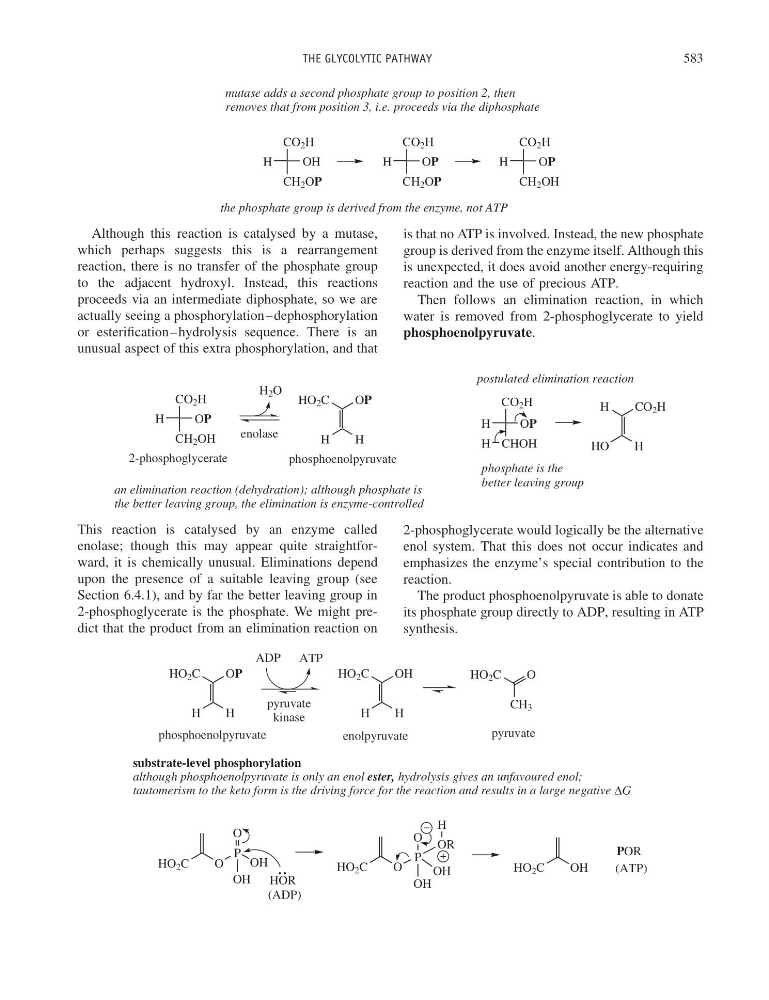
the phosphate group is derived from the enzyme, not ATP
mutase adds a second phosphate group to position 2, then
removes that from position 3, i.e. proceeds via the diphosphate
Although this reaction is catalysed by a mutase,
which perhaps suggests this is a rearrangement
reaction, there is no transfer of the phosphate group
to the adjacent hydroxyl. Instead, this reactions
proceeds via an intermediate diphosphate, so we are
actually seeing a phosphorylation–dephosphorylation
or esterification–hydrolysis sequence. There is an
unusual aspect of this extra phosphorylation, and that
is that no ATP is involved. Instead, the new phosphate
group is derived from the enzyme itself. Although this
is unexpected, it does avoid another energy-requiring
reaction and the use of precious ATP.
Then follows an elimination reaction, in which
water is removed from 2-phosphoglycerate to yield
phosphoenolpyruvate.
CO 2 H
H
OP
CH 2 OH
2-phosphoglycerate
enolase
phosphoenolpyruvate
an elimination reaction (dehydration); although phosphate is
the better leaving group, the elimination is enzyme-controlled
CO 2 H
H
OP
CHOH
H
phosphate is the
better leaving group
postulated elimination reaction
CO 2 H
HO
H
H
OP
HO 2 C
H
H
H 2 O
This reaction is catalysed by an enzyme called
enolase; though this may appear quite straightforward, it is chemically unusual. Eliminations depend
upon the presence of a suitable leaving group (see
Section 6.4.1), and by far the better leaving group in
2-phosphoglycerate is the phosphate. We might predict that the product from an elimination reaction on
2-phosphoglycerate would logically be the alternative
enol system. That this does not occur indicates and
emphasizes the enzyme’s special contribution to the
reaction.
The product phosphoenolpyruvate is able to donate
its phosphate group directly to ADP, resulting in ATP
synthesis.
phosphoenolpyruvate
enolpyruvate
pyruvate
ADP ATP
pyruvate
kinase
substrate-level phosphorylation
although phosphoenolpyruvate is only an enol ester, hydrolysis gives an unfavoured enol;
tautomerism to the keto form is the driving force for the reaction and r
(ADP)
(ATP)
OP
HO 2 C
H
H
OH
HO 2 C
H
H
CH 3
HO 2 C
O
OH
HO 2 C
O
P
O
OH
OH
HO 2 C
HO 2 C
O
P
OH
OH
O
OR
H
HOR
POR
esults in a large negative ΔG
583
CO 2 H
H
OP
CH 2 OH
CO 2 H
H
OP
CH 2 OP
CO 2 H
H
OH
CH 2 OP
the phosphate group is derived from the enzyme, not ATP
mutase adds a second phosphate group to position 2, then
removes that from position 3, i.e. proceeds via the diphosphate
Although this reaction is catalysed by a mutase,
which perhaps suggests this is a rearrangement
reaction, there is no transfer of the phosphate group
to the adjacent hydroxyl. Instead, this reactions
proceeds via an intermediate diphosphate, so we are
actually seeing a phosphorylation–dephosphorylation
or esterification–hydrolysis sequence. There is an
unusual aspect of this extra phosphorylation, and that
is that no ATP is involved. Instead, the new phosphate
group is derived from the enzyme itself. Although this
is unexpected, it does avoid another energy-requiring
reaction and the use of precious ATP.
Then follows an elimination reaction, in which
water is removed from 2-phosphoglycerate to yield
phosphoenolpyruvate.
CO 2 H
H
OP
CH 2 OH
2-phosphoglycerate
enolase
phosphoenolpyruvate
an elimination reaction (dehydration); although phosphate is
the better leaving group, the elimination is enzyme-controlled
CO 2 H
H
OP
CHOH
H
phosphate is the
better leaving group
postulated elimination reaction
CO 2 H
HO
H
H
OP
HO 2 C
H
H
H 2 O
This reaction is catalysed by an enzyme called
enolase; though this may appear quite straightforward, it is chemically unusual. Eliminations depend
upon the presence of a suitable leaving group (see
Section 6.4.1), and by far the better leaving group in
2-phosphoglycerate is the phosphate. We might predict that the product from an elimination reaction on
2-phosphoglycerate would logically be the alternative
enol system. That this does not occur indicates and
emphasizes the enzyme’s special contribution to the
reaction.
The product phosphoenolpyruvate is able to donate
its phosphate group directly to ADP, resulting in ATP
synthesis.
phosphoenolpyruvate
enolpyruvate
pyruvate
ADP ATP
pyruvate
kinase
substrate-level phosphorylation
although phosphoenolpyruvate is only an enol ester, hydrolysis gives an unfavoured enol;
tautomerism to the keto form is the driving force for the reaction and r
(ADP)
(ATP)
OP
HO 2 C
H
H
OH
HO 2 C
H
H
CH 3
HO 2 C
O
OH
HO 2 C
O
P
O
OH
OH
HO 2 C
HO 2 C
O
P
OH
OH
O
OR
H
HOR
POR
esults in a large negative ΔG