

SYNTHESIS OF FATTY ACIDS
595
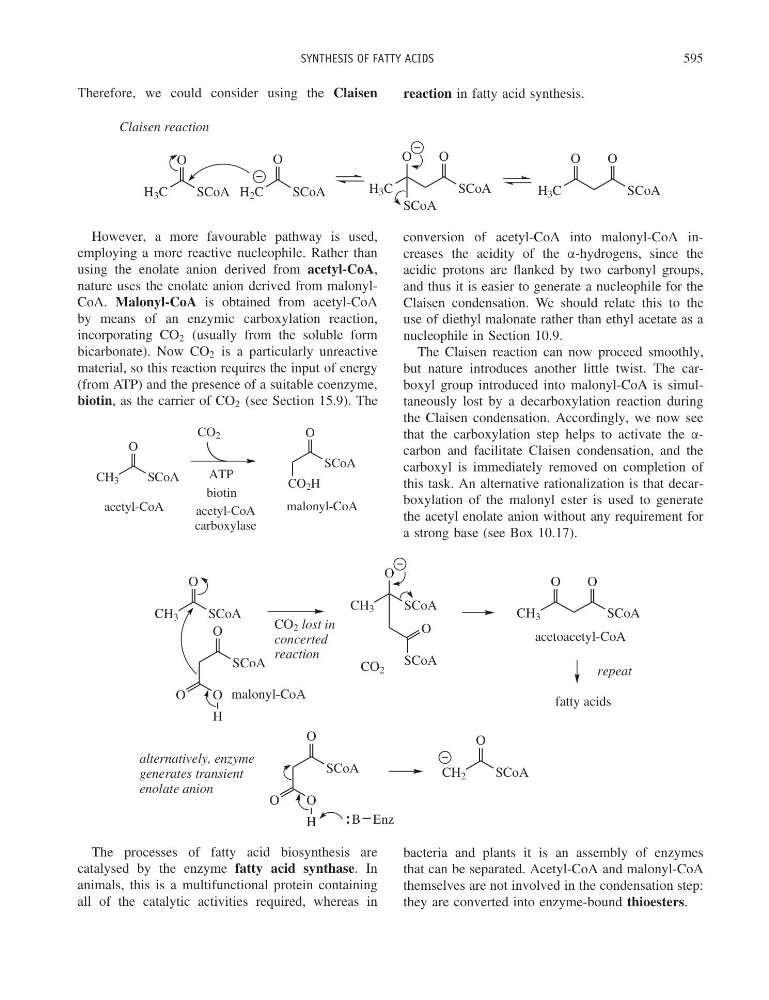
Therefore, we could consider using the Claisen
reaction in fatty acid synthesis.
Claisen reaction
H 3 C
SCoA
O
O
O
H 3 C
SCoA
O
H 2 C
SCoA
H 3 C
SCoA
O
O
SCoA
However, a more favourable pathway is used,
employing a more reactive nucleophile. Rather than
using the enolate anion derived from acetyl-CoA,
nature uses the enolate anion derived from malonylCoA. Malonyl-CoA is obtained from acetyl-CoA
by means of an enzymic carboxylation reaction,
incorporating CO 2 (usually from the soluble form
bicarbonate). Now CO 2 is a particularly unreactive
material, so this reaction requires the input of energy
(from ATP) and the presence of a suitable coenzyme,
biotin, as the carrier of CO 2 (see Section 15.9). The
acetyl-CoA
O
CH 3
SCoA
CO 2
ATP
acetyl-CoA
carboxylase
biotin
O
SCoA
CO 2 H
malonyl-CoA
conversion of acetyl-CoA into malonyl-CoA increases the acidity of the α-hydrogens, since the
acidic protons are flanked by two carbonyl groups,
and thus it is easier to generate a nucleophile for the
Claisen condensation. We should relate this to the
use of diethyl malonate rather than ethyl acetate as a
nucleophile in Section 10.9.
The Claisen reaction can now proceed smoothly,
but nature introduces another little twist. The carboxyl group introduced into malonyl-CoA is simultaneously lost by a decarboxylation reaction during
the Claisen condensation. Accordingly, we now see
that the carboxylation step helps to activate the αcarbon and facilitate Claisen condensation, and the
carboxyl is immediately removed on completion of
this task. An alternative rationalization is that decarboxylation of the malonyl ester is used to generate
the acetyl enolate anion without any requirement for
a strong base (see Box 10.17).
fatty acids
repeat
acetoacetyl-CoA
malonyl-CoA
B Enz
O
SCoA
O
O
H
O
CH 3
SCoA
O
CH 3
SCoA
SCoA
O
CH 3
SCoA
O
O
O
SCoA
O
O
H
O
CH 2
SCoA
CO 2 lost in
concerted
reaction
alternatively, enzyme
generates transient
enolate anion
CO 2
The processes of fatty acid biosynthesis are
catalysed by the enzyme fatty acid synthase. In
animals, this is a multifunctional protein containing
all of the catalytic activities required, whereas in
bacteria and plants it is an assembly of enzymes
that can be separated. Acetyl-CoA and malonyl-CoA
themselves are not involved in the condensation step:
they are converted into enzyme-bound thioesters.
595
Therefore, we could consider using the Claisen
reaction in fatty acid synthesis.
Claisen reaction
H 3 C
SCoA
O
O
O
H 3 C
SCoA
O
H 2 C
SCoA
H 3 C
SCoA
O
O
SCoA
However, a more favourable pathway is used,
employing a more reactive nucleophile. Rather than
using the enolate anion derived from acetyl-CoA,
nature uses the enolate anion derived from malonylCoA. Malonyl-CoA is obtained from acetyl-CoA
by means of an enzymic carboxylation reaction,
incorporating CO 2 (usually from the soluble form
bicarbonate). Now CO 2 is a particularly unreactive
material, so this reaction requires the input of energy
(from ATP) and the presence of a suitable coenzyme,
biotin, as the carrier of CO 2 (see Section 15.9). The
acetyl-CoA
O
CH 3
SCoA
CO 2
ATP
acetyl-CoA
carboxylase
biotin
O
SCoA
CO 2 H
malonyl-CoA
conversion of acetyl-CoA into malonyl-CoA increases the acidity of the α-hydrogens, since the
acidic protons are flanked by two carbonyl groups,
and thus it is easier to generate a nucleophile for the
Claisen condensation. We should relate this to the
use of diethyl malonate rather than ethyl acetate as a
nucleophile in Section 10.9.
The Claisen reaction can now proceed smoothly,
but nature introduces another little twist. The carboxyl group introduced into malonyl-CoA is simultaneously lost by a decarboxylation reaction during
the Claisen condensation. Accordingly, we now see
that the carboxylation step helps to activate the αcarbon and facilitate Claisen condensation, and the
carboxyl is immediately removed on completion of
this task. An alternative rationalization is that decarboxylation of the malonyl ester is used to generate
the acetyl enolate anion without any requirement for
a strong base (see Box 10.17).
fatty acids
repeat
acetoacetyl-CoA
malonyl-CoA
B Enz
O
SCoA
O
O
H
O
CH 3
SCoA
O
CH 3
SCoA
SCoA
O
CH 3
SCoA
O
O
O
SCoA
O
O
H
O
CH 2
SCoA
CO 2 lost in
concerted
reaction
alternatively, enzyme
generates transient
enolate anion
CO 2
The processes of fatty acid biosynthesis are
catalysed by the enzyme fatty acid synthase. In
animals, this is a multifunctional protein containing
all of the catalytic activities required, whereas in
bacteria and plants it is an assembly of enzymes
that can be separated. Acetyl-CoA and malonyl-CoA
themselves are not involved in the condensation step:
they are converted into enzyme-bound thioesters.