

580
THE ORGANIC CHEMISTRY OF INTERMEDIARY METABOLISM
O
HO
HO
OP
OH
HO
O
HO
HO
OH
PO
OH
CHO
OH
H
HO
H
H
OH
H
OH
CH 2 OP
OH
HO
H
H
OH
H
OH
CH 2 OP
H
OH
CH 2 OH
O
HO
H
H
OH
H
OH
CH 2 OP
glucose 6-P
(hemiacetal form)
fructose 6-P
(hemiketal form)
phosphoglucose
isomerase
keto−enol
tautomerism
enol−keto
tautomerism
open-chain aldose
open-chain ketose
common enol
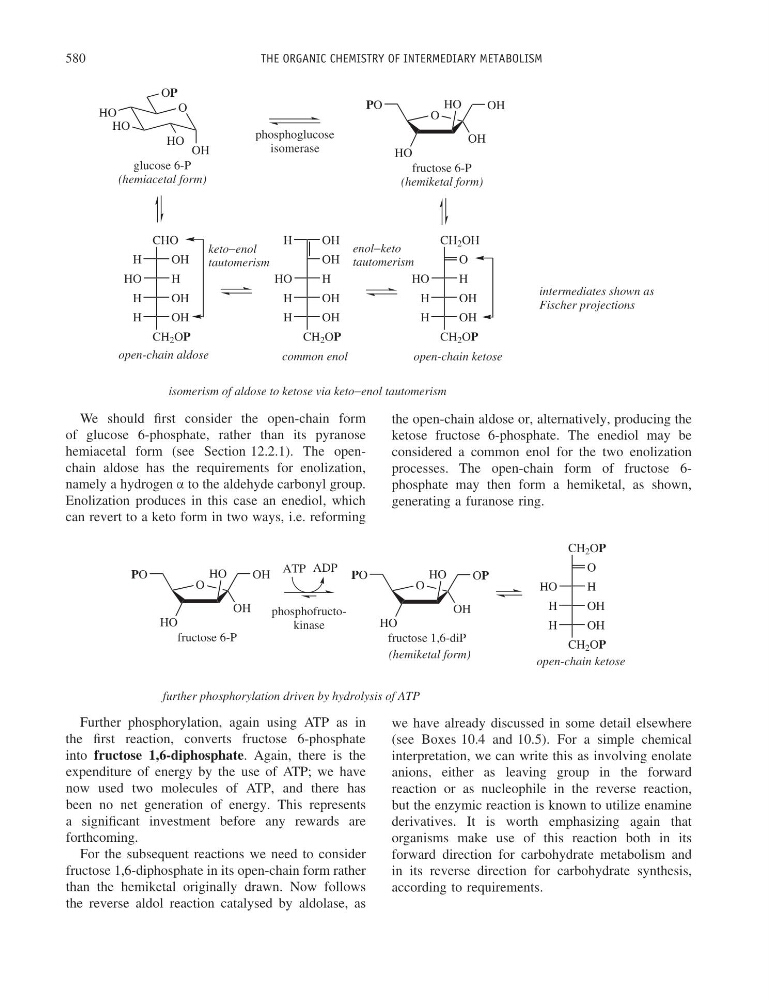
isomerism of aldose to ketose via keto−enol tautomerism
intermediates shown as
Fischer projections
We should first consider the open-chain form
of glucose 6-phosphate, rather than its pyranose
hemiacetal form (see Section 12.2.1). The openchain aldose has the requirements for enolization,
namely a hydrogen α to the aldehyde carbonyl group.
Enolization produces in this case an enediol, which
can revert to a keto form in two ways, i.e. reforming
the open-chain aldose or, alternatively, producing the
ketose fructose 6-phosphate. The enediol may be
considered a common enol for the two enolization
processes. The open-chain form of fructose 6phosphate may then form a hemiketal, as shown,
generating a furanose ring.
O
HO
HO
OH
PO
OH
O
HO
HO
OH
PO
OP
fructose 6-P
fructose 1,6-diP
ATP
CH 2 OP
O
HO
H
H
OH
H
OH
CH 2 OP
phosphofructokinase
further phosphorylation driven by hydrolysis of ATP
ADP
(hemiketal form)
open-chain ketose
Further phosphorylation, again using ATP as in
the first reaction, converts fructose 6-phosphate
into fructose 1,6-diphosphate. Again, there is the
expenditure of energy by the use of ATP; we have
now used two molecules of ATP, and there has
been no net generation of energy. This represents
a significant investment before any rewards are
forthcoming.
For the subsequent reactions we need to consider
fructose 1,6-diphosphate in its open-chain form rather
than the hemiketal originally drawn. Now follows
the reverse aldol reaction catalysed by aldolase, as
we have already discussed in some detail elsewhere
(see Boxes 10.4 and 10.5). For a simple chemical
interpretation, we can write this as involving enolate
anions, either as leaving group in the forward
reaction or as nucleophile in the reverse reaction,
but the enzymic reaction is known to utilize enamine
derivatives. It is worth emphasizing again that
organisms make use of this reaction both in its
forward direction for carbohydrate metabolism and
in its reverse direction for carbohydrate synthesis,
according to requirements.
THE ORGANIC CHEMISTRY OF INTERMEDIARY METABOLISM
O
HO
HO
OP
OH
HO
O
HO
HO
OH
PO
OH
CHO
OH
H
HO
H
H
OH
H
OH
CH 2 OP
OH
HO
H
H
OH
H
OH
CH 2 OP
H
OH
CH 2 OH
O
HO
H
H
OH
H
OH
CH 2 OP
glucose 6-P
(hemiacetal form)
fructose 6-P
(hemiketal form)
phosphoglucose
isomerase
keto−enol
tautomerism
enol−keto
tautomerism
open-chain aldose
open-chain ketose
common enol
isomerism of aldose to ketose via keto−enol tautomerism
intermediates shown as
Fischer projections
We should first consider the open-chain form
of glucose 6-phosphate, rather than its pyranose
hemiacetal form (see Section 12.2.1). The openchain aldose has the requirements for enolization,
namely a hydrogen α to the aldehyde carbonyl group.
Enolization produces in this case an enediol, which
can revert to a keto form in two ways, i.e. reforming
the open-chain aldose or, alternatively, producing the
ketose fructose 6-phosphate. The enediol may be
considered a common enol for the two enolization
processes. The open-chain form of fructose 6phosphate may then form a hemiketal, as shown,
generating a furanose ring.
O
HO
HO
OH
PO
OH
O
HO
HO
OH
PO
OP
fructose 6-P
fructose 1,6-diP
ATP
CH 2 OP
O
HO
H
H
OH
H
OH
CH 2 OP
phosphofructokinase
further phosphorylation driven by hydrolysis of ATP
ADP
(hemiketal form)
open-chain ketose
Further phosphorylation, again using ATP as in
the first reaction, converts fructose 6-phosphate
into fructose 1,6-diphosphate. Again, there is the
expenditure of energy by the use of ATP; we have
now used two molecules of ATP, and there has
been no net generation of energy. This represents
a significant investment before any rewards are
forthcoming.
For the subsequent reactions we need to consider
fructose 1,6-diphosphate in its open-chain form rather
than the hemiketal originally drawn. Now follows
the reverse aldol reaction catalysed by aldolase, as
we have already discussed in some detail elsewhere
(see Boxes 10.4 and 10.5). For a simple chemical
interpretation, we can write this as involving enolate
anions, either as leaving group in the forward
reaction or as nucleophile in the reverse reaction,
but the enzymic reaction is known to utilize enamine
derivatives. It is worth emphasizing again that
organisms make use of this reaction both in its
forward direction for carbohydrate metabolism and
in its reverse direction for carbohydrate synthesis,
according to requirements.