

THE GLYCOLYTIC PATHWAY
581
C
H
OH
CH 2 OP
CHOH
O
CH 2 OP
H
O
CH 2 OP
O
HO
H
H
OH
H
OH
CH 2 OP
glyceraldehyde
3-phosphate
aldol
reaction
reverse aldol
reaction
dihydroxyacetone
phosphate
aldolase
fructose 1,6-diP
important in carbohydrate metabolism − reverse aldol reaction
important in carbohydrate synthesis − aldol reaction
cleavage of hexose via reverse aldol reaction
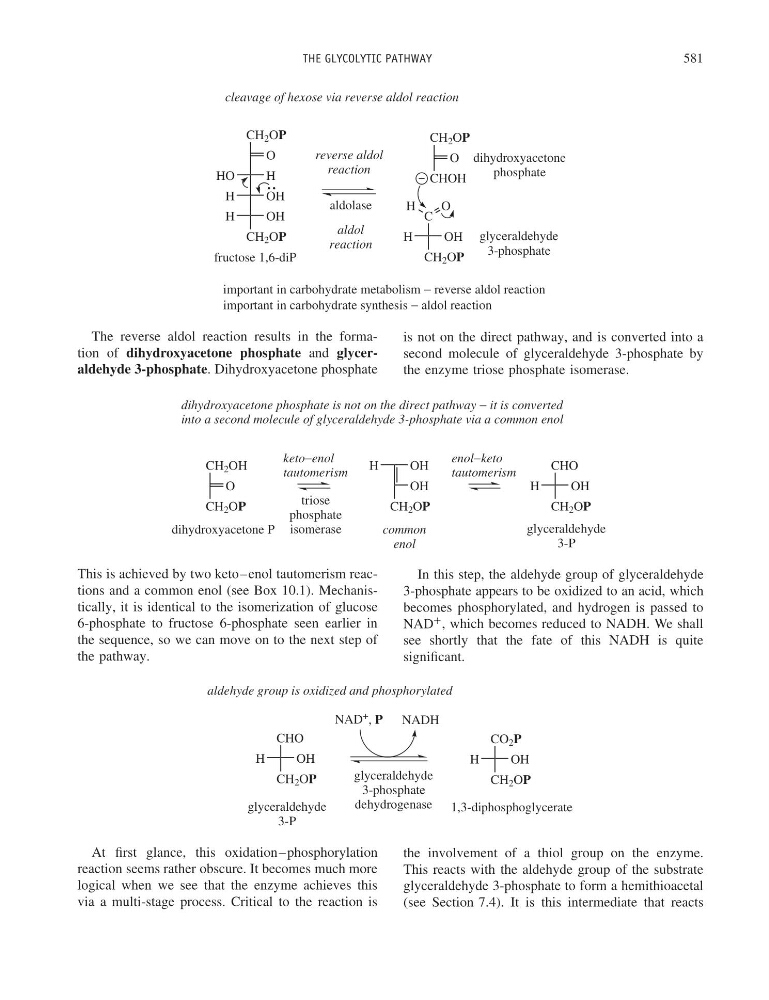
The reverse aldol reaction results in the formation of dihydroxyacetone phosphate and glyceraldehyde 3-phosphate. Dihydroxyacetone phosphate
is not on the direct pathway, and is converted into a
second molecule of glyceraldehyde 3-phosphate by
the enzyme triose phosphate isomerase.
CHO
H
OH
CH 2 OP
dihydroxyacetone phosphate is not on the direct pathway − it is converted
into a second molecule of glyceraldehyde 3-phosphate via a common enol
CH 2 OH
O
CH 2 OP
OH
CH 2 OP
OH
H
dihydroxyacetone P
glyceraldehyde
3-P
keto−enol
tautomerism
enol−keto
tautomerism
triose
phosphate
isomerase
common
enol
This is achieved by two keto–enol tautomerism reactions and a common enol (see Box 10.1). Mechanistically, it is identical to the isomerization of glucose
6-phosphate to fructose 6-phosphate seen earlier in
the sequence, so we can move on to the next step of
the pathway.
In this step, the aldehyde group of glyceraldehyde
3-phosphate appears to be oxidized to an acid, which
becomes phosphorylated, and hydrogen is passed to
NAD
+ , which becomes reduced to NADH. We shall
see shortly that the fate of this NADH is quite
significant.
CHO
H
OH
CH 2 OP
CO 2 P
H
OH
CH 2 OP
glyceraldehyde
3-P
1,3-diphosphoglycerate
NAD + , P
glyceraldehyde
3-phosphate
dehydrogenase
aldehyde group is oxidized and phosphorylated
NADH
At first glance, this oxidation–phosphorylation
reaction seems rather obscure. It becomes much more
logical when we see that the enzyme achieves this
via a multi-stage process. Critical to the reaction is
the involvement of a thiol group on the enzyme.
This reacts with the aldehyde group of the substrate
glyceraldehyde 3-phosphate to form a hemithioacetal
(see Section 7.4). It is this intermediate that reacts
581
C
H
OH
CH 2 OP
CHOH
O
CH 2 OP
H
O
CH 2 OP
O
HO
H
H
OH
H
OH
CH 2 OP
glyceraldehyde
3-phosphate
aldol
reaction
reverse aldol
reaction
dihydroxyacetone
phosphate
aldolase
fructose 1,6-diP
important in carbohydrate metabolism − reverse aldol reaction
important in carbohydrate synthesis − aldol reaction
cleavage of hexose via reverse aldol reaction
The reverse aldol reaction results in the formation of dihydroxyacetone phosphate and glyceraldehyde 3-phosphate. Dihydroxyacetone phosphate
is not on the direct pathway, and is converted into a
second molecule of glyceraldehyde 3-phosphate by
the enzyme triose phosphate isomerase.
CHO
H
OH
CH 2 OP
dihydroxyacetone phosphate is not on the direct pathway − it is converted
into a second molecule of glyceraldehyde 3-phosphate via a common enol
CH 2 OH
O
CH 2 OP
OH
CH 2 OP
OH
H
dihydroxyacetone P
glyceraldehyde
3-P
keto−enol
tautomerism
enol−keto
tautomerism
triose
phosphate
isomerase
common
enol
This is achieved by two keto–enol tautomerism reactions and a common enol (see Box 10.1). Mechanistically, it is identical to the isomerization of glucose
6-phosphate to fructose 6-phosphate seen earlier in
the sequence, so we can move on to the next step of
the pathway.
In this step, the aldehyde group of glyceraldehyde
3-phosphate appears to be oxidized to an acid, which
becomes phosphorylated, and hydrogen is passed to
NAD
+ , which becomes reduced to NADH. We shall
see shortly that the fate of this NADH is quite
significant.
CHO
H
OH
CH 2 OP
CO 2 P
H
OH
CH 2 OP
glyceraldehyde
3-P
1,3-diphosphoglycerate
NAD + , P
glyceraldehyde
3-phosphate
dehydrogenase
aldehyde group is oxidized and phosphorylated
NADH
At first glance, this oxidation–phosphorylation
reaction seems rather obscure. It becomes much more
logical when we see that the enzyme achieves this
via a multi-stage process. Critical to the reaction is
the involvement of a thiol group on the enzyme.
This reacts with the aldehyde group of the substrate
glyceraldehyde 3-phosphate to form a hemithioacetal
(see Section 7.4). It is this intermediate that reacts