

THE GLYCOLYTIC PATHWAY
579
due course, electrons are passed to oxygen, which is
converted into water in the presence of protons. The
total process whereby hydrogen atoms are passed to
NAD
+ generates three molecules of ATP per pair
of hydrogen atoms. However, substrates with the
CH 2 –CH 2 grouping that are oxidized by flavoproteins
effectively bypass the first ATP generation step, so
only produce two molecules of ATP per pair of
hydrogen atoms.
The electron transport chain is vital to aerobic
organisms. Interference with its action may be life
threatening. Thus, cyanide and carbon monoxide
bind to haem groups and inhibit the action of the
enzyme cytochrome c oxidase, a protein complex
that is effectively responsible for the terminal part
of the electron transport sequence and the reduction
of oxygen to water.
What has been achieved by the participation of
coenzyme systems and the electron transport chain is
twofold. First, there is no need for the substrate AH 2
to react with oxygen. Second, it provides common
routes for the oxidation of many different organic
compounds, rather than a specific route for every
compound, a vast variety of which will be present in
the normal diet. Although it is somewhat simplistic,
many of the non-oxidative reactions of intermediary
metabolism can be viewed as additional chemical
transformations designed to provide substrates containing either CH–OH or CH 2 –CH 2 that may then be
subjected to dehydrogenation.
15.2 The glycolytic pathway
The glycolytic pathway, or glycolysis, is a metabolic
sequence in which glucose is broken down to
pyruvic acid. The subsequent fate of pyruvate then
depends upon whether or not the organism is aerobic
or anaerobic: Under aerobic conditions, pyruvate
is oxidized via oxidative phosphorylation; under
anaerobic conditions, pyruvate is converted further
into compounds such as lactate or ethanol, depending
upon the organism.
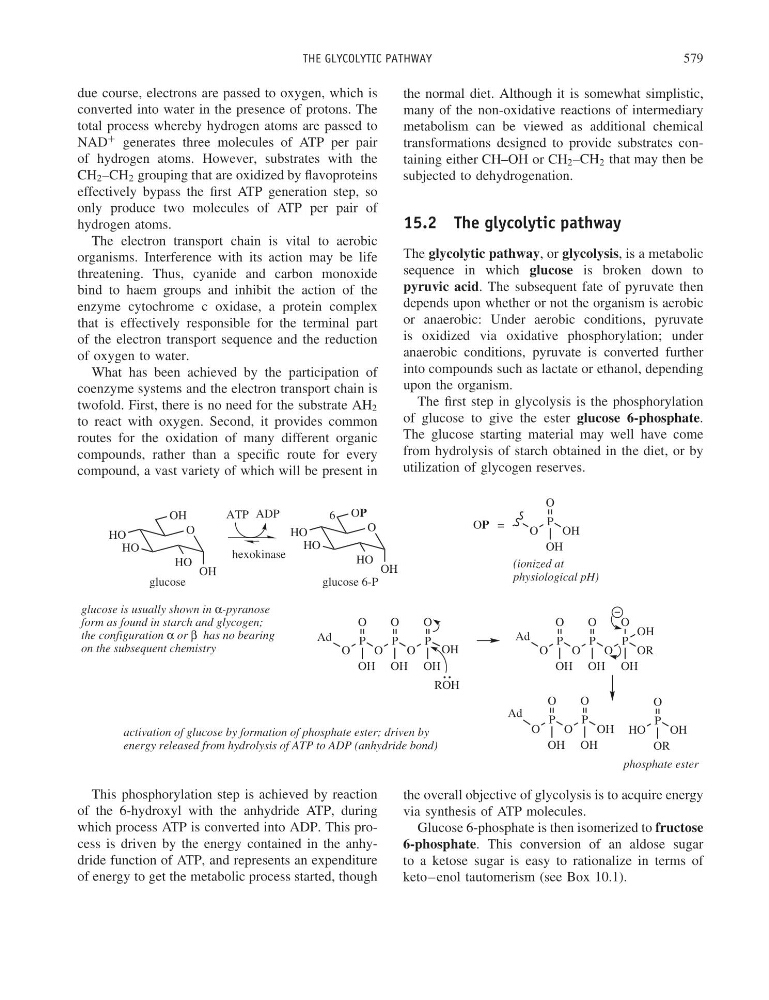
The first step in glycolysis is the phosphorylation
of glucose to give the ester glucose 6-phosphate.
The glucose starting material may well have come
from hydrolysis of starch obtained in the diet, or by
utilization of glycogen reserves.
O
HO
HO
OP
OH
HO
O
HO
HO
OH
OH
HO
6
glucose 6-P
glucose
ATP ADP
hexokinase
activation of glucose by formation of phosphate ester; driven by
energy released from hydrolysis of ATP to ADP (anhydride bond)
glucose is usually shown in α-pyranose
form as found in starch and glycogen;
the configuration α or β has no bearing
on the subsequent chemistry
=
(ionized at
physiological pH)
phosphate ester
O
P
OH
O
P
O
O
OH
OH
P
O
O
OH
Ad
O
P
OR
O
P
O
O
OH
OH
P
O
O
OH
Ad
OH
O
P
OH
O
P
O
O
OH
OH
Ad
O
P
HO
OH
OR
O
P
O
OH
OH
OP
ROH
This phosphorylation step is achieved by reaction
of the 6-hydroxyl with the anhydride ATP, during
which process ATP is converted into ADP. This process is driven by the energy contained in the anhydride function of ATP, and represents an expenditure
of energy to get the metabolic process started, though
the overall objective of glycolysis is to acquire energy
via synthesis of ATP molecules.
Glucose 6-phosphate is then isomerized to fructose
6-phosphate. This conversion of an aldose sugar
to a ketose sugar is easy to rationalize in terms of
keto–enol tautomerism (see Box 10.1).
579
due course, electrons are passed to oxygen, which is
converted into water in the presence of protons. The
total process whereby hydrogen atoms are passed to
NAD
+ generates three molecules of ATP per pair
of hydrogen atoms. However, substrates with the
CH 2 –CH 2 grouping that are oxidized by flavoproteins
effectively bypass the first ATP generation step, so
only produce two molecules of ATP per pair of
hydrogen atoms.
The electron transport chain is vital to aerobic
organisms. Interference with its action may be life
threatening. Thus, cyanide and carbon monoxide
bind to haem groups and inhibit the action of the
enzyme cytochrome c oxidase, a protein complex
that is effectively responsible for the terminal part
of the electron transport sequence and the reduction
of oxygen to water.
What has been achieved by the participation of
coenzyme systems and the electron transport chain is
twofold. First, there is no need for the substrate AH 2
to react with oxygen. Second, it provides common
routes for the oxidation of many different organic
compounds, rather than a specific route for every
compound, a vast variety of which will be present in
the normal diet. Although it is somewhat simplistic,
many of the non-oxidative reactions of intermediary
metabolism can be viewed as additional chemical
transformations designed to provide substrates containing either CH–OH or CH 2 –CH 2 that may then be
subjected to dehydrogenation.
15.2 The glycolytic pathway
The glycolytic pathway, or glycolysis, is a metabolic
sequence in which glucose is broken down to
pyruvic acid. The subsequent fate of pyruvate then
depends upon whether or not the organism is aerobic
or anaerobic: Under aerobic conditions, pyruvate
is oxidized via oxidative phosphorylation; under
anaerobic conditions, pyruvate is converted further
into compounds such as lactate or ethanol, depending
upon the organism.
The first step in glycolysis is the phosphorylation
of glucose to give the ester glucose 6-phosphate.
The glucose starting material may well have come
from hydrolysis of starch obtained in the diet, or by
utilization of glycogen reserves.
O
HO
HO
OP
OH
HO
O
HO
HO
OH
OH
HO
6
glucose 6-P
glucose
ATP ADP
hexokinase
activation of glucose by formation of phosphate ester; driven by
energy released from hydrolysis of ATP to ADP (anhydride bond)
glucose is usually shown in α-pyranose
form as found in starch and glycogen;
the configuration α or β has no bearing
on the subsequent chemistry
=
(ionized at
physiological pH)
phosphate ester
O
P
OH
O
P
O
O
OH
OH
P
O
O
OH
Ad
O
P
OR
O
P
O
O
OH
OH
P
O
O
OH
Ad
OH
O
P
OH
O
P
O
O
OH
OH
Ad
O
P
HO
OH
OR
O
P
O
OH
OH
OP
ROH
This phosphorylation step is achieved by reaction
of the 6-hydroxyl with the anhydride ATP, during
which process ATP is converted into ADP. This process is driven by the energy contained in the anhydride function of ATP, and represents an expenditure
of energy to get the metabolic process started, though
the overall objective of glycolysis is to acquire energy
via synthesis of ATP molecules.
Glucose 6-phosphate is then isomerized to fructose
6-phosphate. This conversion of an aldose sugar
to a ketose sugar is easy to rationalize in terms of
keto–enol tautomerism (see Box 10.1).