

INTERMEDIARY METABOLISM
577
N
N
N
NH 2
HO
OH
O
N
N
N
N
NH
H 3 C
H 3 C
O
O
OH OH
OH
CH 2
N
N
N
NH
H 3 C
H 3 C
O
O
N
N
N
NH
H 3 C
H 3 C
O
O
R
R
H
H
C
C
H
H
C
C
FMN
adenine
ribose
ribitol
flavin
FAD
FMN
FADH 2
FMNH 2
≡
FAD and FMN
dehydrogenase
abstraction of
hydride from
substrate
donation of
hydride to
substrate
O
P
O
O
P
O
O
OH OH
FAD
P
P
H
H
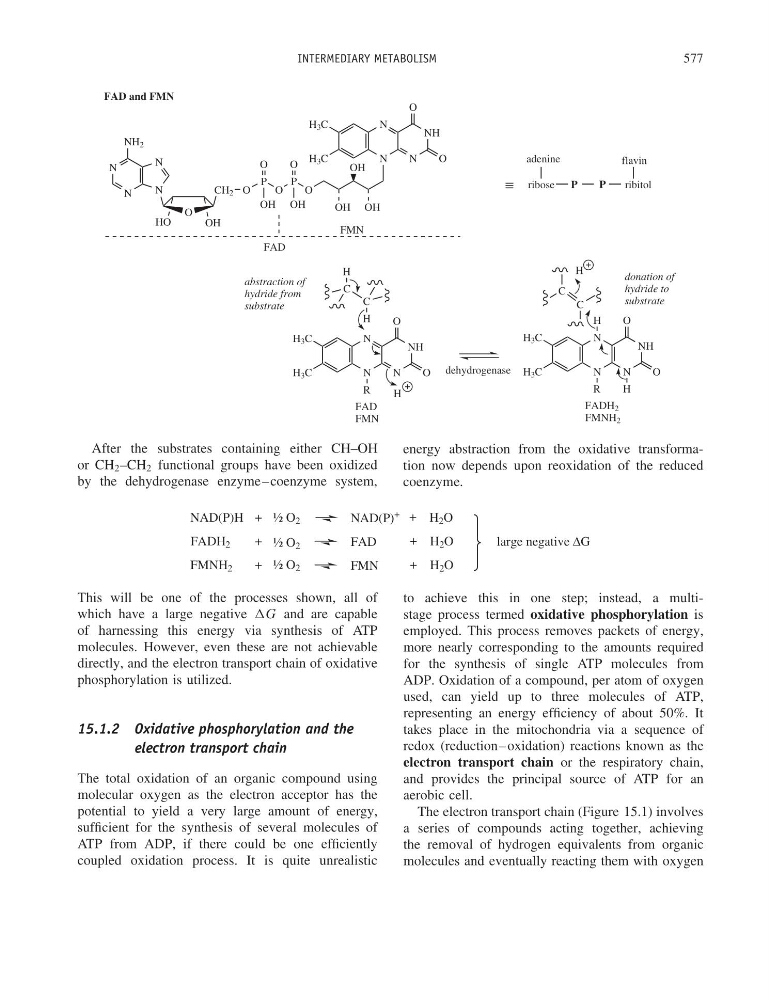
After the substrates containing either CH–OH
or CH 2 –CH 2 functional groups have been oxidized
by the dehydrogenase enzyme–coenzyme system,
energy abstraction from the oxidative transformation now depends upon reoxidation of the reduced
coenzyme.
NAD(P)
+
NAD(P)H
+
+
FMN
+
+
+
+
large negative ΔG
½ O 2
½ O 2
½ O 2
H 2 O
FAD
FADH 2
H 2 O
FMNH 2
H 2 O
This will be one of the processes shown, all of
which have a large negative G and are capable
of harnessing this energy via synthesis of ATP
molecules. However, even these are not achievable
directly, and the electron transport chain of oxidative
phosphorylation is utilized.
15.1.2 Oxidative phosphorylation and the
electron transport chain
The total oxidation of an organic compound using
molecular oxygen as the electron acceptor has the
potential to yield a very large amount of energy,
sufficient for the synthesis of several molecules of
ATP from ADP, if there could be one efficiently
coupled oxidation process. It is quite unrealistic
to achieve this in one step; instead, a multistage process termed oxidative phosphorylation is
employed. This process removes packets of energy,
more nearly corresponding to the amounts required
for the synthesis of single ATP molecules from
ADP. Oxidation of a compound, per atom of oxygen
used, can yield up to three molecules of ATP,
representing an energy efficiency of about 50%. It
takes place in the mitochondria via a sequence of
redox (reduction–oxidation) reactions known as the
electron transport chain or the respiratory chain,
and provides the principal source of ATP for an
aerobic cell.
The electron transport chain (Figure 15.1) involves
a series of compounds acting together, achieving
the removal of hydrogen equivalents from organic
molecules and eventually reacting them with oxygen
577
N
N
N
NH 2
HO
OH
O
N
N
N
N
NH
H 3 C
H 3 C
O
O
OH OH
OH
CH 2
N
N
N
NH
H 3 C
H 3 C
O
O
N
N
N
NH
H 3 C
H 3 C
O
O
R
R
H
H
C
C
H
H
C
C
FMN
adenine
ribose
ribitol
flavin
FAD
FMN
FADH 2
FMNH 2
≡
FAD and FMN
dehydrogenase
abstraction of
hydride from
substrate
donation of
hydride to
substrate
O
P
O
O
P
O
O
OH OH
FAD
P
P
H
H
After the substrates containing either CH–OH
or CH 2 –CH 2 functional groups have been oxidized
by the dehydrogenase enzyme–coenzyme system,
energy abstraction from the oxidative transformation now depends upon reoxidation of the reduced
coenzyme.
NAD(P)
+
NAD(P)H
+
+
FMN
+
+
+
+
large negative ΔG
½ O 2
½ O 2
½ O 2
H 2 O
FAD
FADH 2
H 2 O
FMNH 2
H 2 O
This will be one of the processes shown, all of
which have a large negative G and are capable
of harnessing this energy via synthesis of ATP
molecules. However, even these are not achievable
directly, and the electron transport chain of oxidative
phosphorylation is utilized.
15.1.2 Oxidative phosphorylation and the
electron transport chain
The total oxidation of an organic compound using
molecular oxygen as the electron acceptor has the
potential to yield a very large amount of energy,
sufficient for the synthesis of several molecules of
ATP from ADP, if there could be one efficiently
coupled oxidation process. It is quite unrealistic
to achieve this in one step; instead, a multistage process termed oxidative phosphorylation is
employed. This process removes packets of energy,
more nearly corresponding to the amounts required
for the synthesis of single ATP molecules from
ADP. Oxidation of a compound, per atom of oxygen
used, can yield up to three molecules of ATP,
representing an energy efficiency of about 50%. It
takes place in the mitochondria via a sequence of
redox (reduction–oxidation) reactions known as the
electron transport chain or the respiratory chain,
and provides the principal source of ATP for an
aerobic cell.
The electron transport chain (Figure 15.1) involves
a series of compounds acting together, achieving
the removal of hydrogen equivalents from organic
molecules and eventually reacting them with oxygen