

576
THE ORGANIC CHEMISTRY OF INTERMEDIARY METABOLISM
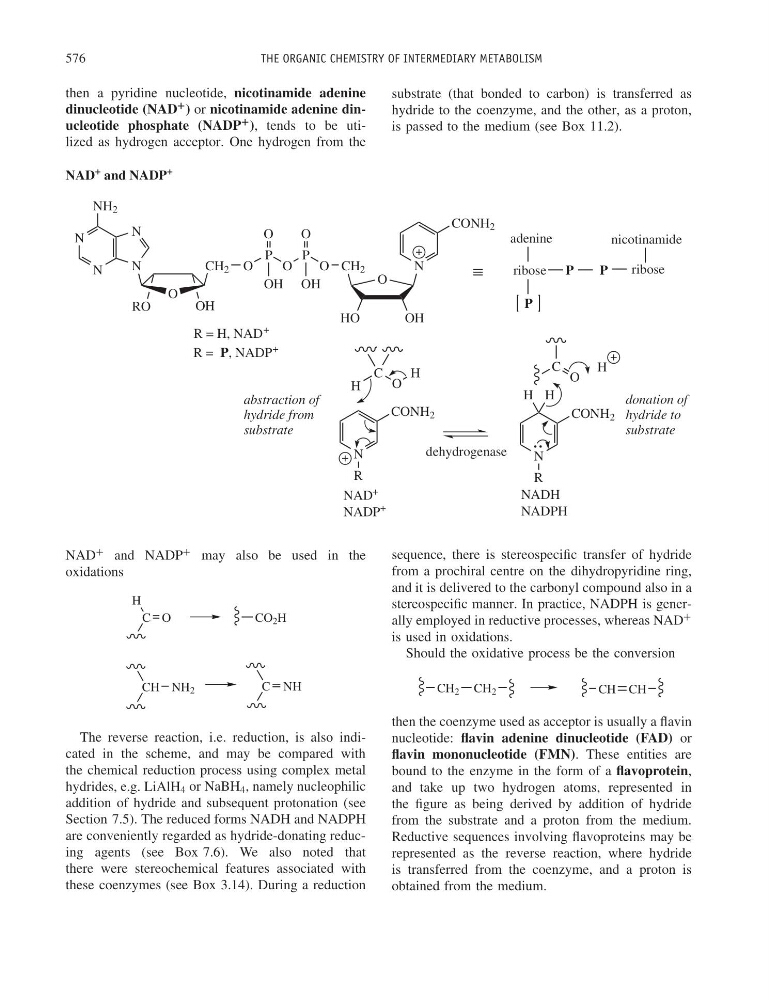
then a pyridine nucleotide, nicotinamide adenine
dinucleotide (NAD
+ ) or nicotinamide adenine dinucleotide phosphate (NADP
+ ), tends to be utilized as hydrogen acceptor. One hydrogen from the
substrate (that bonded to carbon) is transferred as
hydride to the coenzyme, and the other, as a proton,
is passed to the medium (see Box 11.2).
N
CONH 2
R
N
CONH 2
R
H
C
O
H
H
H
C
O
O
HO
OH
N
CONH 2
N
N
N
NH 2
RO
OH
O
N
CH 2
CH 2
NAD +
NADP
+
NADH
NADPH
adenine
ribose
ribose
nicotinamide
R = H, NAD
+
R = P, NADP +
≡
NAD
+ and NADP
+
dehydrogenase
abstraction of
hydride from
substrate
donation of
hydride to
substrate
O
P
O
O
P
O
O
OH OH
H
P
P
P
NAD
+ and NADP
+ may also be used in the
oxidations
C O
CO 2 H
CH NH 2
C NH
H
The reverse reaction, i.e. reduction, is also indicated in the scheme, and may be compared with
the chemical reduction process using complex metal
hydrides, e.g. LiAlH 4 or NaBH 4 , namely nucleophilic
addition of hydride and subsequent protonation (see
Section 7.5). The reduced forms NADH and NADPH
are conveniently regarded as hydride-donating reducing agents (see Box 7.6). We also noted that
there were stereochemical features associated with
these coenzymes (see Box 3.14). During a reduction
sequence, there is stereospecific transfer of hydride
from a prochiral centre on the dihydropyridine ring,
and it is delivered to the carbonyl compound also in a
stereospecific manner. In practice, NADPH is generally employed in reductive processes, whereas NAD
+
is used in oxidations.
Should the oxidative process be the conversion
CH 2 CH 2
CH CH
then the coenzyme used as acceptor is usually a flavin
nucleotide: flavin adenine dinucleotide (FAD) or
flavin mononucleotide (FMN). These entities are
bound to the enzyme in the form of a flavoprotein,
and take up two hydrogen atoms, represented in
the figure as being derived by addition of hydride
from the substrate and a proton from the medium.
Reductive sequences involving flavoproteins may be
represented as the reverse reaction, where hydride
is transferred from the coenzyme, and a proton is
obtained from the medium.
THE ORGANIC CHEMISTRY OF INTERMEDIARY METABOLISM
then a pyridine nucleotide, nicotinamide adenine
dinucleotide (NAD
+ ) or nicotinamide adenine dinucleotide phosphate (NADP
+ ), tends to be utilized as hydrogen acceptor. One hydrogen from the
substrate (that bonded to carbon) is transferred as
hydride to the coenzyme, and the other, as a proton,
is passed to the medium (see Box 11.2).
N
CONH 2
R
N
CONH 2
R
H
C
O
H
H
H
C
O
O
HO
OH
N
CONH 2
N
N
N
NH 2
RO
OH
O
N
CH 2
CH 2
NAD +
NADP
+
NADH
NADPH
adenine
ribose
ribose
nicotinamide
R = H, NAD
+
R = P, NADP +
≡
NAD
+ and NADP
+
dehydrogenase
abstraction of
hydride from
substrate
donation of
hydride to
substrate
O
P
O
O
P
O
O
OH OH
H
P
P
P
NAD
+ and NADP
+ may also be used in the
oxidations
C O
CO 2 H
CH NH 2
C NH
H
The reverse reaction, i.e. reduction, is also indicated in the scheme, and may be compared with
the chemical reduction process using complex metal
hydrides, e.g. LiAlH 4 or NaBH 4 , namely nucleophilic
addition of hydride and subsequent protonation (see
Section 7.5). The reduced forms NADH and NADPH
are conveniently regarded as hydride-donating reducing agents (see Box 7.6). We also noted that
there were stereochemical features associated with
these coenzymes (see Box 3.14). During a reduction
sequence, there is stereospecific transfer of hydride
from a prochiral centre on the dihydropyridine ring,
and it is delivered to the carbonyl compound also in a
stereospecific manner. In practice, NADPH is generally employed in reductive processes, whereas NAD
+
is used in oxidations.
Should the oxidative process be the conversion
CH 2 CH 2
CH CH
then the coenzyme used as acceptor is usually a flavin
nucleotide: flavin adenine dinucleotide (FAD) or
flavin mononucleotide (FMN). These entities are
bound to the enzyme in the form of a flavoprotein,
and take up two hydrogen atoms, represented in
the figure as being derived by addition of hydride
from the substrate and a proton from the medium.
Reductive sequences involving flavoproteins may be
represented as the reverse reaction, where hydride
is transferred from the coenzyme, and a proton is
obtained from the medium.