

INTERMEDIARY METABOLISM
575
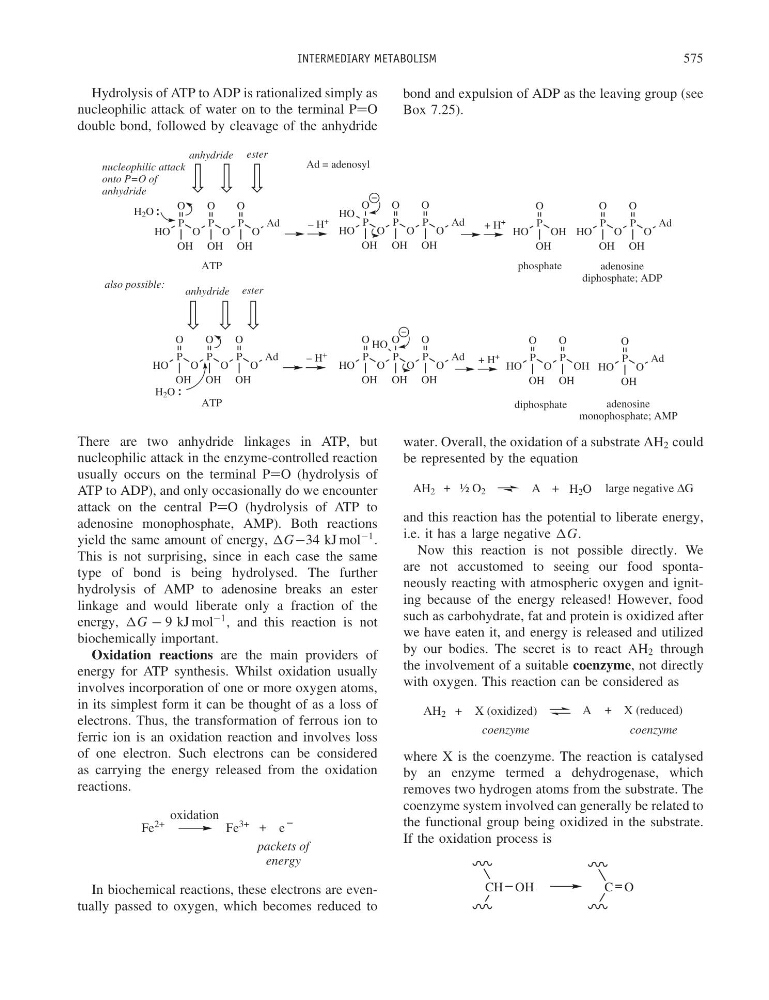
Hydrolysis of ATP to ADP is rationalized simply as
nucleophilic attack of water on to the terminal P=O
double bond, followed by cleavage of the anhydride
bond and expulsion of ADP as the leaving group (see
Box 7.25).
nucleophilic attack
onto P=O of
anhydride
also possible:
anhydride ester
O
P
HO
O
P
O
O
OH OH
P
O
O
OH
Ad
– H +
O
P
HO
O
P
O
O
OH OH
P
O
O
OH
Ad
HO
+ H
+
O
P
HO
OH
OH
O
P
HO
O
P
O
O
OH OH
Ad
ATP
phosphate
adenosine
diphosphate; ADP
Ad = adenosyl
anhydride ester
O
P
HO
O
P
O
O
OH OH
P
O
O
OH
Ad
– H +
O
P
HO
O
P
O
O
OH OH
P
O
O
OH
Ad + H +
HO
O
P
HO
O
OH
O
P
HO
O
P
OH
O
OH OH
Ad
diphosphate
adenosine
monophosphate; AMP
ATP
H 2 O
H 2 O
There are two anhydride linkages in ATP, but
nucleophilic attack in the enzyme-controlled reaction
usually occurs on the terminal P=O (hydrolysis of
ATP to ADP), and only occasionally do we encounter
attack on the central P=O (hydrolysis of ATP to
adenosine monophosphate, AMP). Both reactions
yield the same amount of energy, G−34 kJ mol
−1 .
This is not surprising, since in each case the same
type of bond is being hydrolysed. The further
hydrolysis of AMP to adenosine breaks an ester
linkage and would liberate only a fraction of the
energy, G − 9 kJ mol
−1 , and this reaction is not
biochemically important.
Oxidation reactions are the main providers of
energy for ATP synthesis. Whilst oxidation usually
involves incorporation of one or more oxygen atoms,
in its simplest form it can be thought of as a loss of
electrons. Thus, the transformation of ferrous ion to
ferric ion is an oxidation reaction and involves loss
of one electron. Such electrons can be considered
as carrying the energy released from the oxidation
reactions.
+
packets of
energy
e
oxidation
Fe
2+
Fe
3+
In biochemical reactions, these electrons are eventually passed to oxygen, which becomes reduced to
water. Overall, the oxidation of a substrate AH 2 could
be represented by the equation
+
+
large negative ΔG
½ O 2
AH 2
A
H 2 O
and this reaction has the potential to liberate energy,
i.e. it has a large negative G.
Now this reaction is not possible directly. We
are not accustomed to seeing our food spontaneously reacting with atmospheric oxygen and igniting because of the energy released! However, food
such as carbohydrate, fat and protein is oxidized after
we have eaten it, and energy is released and utilized
by our bodies. The secret is to react AH 2 through
the involvement of a suitable coenzyme, not directly
with oxygen. This reaction can be considered as
+ X (oxidized)
+ X (reduced)
coenzyme
coenzyme
AH 2
A
where X is the coenzyme. The reaction is catalysed
by an enzyme termed a dehydrogenase, which
removes two hydrogen atoms from the substrate. The
coenzyme system involved can generally be related to
the functional group being oxidized in the substrate.
If the oxidation process is
CH OH
C O
575
Hydrolysis of ATP to ADP is rationalized simply as
nucleophilic attack of water on to the terminal P=O
double bond, followed by cleavage of the anhydride
bond and expulsion of ADP as the leaving group (see
Box 7.25).
nucleophilic attack
onto P=O of
anhydride
also possible:
anhydride ester
O
P
HO
O
P
O
O
OH OH
P
O
O
OH
Ad
– H +
O
P
HO
O
P
O
O
OH OH
P
O
O
OH
Ad
HO
+ H
+
O
P
HO
OH
OH
O
P
HO
O
P
O
O
OH OH
Ad
ATP
phosphate
adenosine
diphosphate; ADP
Ad = adenosyl
anhydride ester
O
P
HO
O
P
O
O
OH OH
P
O
O
OH
Ad
– H +
O
P
HO
O
P
O
O
OH OH
P
O
O
OH
Ad + H +
HO
O
P
HO
O
OH
O
P
HO
O
P
OH
O
OH OH
Ad
diphosphate
adenosine
monophosphate; AMP
ATP
H 2 O
H 2 O
There are two anhydride linkages in ATP, but
nucleophilic attack in the enzyme-controlled reaction
usually occurs on the terminal P=O (hydrolysis of
ATP to ADP), and only occasionally do we encounter
attack on the central P=O (hydrolysis of ATP to
adenosine monophosphate, AMP). Both reactions
yield the same amount of energy, G−34 kJ mol
−1 .
This is not surprising, since in each case the same
type of bond is being hydrolysed. The further
hydrolysis of AMP to adenosine breaks an ester
linkage and would liberate only a fraction of the
energy, G − 9 kJ mol
−1 , and this reaction is not
biochemically important.
Oxidation reactions are the main providers of
energy for ATP synthesis. Whilst oxidation usually
involves incorporation of one or more oxygen atoms,
in its simplest form it can be thought of as a loss of
electrons. Thus, the transformation of ferrous ion to
ferric ion is an oxidation reaction and involves loss
of one electron. Such electrons can be considered
as carrying the energy released from the oxidation
reactions.
+
packets of
energy
e
oxidation
Fe
2+
Fe
3+
In biochemical reactions, these electrons are eventually passed to oxygen, which becomes reduced to
water. Overall, the oxidation of a substrate AH 2 could
be represented by the equation
+
+
large negative ΔG
½ O 2
AH 2
A
H 2 O
and this reaction has the potential to liberate energy,
i.e. it has a large negative G.
Now this reaction is not possible directly. We
are not accustomed to seeing our food spontaneously reacting with atmospheric oxygen and igniting because of the energy released! However, food
such as carbohydrate, fat and protein is oxidized after
we have eaten it, and energy is released and utilized
by our bodies. The secret is to react AH 2 through
the involvement of a suitable coenzyme, not directly
with oxygen. This reaction can be considered as
+ X (oxidized)
+ X (reduced)
coenzyme
coenzyme
AH 2
A
where X is the coenzyme. The reaction is catalysed
by an enzyme termed a dehydrogenase, which
removes two hydrogen atoms from the substrate. The
coenzyme system involved can generally be related to
the functional group being oxidized in the substrate.
If the oxidation process is
CH OH
C O