

564
NUCLEOSIDES, NUCLEOTIDES AND NUCLEIC ACIDS
The amino group now provides the nucleus for
purine ring formation, an extended series of reactions
we shall not describe. The first-formed purine product
is inosine 5
-phosphate (IMP), which leads to either
AMP or GMP; these require amination at alternative
sites, and utilize either GTP- or ATP-dependent
reactions for amination. GTP or ATP (as appropriate)
will also be required for further phosphorylations to
produce the nucleotide triphosphates.
2
-Deoxyribonucleotides are generally formed
by reduction of ribonucleoside diphosphates. This
involves a series of redox reactions in which NADP
+
and FAD play a role (see Section 15.1.1), with a subsequent electron transport chain. DNA contains thymine
rather than uracil, so thymidine triphosphate (dTTP)
is a requirement. Methylation of dUMP to dTMP is
a major route to thymine nucleotides, and is dependent upon N
5 , N
10 -methylenetetrahydrofolate as the
source of the methyl group (see Box 11.13).
14.5 Determination of nucleotide
sequence
14.5.1 Restriction endonucleases
Natural DNA molecules are extremely large, and
for sequence determination it is necessary to cleave
them into manageable fragments. This may be accomplished by using enzymes, called restriction endonucleases, that are obtained mainly from bacterial
sources. These enzymes appear to have developed
so that a cell can destroy foreign, particularly viral,
DNA. The enzymes, of which several hundred are
available, cleave the DNA at specific points in
the chain, dictated by a series of nucleotides, typically three to six nucleotides. For example, the
enzyme EcoRI (from Escherichia coli ) cleaves a
GAATTC sequence between G and A. Also important
is the property that most restriction endonucleases
cleave both strands of DNA, because the recognition
sequence reads the same both ways: the complementary strand to GAATTC (in 5
→ 3
direction) is
CTTAAG (in 3
→ 5
direction) (see Section 14.2.1).
The restriction endonuclease recognizes a specific
sequence, but the probability of these sequences occurring in a given DNA molecule is usually quite low;
therefore, cleavage produces only a few fragments.
Use of a different enzyme on the same DNA will
produce different fragments, but there then will be
overlap of sequences. Hence, sequencing of both sets
of fragments should allow the full sequence to be
deduced. This deductive approach is thus similar to
that used in amino acid sequencing (see Section 13.7).
14.5.2 Chemical sequencing
Before separation, double-stranded restriction fragments are labelled chemically, by attaching a radioactive or fluorescent marker to the 5
-end of the chain.
For example, radioactive
32 P-labelled phosphate may
be added using labelled ATP in an enzymic reaction. The labelled fragments are then separated chromatographically using conditions that are known to
cause strand separation into single-stranded DNA
molecules. The separated fragments are then split
into four portions, and each portion is treated chemically with a suitable reagent. The reagent needs to be
one that induces cleavage reactions, but which shows
selectivity for the different nucleotides. Now this
could potentially lead to almost total cleavage, but
the trick is to use reagents at concentrations so low
that, statistically, only one cleavage occurs per chain.
The reagents are dimethyl sulfate and hydrazine
(only two reagents, but read on), and though we shall
not consider the full mechanisms of the reactions
here, they may be summarized as follows:
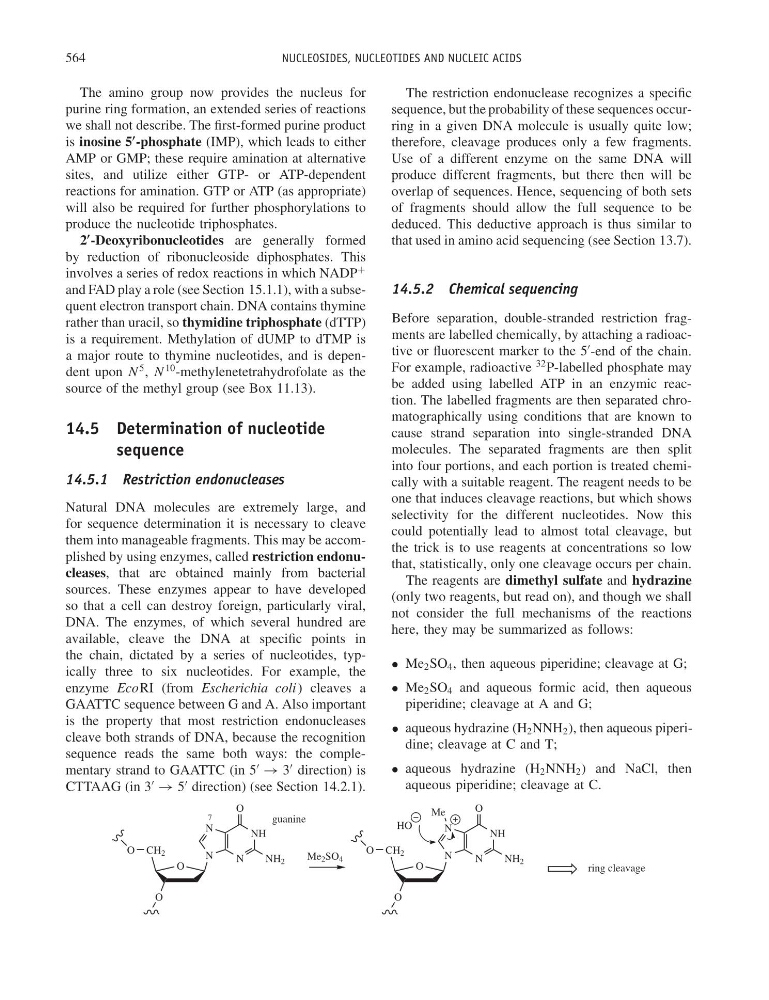
• Me 2 SO 4 , then aqueous piperidine; cleavage at G;
• Me 2 SO 4 and aqueous formic acid, then aqueous
piperidine; cleavage at A and G;
• aqueous hydrazine (H 2 NNH 2 ), then aqueous piperidine; cleavage at C and T;
• aqueous hydrazine (H 2 NNH 2 ) and NaCl, then
aqueous piperidine; cleavage at C.
N
NH
N
O
O
N
O CH 2
O
NH 2
Me
N
NH
N
O
O
N
O CH 2
O
guanine
NH 2
HO
7
Me 2 SO 4
ring cleavage
NUCLEOSIDES, NUCLEOTIDES AND NUCLEIC ACIDS
The amino group now provides the nucleus for
purine ring formation, an extended series of reactions
we shall not describe. The first-formed purine product
is inosine 5
-phosphate (IMP), which leads to either
AMP or GMP; these require amination at alternative
sites, and utilize either GTP- or ATP-dependent
reactions for amination. GTP or ATP (as appropriate)
will also be required for further phosphorylations to
produce the nucleotide triphosphates.
2
-Deoxyribonucleotides are generally formed
by reduction of ribonucleoside diphosphates. This
involves a series of redox reactions in which NADP
+
and FAD play a role (see Section 15.1.1), with a subsequent electron transport chain. DNA contains thymine
rather than uracil, so thymidine triphosphate (dTTP)
is a requirement. Methylation of dUMP to dTMP is
a major route to thymine nucleotides, and is dependent upon N
5 , N
10 -methylenetetrahydrofolate as the
source of the methyl group (see Box 11.13).
14.5 Determination of nucleotide
sequence
14.5.1 Restriction endonucleases
Natural DNA molecules are extremely large, and
for sequence determination it is necessary to cleave
them into manageable fragments. This may be accomplished by using enzymes, called restriction endonucleases, that are obtained mainly from bacterial
sources. These enzymes appear to have developed
so that a cell can destroy foreign, particularly viral,
DNA. The enzymes, of which several hundred are
available, cleave the DNA at specific points in
the chain, dictated by a series of nucleotides, typically three to six nucleotides. For example, the
enzyme EcoRI (from Escherichia coli ) cleaves a
GAATTC sequence between G and A. Also important
is the property that most restriction endonucleases
cleave both strands of DNA, because the recognition
sequence reads the same both ways: the complementary strand to GAATTC (in 5
→ 3
direction) is
CTTAAG (in 3
→ 5
direction) (see Section 14.2.1).
The restriction endonuclease recognizes a specific
sequence, but the probability of these sequences occurring in a given DNA molecule is usually quite low;
therefore, cleavage produces only a few fragments.
Use of a different enzyme on the same DNA will
produce different fragments, but there then will be
overlap of sequences. Hence, sequencing of both sets
of fragments should allow the full sequence to be
deduced. This deductive approach is thus similar to
that used in amino acid sequencing (see Section 13.7).
14.5.2 Chemical sequencing
Before separation, double-stranded restriction fragments are labelled chemically, by attaching a radioactive or fluorescent marker to the 5
-end of the chain.
For example, radioactive
32 P-labelled phosphate may
be added using labelled ATP in an enzymic reaction. The labelled fragments are then separated chromatographically using conditions that are known to
cause strand separation into single-stranded DNA
molecules. The separated fragments are then split
into four portions, and each portion is treated chemically with a suitable reagent. The reagent needs to be
one that induces cleavage reactions, but which shows
selectivity for the different nucleotides. Now this
could potentially lead to almost total cleavage, but
the trick is to use reagents at concentrations so low
that, statistically, only one cleavage occurs per chain.
The reagents are dimethyl sulfate and hydrazine
(only two reagents, but read on), and though we shall
not consider the full mechanisms of the reactions
here, they may be summarized as follows:
• Me 2 SO 4 , then aqueous piperidine; cleavage at G;
• Me 2 SO 4 and aqueous formic acid, then aqueous
piperidine; cleavage at A and G;
• aqueous hydrazine (H 2 NNH 2 ), then aqueous piperidine; cleavage at C and T;
• aqueous hydrazine (H 2 NNH 2 ) and NaCl, then
aqueous piperidine; cleavage at C.
N
NH
N
O
O
N
O CH 2
O
NH 2
Me
N
NH
N
O
O
N
O CH 2
O
guanine
NH 2
HO
7
Me 2 SO 4
ring cleavage