

NUCLEOTIDE BIOSYNTHESIS
563
14.4 Nucleotide biosynthesis
Nucleic acids are synthesized in nature from nucleoside triphosphates, which are coupled by a chain
extension process. We have seen that coupling is simply an esterification reaction utilizing the 3
-hydroxyl
of the sugar of the growing chain, with diphosphate
as a good leaving group (see Section 14.2.2). Nucleoside triphosphates, especially ATP, have other major
biochemical roles (see Section 15.1.1). A full discussion of the origins of these compounds is outside our
requirements, but there are some features of particular interest pertinent to our understanding of these
compounds. One of these is that several of the biosynthetic reactions require the involvement of ATP,
demonstrating that nucleotide production requires
input from other nucleotides. Another interesting
aspect is the quite different approach nature adopts
for synthesis of pyrimidine or purine nucleotides.
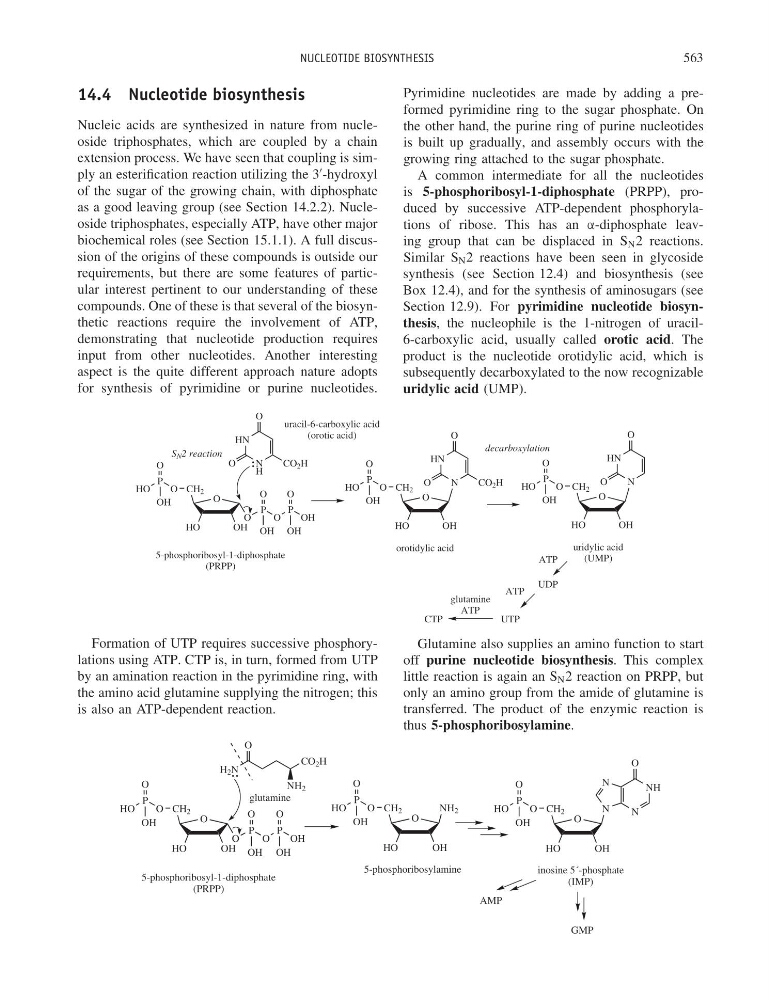
Pyrimidine nucleotides are made by adding a preformed pyrimidine ring to the sugar phosphate. On
the other hand, the purine ring of purine nucleotides
is built up gradually, and assembly occurs with the
growing ring attached to the sugar phosphate.
A common intermediate for all the nucleotides
is 5-phosphoribosyl-1-diphosphate (PRPP), produced by successive ATP-dependent phosphorylations of ribose. This has an α-diphosphate leaving group that can be displaced in S N 2 reactions.
Similar S N 2 reactions have been seen in glycoside
synthesis (see Section 12.4) and biosynthesis (see
Box 12.4), and for the synthesis of aminosugars (see
Section 12.9). For pyrimidine nucleotide biosynthesis, the nucleophile is the 1-nitrogen of uracil6-carboxylic acid, usually called orotic acid. The
product is the nucleotide orotidylic acid, which is
subsequently decarboxylated to the now recognizable
uridylic acid (UMP).
O
HO
OH
CH 2
5-phosphoribosyl-1-diphosphate
(PRPP)
N
H
HN
O
O
CO 2 H
uracil-6-carboxylic acid
(orotic acid)
O
HO
OH
CH 2
N
HN
O
O
CO 2 H
orotidylic acid
O
HO
OH
CH 2
N
HN
O
O
uridylic acid
(UMP)
UTP
ATP
UDP
ATP
S N 2 reaction
CTP
decarboxylation
glutamine
ATP
O
P
HO
O
OH
O
P
O
O
P
OH
O
OH OH
O
P
HO
O
OH
O
P
HO
O
OH
Formation of UTP requires successive phosphorylations using ATP. CTP is, in turn, formed from UTP
by an amination reaction in the pyrimidine ring, with
the amino acid glutamine supplying the nitrogen; this
is also an ATP-dependent reaction.
Glutamine also supplies an amino function to start
off purine nucleotide biosynthesis. This complex
little reaction is again an S N 2 reaction on PRPP, but
only an amino group from the amide of glutamine is
transferred. The product of the enzymic reaction is
thus 5-phosphoribosylamine.
O
HO
OH
CH 2
5-phosphoribosyl-1-diphosphate
(PRPP)
H 2 N
CO 2 H
NH 2
O
glutamine
O
HO
OH
CH 2
NH 2
5-phosphoribosylamine
N
NH
N
O
O
HO
OH
N
CH 2
inosine 5´-phosphate
(IMP)
AMP
GMP
O
P
HO
O
OH
O
P
O
O
P
OH
O
OH OH
O
P
HO
O
OH
O
P
HO
O
OH
563
14.4 Nucleotide biosynthesis
Nucleic acids are synthesized in nature from nucleoside triphosphates, which are coupled by a chain
extension process. We have seen that coupling is simply an esterification reaction utilizing the 3
-hydroxyl
of the sugar of the growing chain, with diphosphate
as a good leaving group (see Section 14.2.2). Nucleoside triphosphates, especially ATP, have other major
biochemical roles (see Section 15.1.1). A full discussion of the origins of these compounds is outside our
requirements, but there are some features of particular interest pertinent to our understanding of these
compounds. One of these is that several of the biosynthetic reactions require the involvement of ATP,
demonstrating that nucleotide production requires
input from other nucleotides. Another interesting
aspect is the quite different approach nature adopts
for synthesis of pyrimidine or purine nucleotides.
Pyrimidine nucleotides are made by adding a preformed pyrimidine ring to the sugar phosphate. On
the other hand, the purine ring of purine nucleotides
is built up gradually, and assembly occurs with the
growing ring attached to the sugar phosphate.
A common intermediate for all the nucleotides
is 5-phosphoribosyl-1-diphosphate (PRPP), produced by successive ATP-dependent phosphorylations of ribose. This has an α-diphosphate leaving group that can be displaced in S N 2 reactions.
Similar S N 2 reactions have been seen in glycoside
synthesis (see Section 12.4) and biosynthesis (see
Box 12.4), and for the synthesis of aminosugars (see
Section 12.9). For pyrimidine nucleotide biosynthesis, the nucleophile is the 1-nitrogen of uracil6-carboxylic acid, usually called orotic acid. The
product is the nucleotide orotidylic acid, which is
subsequently decarboxylated to the now recognizable
uridylic acid (UMP).
O
HO
OH
CH 2
5-phosphoribosyl-1-diphosphate
(PRPP)
N
H
HN
O
O
CO 2 H
uracil-6-carboxylic acid
(orotic acid)
O
HO
OH
CH 2
N
HN
O
O
CO 2 H
orotidylic acid
O
HO
OH
CH 2
N
HN
O
O
uridylic acid
(UMP)
UTP
ATP
UDP
ATP
S N 2 reaction
CTP
decarboxylation
glutamine
ATP
O
P
HO
O
OH
O
P
O
O
P
OH
O
OH OH
O
P
HO
O
OH
O
P
HO
O
OH
Formation of UTP requires successive phosphorylations using ATP. CTP is, in turn, formed from UTP
by an amination reaction in the pyrimidine ring, with
the amino acid glutamine supplying the nitrogen; this
is also an ATP-dependent reaction.
Glutamine also supplies an amino function to start
off purine nucleotide biosynthesis. This complex
little reaction is again an S N 2 reaction on PRPP, but
only an amino group from the amide of glutamine is
transferred. The product of the enzymic reaction is
thus 5-phosphoribosylamine.
O
HO
OH
CH 2
5-phosphoribosyl-1-diphosphate
(PRPP)
H 2 N
CO 2 H
NH 2
O
glutamine
O
HO
OH
CH 2
NH 2
5-phosphoribosylamine
N
NH
N
O
O
HO
OH
N
CH 2
inosine 5´-phosphate
(IMP)
AMP
GMP
O
P
HO
O
OH
O
P
O
O
P
OH
O
OH OH
O
P
HO
O
OH
O
P
HO
O
OH