

562
NUCLEOSIDES, NUCLEOTIDES AND NUCLEIC ACIDS
Box 14.3 (continued)
N
N
N
NH 2
O
OH
OH
N
CH 2
O
N
N
N
NH 2
O
O
OH
N
CH 2
O
P
OH
O
ATP
P
O
P
O
P
HO
O
O
O
HO HO
HO
O
HO
OH
CH 2
O
P
O
P
O
P
HO
O
O
O
HO
HO HO
O
P
O
P
HO
O
O
HO
HO
O
P
HO
O
HO
2
adenylate cyclase
AMP
N
N
N
NH 2
O
HO
OH
N
CH 2
O
P
HO
O
HO
phosphodiesterase
pyrophosphatase
nucleophilic attack of ribose 3´-hydroxyl
onto phosphoric anhydride
cyclic AMP
cAMP
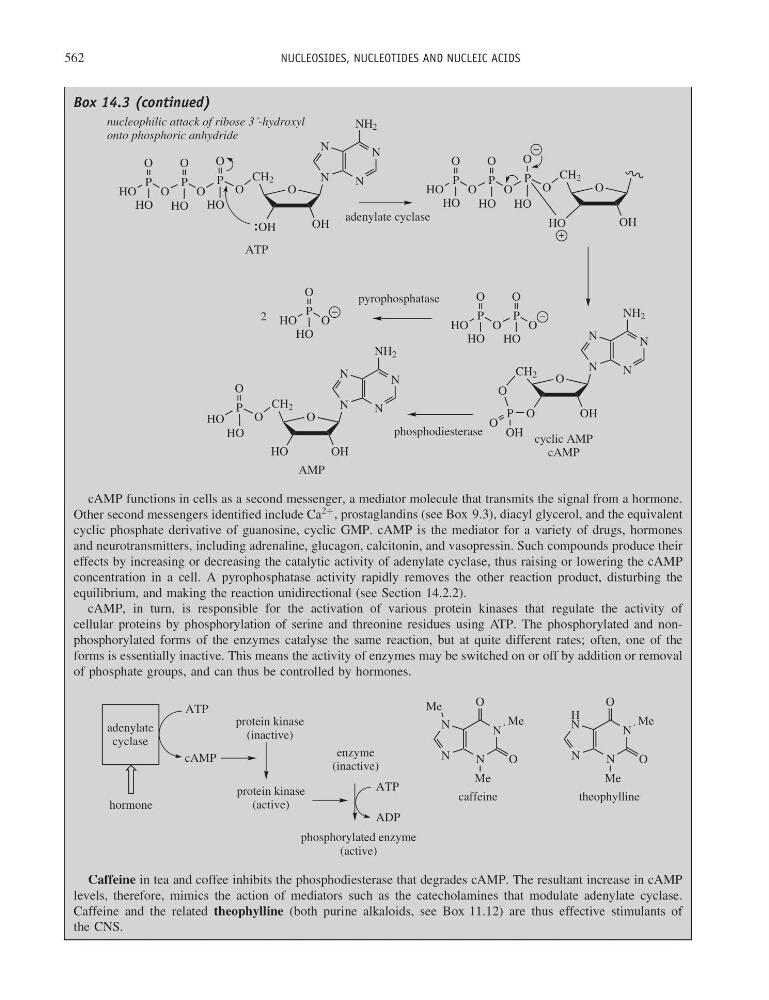
cAMP functions in cells as a second messenger, a mediator molecule that transmits the signal from a hormone.
Other second messengers identified include Ca
2+ , prostaglandins (see Box 9.3), diacyl glycerol, and the equivalent
cyclic phosphate derivative of guanosine, cyclic GMP. cAMP is the mediator for a variety of drugs, hormones
and neurotransmitters, including adrenaline, glucagon, calcitonin, and vasopressin. Such compounds produce their
effects by increasing or decreasing the catalytic activity of adenylate cyclase, thus raising or lowering the cAMP
concentration in a cell. A pyrophosphatase activity rapidly removes the other reaction product, disturbing the
equilibrium, and making the reaction unidirectional (see Section 14.2.2).
cAMP, in turn, is responsible for the activation of various protein kinases that regulate the activity of
cellular proteins by phosphorylation of serine and threonine residues using ATP. The phosphorylated and nonphosphorylated forms of the enzymes catalyse the same reaction, but at quite different rates; often, one of the
forms is essentially inactive. This means the activity of enzymes may be switched on or off by addition or removal
of phosphate groups, and can thus be controlled by hormones.
ATP
adenylate
cyclase
protein kinase
(inactive)
protein kinase
(active)
enzyme
(inactive)
phosphorylated enzyme
(active)
ATP
ADP
hormone
N
N
N
O
N
O
Me
Me
Me
caffeine
N
N
H
N
O
N
O
Me
Me
theophylline
cAMP
Caffeine in tea and coffee inhibits the phosphodiesterase that degrades cAMP. The resultant increase in cAMP
levels, therefore, mimics the action of mediators such as the catecholamines that modulate adenylate cyclase.
Caffeine and the related theophylline (both purine alkaloids, see Box 11.12) are thus effective stimulants of
the CNS.
NUCLEOSIDES, NUCLEOTIDES AND NUCLEIC ACIDS
Box 14.3 (continued)
N
N
N
NH 2
O
OH
OH
N
CH 2
O
N
N
N
NH 2
O
O
OH
N
CH 2
O
P
OH
O
ATP
P
O
P
O
P
HO
O
O
O
HO HO
HO
O
HO
OH
CH 2
O
P
O
P
O
P
HO
O
O
O
HO
HO HO
O
P
O
P
HO
O
O
HO
HO
O
P
HO
O
HO
2
adenylate cyclase
AMP
N
N
N
NH 2
O
HO
OH
N
CH 2
O
P
HO
O
HO
phosphodiesterase
pyrophosphatase
nucleophilic attack of ribose 3´-hydroxyl
onto phosphoric anhydride
cyclic AMP
cAMP
cAMP functions in cells as a second messenger, a mediator molecule that transmits the signal from a hormone.
Other second messengers identified include Ca
2+ , prostaglandins (see Box 9.3), diacyl glycerol, and the equivalent
cyclic phosphate derivative of guanosine, cyclic GMP. cAMP is the mediator for a variety of drugs, hormones
and neurotransmitters, including adrenaline, glucagon, calcitonin, and vasopressin. Such compounds produce their
effects by increasing or decreasing the catalytic activity of adenylate cyclase, thus raising or lowering the cAMP
concentration in a cell. A pyrophosphatase activity rapidly removes the other reaction product, disturbing the
equilibrium, and making the reaction unidirectional (see Section 14.2.2).
cAMP, in turn, is responsible for the activation of various protein kinases that regulate the activity of
cellular proteins by phosphorylation of serine and threonine residues using ATP. The phosphorylated and nonphosphorylated forms of the enzymes catalyse the same reaction, but at quite different rates; often, one of the
forms is essentially inactive. This means the activity of enzymes may be switched on or off by addition or removal
of phosphate groups, and can thus be controlled by hormones.
ATP
adenylate
cyclase
protein kinase
(inactive)
protein kinase
(active)
enzyme
(inactive)
phosphorylated enzyme
(active)
ATP
ADP
hormone
N
N
N
O
N
O
Me
Me
Me
caffeine
N
N
H
N
O
N
O
Me
Me
theophylline
cAMP
Caffeine in tea and coffee inhibits the phosphodiesterase that degrades cAMP. The resultant increase in cAMP
levels, therefore, mimics the action of mediators such as the catecholamines that modulate adenylate cyclase.
Caffeine and the related theophylline (both purine alkaloids, see Box 11.12) are thus effective stimulants of
the CNS.