

554
NUCLEOSIDES, NUCLEOTIDES AND NUCLEIC ACIDS
A T
C G
G C
T A
A T
C G
G C
T A
new double strands
each new molecule contains
one of the original strands
A
T
C
G
G
C
T
A
A
C
G
T
C
G
synthesis of complementary
strands using base-pairing
A
T
C
G
G
C
T
A
partial unwinding
A T
C G
G C
T A
double-stranded DNA
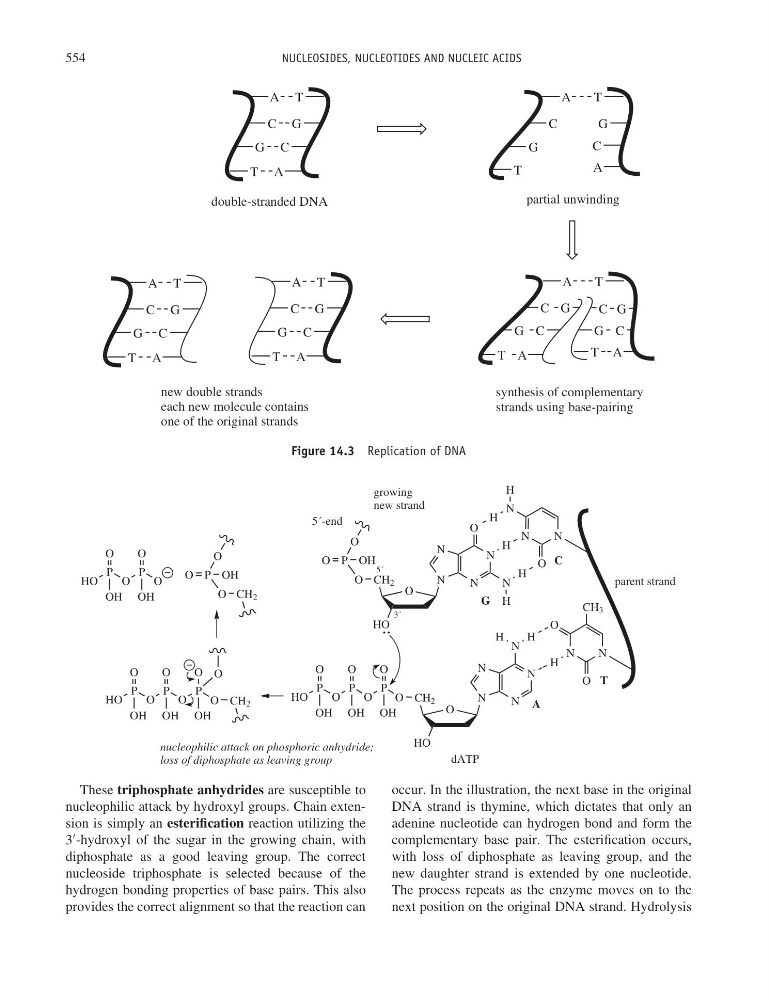
Figure 14.3 Replication of DNA
nucleophilic attack on phosphoric anhydride;
loss of diphosphate as leaving group
O
HO
N
N
N
O
N
N
N
N
O
N
H
H
H
H
H
N
N
N
N
O
HO
N
CH 2
G
C
H
H
N
N
O
O
CH 3
H
dATP
T
3´
parent strand
A
growing
new strand
P
O
CH 2
5´
O
OH
5´-end
O
O
P
HO
O
P
O
O
OH OH
P
O
O
OH
CH 2
O
P
HO
O
P
O
O
OH OH
P
O
O
OH
O
O
P
HO
O
P
O
O
OH OH
P
O
CH 2
O
OH
O
These triphosphate anhydrides are susceptible to
nucleophilic attack by hydroxyl groups. Chain extension is simply an esterification reaction utilizing the
3
-hydroxyl of the sugar in the growing chain, with
diphosphate as a good leaving group. The correct
nucleoside triphosphate is selected because of the
hydrogen bonding properties of base pairs. This also
provides the correct alignment so that the reaction can
occur. In the illustration, the next base in the original
DNA strand is thymine, which dictates that only an
adenine nucleotide can hydrogen bond and form the
complementary base pair. The esterification occurs,
with loss of diphosphate as leaving group, and the
new daughter strand is extended by one nucleotide.
The process repeats as the enzyme moves on to the
next position on the original DNA strand. Hydrolysis
NUCLEOSIDES, NUCLEOTIDES AND NUCLEIC ACIDS
A T
C G
G C
T A
A T
C G
G C
T A
new double strands
each new molecule contains
one of the original strands
A
T
C
G
G
C
T
A
A
C
G
T
C
G
synthesis of complementary
strands using base-pairing
A
T
C
G
G
C
T
A
partial unwinding
A T
C G
G C
T A
double-stranded DNA
Figure 14.3 Replication of DNA
nucleophilic attack on phosphoric anhydride;
loss of diphosphate as leaving group
O
HO
N
N
N
O
N
N
N
N
O
N
H
H
H
H
H
N
N
N
N
O
HO
N
CH 2
G
C
H
H
N
N
O
O
CH 3
H
dATP
T
3´
parent strand
A
growing
new strand
P
O
CH 2
5´
O
OH
5´-end
O
O
P
HO
O
P
O
O
OH OH
P
O
O
OH
CH 2
O
P
HO
O
P
O
O
OH OH
P
O
O
OH
O
O
P
HO
O
P
O
O
OH OH
P
O
CH 2
O
OH
O
These triphosphate anhydrides are susceptible to
nucleophilic attack by hydroxyl groups. Chain extension is simply an esterification reaction utilizing the
3
-hydroxyl of the sugar in the growing chain, with
diphosphate as a good leaving group. The correct
nucleoside triphosphate is selected because of the
hydrogen bonding properties of base pairs. This also
provides the correct alignment so that the reaction can
occur. In the illustration, the next base in the original
DNA strand is thymine, which dictates that only an
adenine nucleotide can hydrogen bond and form the
complementary base pair. The esterification occurs,
with loss of diphosphate as leaving group, and the
new daughter strand is extended by one nucleotide.
The process repeats as the enzyme moves on to the
next position on the original DNA strand. Hydrolysis