

NUCLEIC ACIDS
553
G C
G
C
A
T
T A
C
G
A
T
G C
A
T
G C
T
A
C
G
strand 1
5´-end
strand 2
3´-end
strand 2
5´-end
strand 1
3´-end
G
C
C
G
G
C
major
groove
T
A
C
G
C G
T
A
minor
groove
N
N
N
N
N
N
N
O
O
CH 3
H
H
H
A
T
major groove
O
O
minor groove
5 ´ → 3 ´
3 ´ ← 5 ´
DNA double helix
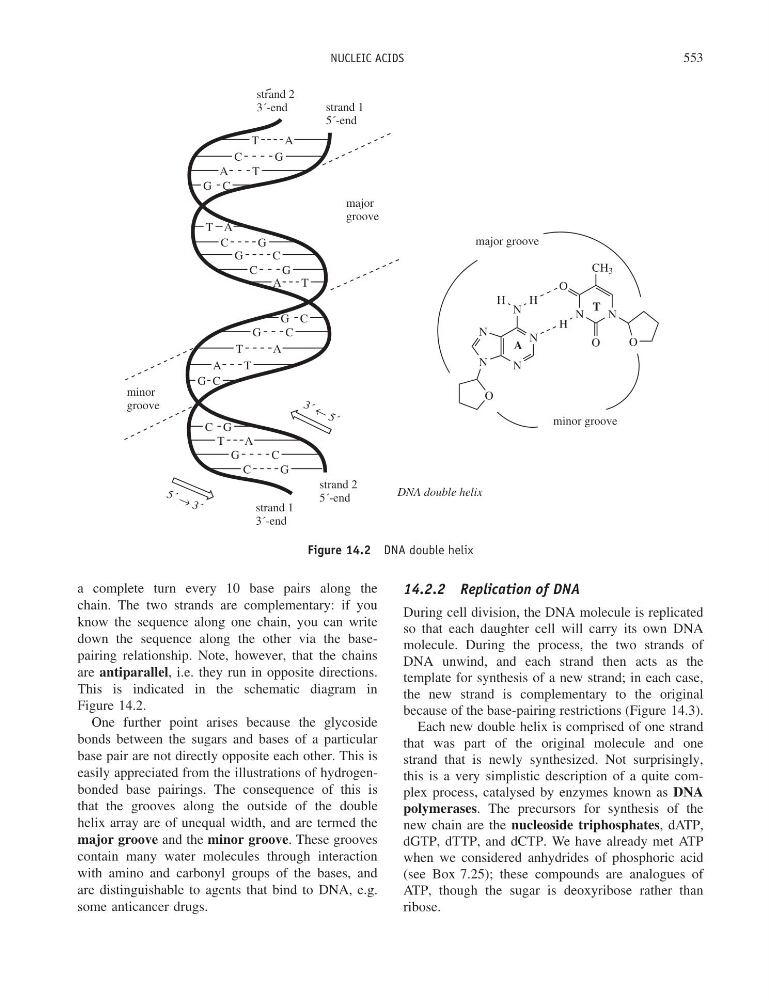
Figure 14.2 DNA double helix
a complete turn every 10 base pairs along the
chain. The two strands are complementary: if you
know the sequence along one chain, you can write
down the sequence along the other via the basepairing relationship. Note, however, that the chains
are antiparallel, i.e. they run in opposite directions.
This is indicated in the schematic diagram in
Figure 14.2.
One further point arises because the glycoside
bonds between the sugars and bases of a particular
base pair are not directly opposite each other. This is
easily appreciated from the illustrations of hydrogenbonded base pairings. The consequence of this is
that the grooves along the outside of the double
helix array are of unequal width, and are termed the
major groove and the minor groove. These grooves
contain many water molecules through interaction
with amino and carbonyl groups of the bases, and
are distinguishable to agents that bind to DNA, e.g.
some anticancer drugs.
14.2.2 Replication of DNA
During cell division, the DNA molecule is replicated
so that each daughter cell will carry its own DNA
molecule. During the process, the two strands of
DNA unwind, and each strand then acts as the
template for synthesis of a new strand; in each case,
the new strand is complementary to the original
because of the base-pairing restrictions (Figure 14.3).
Each new double helix is comprised of one strand
that was part of the original molecule and one
strand that is newly synthesized. Not surprisingly,
this is a very simplistic description of a quite complex process, catalysed by enzymes known as DNA
polymerases. The precursors for synthesis of the
new chain are the nucleoside triphosphates, dATP,
dGTP, dTTP, and dCTP. We have already met ATP
when we considered anhydrides of phosphoric acid
(see Box 7.25); these compounds are analogues of
ATP, though the sugar is deoxyribose rather than
ribose.
553
G C
G
C
A
T
T A
C
G
A
T
G C
A
T
G C
T
A
C
G
strand 1
5´-end
strand 2
3´-end
strand 2
5´-end
strand 1
3´-end
G
C
C
G
G
C
major
groove
T
A
C
G
C G
T
A
minor
groove
N
N
N
N
N
N
N
O
O
CH 3
H
H
H
A
T
major groove
O
O
minor groove
5 ´ → 3 ´
3 ´ ← 5 ´
DNA double helix
Figure 14.2 DNA double helix
a complete turn every 10 base pairs along the
chain. The two strands are complementary: if you
know the sequence along one chain, you can write
down the sequence along the other via the basepairing relationship. Note, however, that the chains
are antiparallel, i.e. they run in opposite directions.
This is indicated in the schematic diagram in
Figure 14.2.
One further point arises because the glycoside
bonds between the sugars and bases of a particular
base pair are not directly opposite each other. This is
easily appreciated from the illustrations of hydrogenbonded base pairings. The consequence of this is
that the grooves along the outside of the double
helix array are of unequal width, and are termed the
major groove and the minor groove. These grooves
contain many water molecules through interaction
with amino and carbonyl groups of the bases, and
are distinguishable to agents that bind to DNA, e.g.
some anticancer drugs.
14.2.2 Replication of DNA
During cell division, the DNA molecule is replicated
so that each daughter cell will carry its own DNA
molecule. During the process, the two strands of
DNA unwind, and each strand then acts as the
template for synthesis of a new strand; in each case,
the new strand is complementary to the original
because of the base-pairing restrictions (Figure 14.3).
Each new double helix is comprised of one strand
that was part of the original molecule and one
strand that is newly synthesized. Not surprisingly,
this is a very simplistic description of a quite complex process, catalysed by enzymes known as DNA
polymerases. The precursors for synthesis of the
new chain are the nucleoside triphosphates, dATP,
dGTP, dTTP, and dCTP. We have already met ATP
when we considered anhydrides of phosphoric acid
(see Box 7.25); these compounds are analogues of
ATP, though the sugar is deoxyribose rather than
ribose.